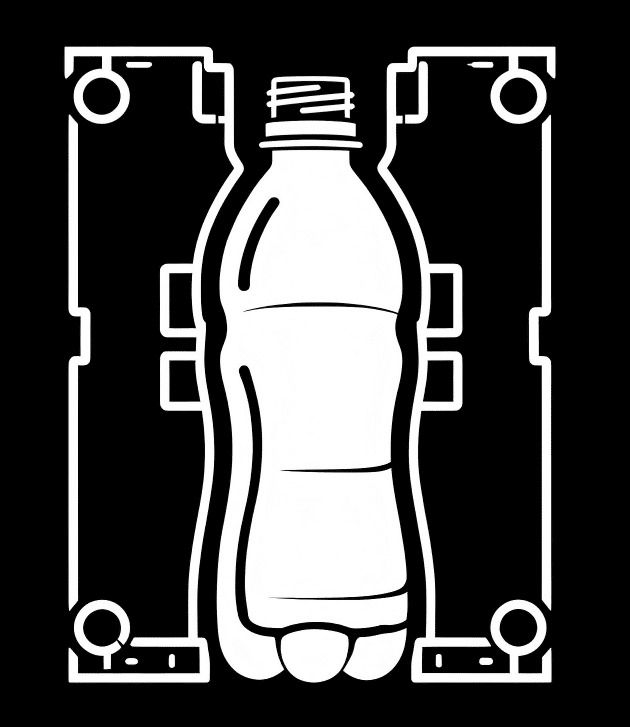
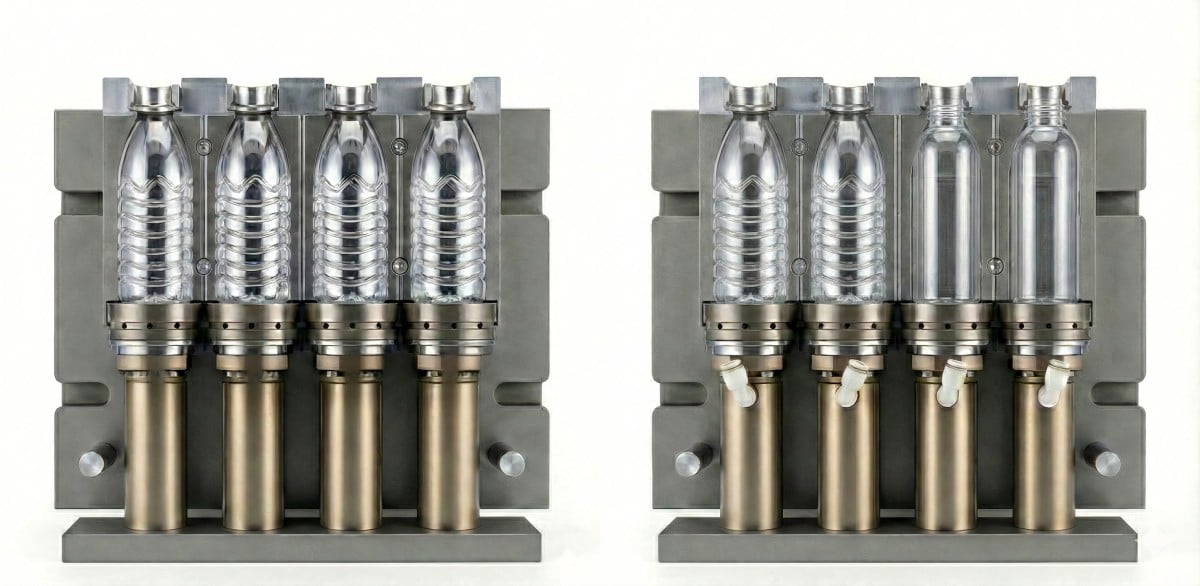
Just last week, I received an inquiry from a client in Ghana who runs a small but ambitious beverage factory. He owns a 4-cavity linear blow molding machine and is planning to launch two new juice products. To save on startup costs, he asked me a very common question: "Vivian, can I make 2 cavities for Bottle A and 2 cavities for Bottle B in the same mold block? I want to save the cost of opening a second mold."
From a user's perspective, I completely understand this logic. When order volumes are low and budgets are tight, saving $2,000 to $3,000 on a mold seems like a smart financial move. However, as an engineer with 20 years of experience in PET manufacturing, I have to look beyond the initial purchase price. Is it technically possible to produce two different bottle designs in one mold? The answer is yes, absolutely. But should you do it? That is a much more complicated question.
While it seems like a cost-saving hack, mixing designs often creates a production nightmare that costs ten times more than the mold itself. Today, my team and I will analyze the strict technical limits, the hidden labor costs, and the operational disasters that often accompany "Mixed Cavity" blow molds, so you can decide if this risk is worth taking.
Can you really mix bottle shapes in one linear blow mold? (The Strict Limits)
Before we even discuss money, we must discuss physics. Many factory owners believe that a mold is just a piece of steel and can be shaped however they want. While this is true for the steel, it is not true for the machine that holds it. Linear blowing machines operate on fixed mechanical principles that cannot be negotiated.
Although it is technically possible to machine a 4-cavity mold with "2 cavities for Design A + 2 cavities for Design B," you must adhere to rigid physical laws. The most critical restriction is the Bottle Height and Diameter.
In a linear blowing machine, the Stretch Rods move together on a single servo or pneumatic drive bar. They all travel down the exact same distance. You cannot tell Rod #1 to go down 200mm and Rod #2 to go down 250mm. They are mechanically linked. Therefore, Bottle A and Bottle B must have the exact same total height. If Bottle A is 200mm tall and Bottle B is 220mm tall, the stretch rod will either smash into the bottom of mold A (destroying the mold) or fail to stretch Bottle B fully (creating a rejected bottle).
Furthermore, the Mold Thickness (the distance from the front plate to the back plate) is uniform. You cannot have a fat bottle next to a skinny bottle if it affects the cooling water channels or the clamping pressure balance. If the diameters differ significantly, the clamping force will be unevenly distributed, leading to "flash" (excess plastic lines) on the larger bottle and poor parting lines on the smaller one.
Vivian’s Technical Checklist for Mixed Molds:
If you cannot check all these boxes, a mixed mold is physically impossible:
- Are both bottles the exact same height? (Tolerance < 1mm)
- Do both bottles fit within the same cavity pitch (center-to-center distance)?
- Do both bottles require the exact same blowing pressure and cooling time?
Why you MUST use the exact same Preform Neck for both bottle designs?
This is the most common mistake I see. A client sends me a drawing for a Water Bottle (29/25 neck) and a Carbonated Drink Bottle (PCO 1881 neck) and asks to put them in one mold. This is impossible, not because of the mold, but because of the machine's heating system.
To understand why, look at the heating chain of your blow molding machine. The preforms are carried through the infrared oven on Heating Spindles (or Mandrels). These spindles are inserted into the neck of the preform to hold it securely while it rotates past the heating lamps.
These spindles are a uniform size. You cannot install a 28mm spindle on Link #1 and a 30mm spindle on Link #2. The machine chain is a continuous loop. If you want to run Bottle A (28mm neck), you must install 28mm spindles. If you want to run Bottle B (30mm neck), you must stop the machine and change every single spindle on the chain, which takes hours.
Therefore, for a mixed mold to work, Bottle A and Bottle B must share the exact same Preform Neck Finish. You cannot mix a wide-mouth jar with a narrow-neck water bottle. They must use the same preform, which means they must likely be the same weight and neck standard. This severely limits your design freedom. If you try to force a heavy carbonated preform into a lightweight water bottle design just to share a mold, you are wasting expensive resin on the water bottle.
| Feature | Design A (Water) | Design B (Juice) | Compatible in One Mold? |
|---|---|---|---|
| Neck Finish | 29/25 Short Neck | 29/25 Short Neck | YES |
| Neck Finish | 30/25 Water Neck | PCO 1881 CSD Neck | NO (Spindles incompatible) |
| Preform Weight | 15g | 28g | NO (Heating profile differs) |
| Bottle Height | 200mm | 200mm | YES |
| Bottle Height | 200mm | 250mm | NO (Stretch rod crash) |
The "Sorting Nightmare": Why your labor costs will double instantly.
Let’s assume you have passed the technical hurdles. Your bottles are the same height and use the same preform. You start the machine. Now, you face the operational reality that most people forget: The Output Conveyor.
In a standard 4-cavity production, the machine ejects four bottles at once. They drop onto the air conveyor or belt conveyor in a random order.
- Cycle 1: A, A, B, B
- Cycle 2: A, B, A, B
The bottles travel down the line mixed together. Your automatic packing machine or palletizer is not smart. It cannot tell the difference between the curves of Bottle A and the ridges of Bottle B. It will pack them all into the same bag or box.
This creates a "Sorting Nightmare." You cannot ship mixed bags to your customers or your own filling line. You must now hire two additional workers to stand by the hot, loud conveyor belt 24 hours a day to manually grab Bottle A and throw it into Bin A, and grab Bottle B and throw it into Bin B.
Let's do the math for my Ghanaian client.
- Cost of a new mold: $3,000 (One-time cost).
- Cost of 2 extra workers per shift x 2 shifts x 365 days: Much more than $3,000.
By trying to save money on steel, you have permanently increased your monthly payroll. The complexity of managing mixed inventory on a fast-moving conveyor belt (running at 4,000 bottles per hour) often leads to mistakes, mixed shipments, and angry customers.
The "Energy Trap": Why are you paying to produce garbage?
The most dangerous aspect of a mixed mold is the Inventory Imbalance.
Imagine your sales team gets a specific order: "We need 50,000 bottles of Design A (Orange Juice) by Friday."
You have a mixed mold (2 cavities A + 2 cavities B). You turn on the machine.
To produce 50,000 bottles of Design A, the machine must run 25,000 cycles.
But because the mold is mixed, in those same 25,000 cycles, you also produced 50,000 bottles of Design B (Apple Juice).
The Problem: You don't have an order for Design B.
Now, you have 50,000 unwanted bottles of Design B sitting on your factory floor.
- Resin Waste: You paid for the plastic to make them.
- Energy Waste: You paid for the electricity to heat and blow them.
- Storage Waste: You have to pay for warehouse space to store them.
- Cash Flow Trap: Your money is tied up in stock that might collect dust for months.
This is the "Energy Trap." You are forced to produce garbage (unsold goods) just to fulfill an order for the product you actually need. Unless your sales for Bottle A and Bottle B are exactly 1:1 forever (which is impossible in the real market), you will always be losing money on overproduction.
When does Vivian actually approve a "Mixed Design" mold?
Is a mixed mold always a bad idea? No. There is one specific commercial scenario where I actually recommend it to my clients.
That scenario is: The "Same Series" Launch.
If you are launching a product line that is sold as a set, or where the consumption rate is identical, a mixed mold makes sense.
- Example: A "His and Hers" water bottle promotion where every box must contain 1 Blue Design and 1 Pink Design.
- Example: A juice brand where the "Classic Bottle" and the "Holiday Edition Bottle" are sold on the same shelf at the same time, and you want to test the market for both.
In these cases, because you plan to bottle and sell both designs simultaneously, the inventory imbalance is not an issue.
Technical Condition: Even in this case, the two bottles must be engineered by us to have identical "Process Windows." This means the blowing pressure, heating profile, and cooling time must be optimized so that one setting works for both bottles. If Design A needs 30 bar pressure and Design B needs 20 bar, we cannot mix them.
Why "Family Molds" work for Injection but fail for Blow Molding.
Clients often come from an Injection Molding background. In injection molding, we often use "Family Molds" (e.g., making a trash can and its lid in the same mold). If you don't want the lid, you can simply turn a switch on the hot runner to block the flow of plastic to that cavity.
You cannot do this in Blow Molding.
Blow molding relies on a delicate balance of high-pressure air and heat distribution.
- Air Balance: The high-pressure air (40 bar) is distributed from a main manifold. If you block 2 cavities and only run 2, the air volume and flow rate change drastically, potentially causing the remaining bottles to burst or form poorly.
- Heat Balance: The infrared oven heats preforms based on a continuous flow. If you leave empty gaps in the chain (running only 2 preforms instead of 4), the heat distribution in the oven changes. The preforms next to the gap will get overheated (edge effect), and the ones in the middle will be too cold.
The Process Window in PET blow molding is very narrow. Trying to run a 4-cavity machine with only 2 cavities active is unstable and produces high scrap rates. You cannot simply "shut off" the cavities you don't want like you can in injection molding. You are committed to running all or nothing.
Why your Filler and Labeler hate "Mixed Bottles" even more than the mold does.
Do not just look at the molding machine. Look downstream at your filling line.
Your filling machine uses Star-wheels (the plastic gears that grab the bottle neck/body) to move bottles. These star-wheels are custom-cut for the specific geometry of the bottle diameter and shape.
If Bottle A is round and Bottle B is square (even if they have the same neck), they cannot run through the same star-wheel.
- The Filler Jam: As mixed bottles come down the conveyor, Bottle A fits the star-wheel, but Bottle B gets crushed or jams the mechanism.
- The Labeling Disaster: A round bottle needs a wrap-around labeler. A square bottle needs a flat-sided labeler or a different sleeve setting. You cannot label them on the same run.
If you produce mixed bottles, you must stop the filling line, clean it, change the star-wheels, and adjust the guide rails every time you switch from sorting Bin A to sorting Bin B. The downtime cost of stopping your filling line (which is the heart of your factory's profit) is far higher than the cost of a mold. A cheap mold can result in a paralyzed production line.
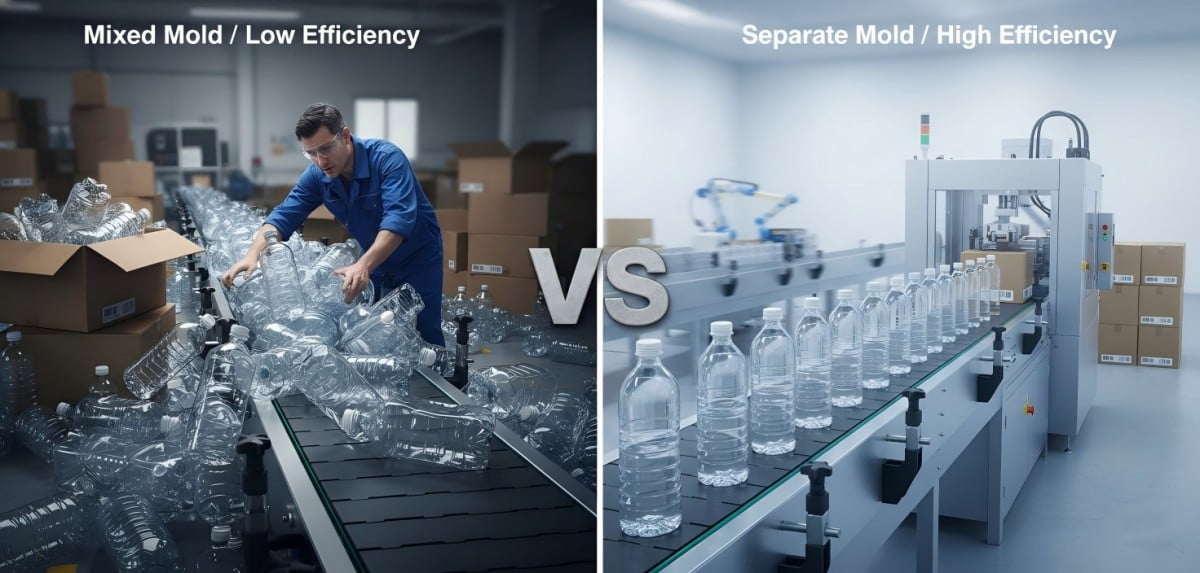
Vivian’s Verdict: Don't let a cheap mold ruin your production line.
After analyzing the situation for my Ghanaian client, my advice was firm: "Do not do it."
The $3,000 you save on the mold today will cost you:
- Labor: Manual sorting of bottles forever.
- Waste: Thousands of unsold bottles produced just to keep the machine running.
- Efficiency: Constant jams at the filler and labeler.
My Professional Recommendation:
If you really need two designs, buy two separate mold sets. A linear blowing machine allows for relatively fast mold changes (usually 30-60 minutes for a skilled team).
- Run 20,000 bottles of Design A on Monday.
- Change the mold.
- Run 20,000 bottles of Design B on Tuesday.
This strategy gives you pure inventory, zero manual sorting, efficient filling, and zero resin waste. The extra cost of the second mold will be paid back in less than 6 months through labor savings and material efficiency. In manufacturing, Flexibility is important, but Stability is profit. Don't sacrifice the stability of your entire factory just to save on a piece of steel. If you are unsure if your bottle designs are compatible, send them to my engineering team, and we will do a feasibility analysis for you.
FAQs
Q1: Can I just load preforms into only the "Bottle A" cavities and leave the "Bottle B" cavities empty to avoid mixing?
A: Technically, yes, you can do this, but it requires a very experienced technician. You can program the machine (via the HMI) to disable the blowing and stretching action for Cavities 3 and 4, and only load preforms for Cavities 1 and 2. However, this method has significant risks. By leaving gaps in the heating chain, the temperature profile in the oven becomes unstable (the empty spaces disrupt the heat reflection). You will need to expertly adjust the lamp voltages to prevent the preforms from overheating or cooling unevenly. It is a temporary "band-aid" solution, not a stable long-term strategy.
Q2: If my bottles are the same height and diameter, but just have different rib patterns, can I mix them?
A: Technically yes, the machine will run fine. However, you still face the "Sorting Nightmare." If your packer puts mixed bottles into the same box, your customer might reject the shipment because their labeling machine might require a smooth surface vs. a ribbed surface. You will still need manual labor to separate them.
Q3: Can I run a mixed mold on a Rotary Blowing Machine?
A: Absolutely not. Rotary machines run at extremely high speeds (20,000+ BPH). The risk of jams in the outfeed star-wheels is too high. Rotary machines require absolute uniformity to function correctly. A mixed mold on a rotary machine is a recipe for disaster.
Q4: How long does it really take to change a mold on a linear machine?
A: For a 4-cavity linear machine, a trained technician can change a mold in about 45 to 60 minutes. If you plan your production schedule well (e.g., change molds once a week), this downtime is negligible compared to the cost of sorting mixed bottles daily.
Q5: Is there any way to automate the sorting of mixed bottles?
A: You would need to invest in a "Vision System" (camera inspection) and a diverter arm on your conveyor to automatically separate Bottle A from Bottle B. However, a reliable vision system costs $10,000 to $20,000, which is far more expensive than just buying a second mold in the first place.
Summary Table: Mixed Mold vs. Separate Molds
| Factor | Mixed Mold (2+2 Cavities) | Separate Molds (4 Cavities each) |
|---|---|---|
| Initial Investment | Low (Save ~$3,000) | High (Pay for 2 molds) |
| Labor Cost | High (Manual sorting required) | Low (Automatic packing) |
| Inventory Management | Bad (Produce unsold stock) | Good (Produce exactly what you need) |
| Downstream Efficiency | Poor (Frequent filler/labeler jams) | Excellent (Continuous running) |
| Production Flexibility | Rigid (Must run A & B together) | Flexible (Run A or B independently) |
| Vivian's Rating | ⭐ (Only for specific series) | ⭐⭐⭐⭐⭐ (Recommended) |
-1-300x300.jpg)