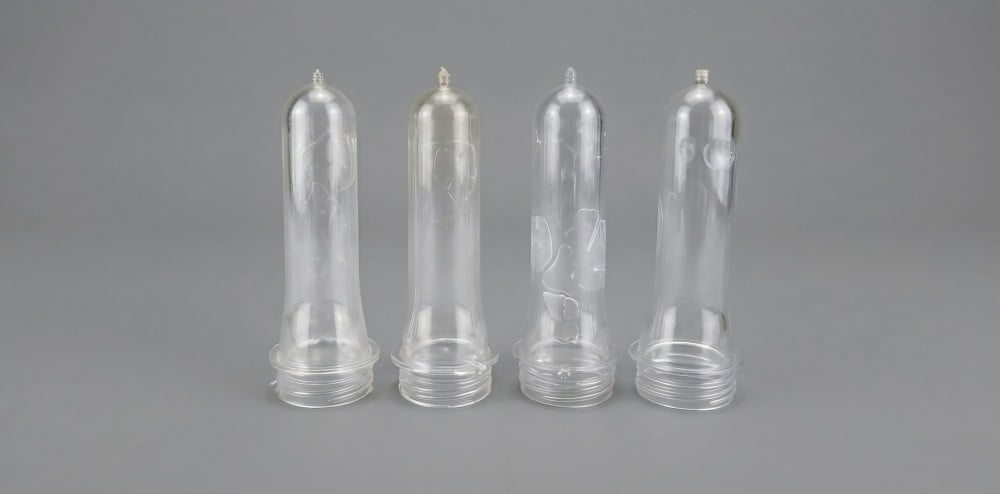
I am Vivian. I have 20 years of experience in PET mold manufacturing and quality control in Zhongshan, China. Overseas buyers ask me many questions about preforms. They worry about the factory capability. A preform mold requires extreme precision. The hot runner system dictates the quality. Overseas buyers share bad past experiences. They received molds with soft valve pins. They experienced gate stringing. They saw white, milky gates. They need strict engineering solutions. You need a perfect bottle design. You need flawless preforms. I will explain the thermodynamics and mechanical engineering behind a perfect PET preform gate.
Eliminating PET preform gate stringing and crystallization requires absolute thermodynamic and mechanical control. You must utilize Beryllium Copper gate inserts for rapid thermal quenching. You must program precision valve pin actuation to cut the polymer melt mechanically. This prevents spherulite formation and ensures an amorphous state.
The Gate Area Dilemma: Balancing stringing and cold slugs.
The gate area presents a severe thermodynamic problem. High nozzle temperatures cause gate stringing. Low nozzle temperatures cause cold slugs. You must balance the heat exchange precisely to maintain continuous production.
Multi-cavity PET preform molding demands perfect temperature control. The gate area is the critical life line of the entire tool. The hot runner nozzle delivers the molten plastic. You face a constant engineering dilemma here. You set the nozzle temperature high. The plastic flows easily. The mold opens. The melt at the gate does not freeze completely. The robot arm moves. The semi-molten plastic stretches into a long thread. Engineers call this PET preform gate stringing. The string interferes with the robot arm. The string falls into the mold cavity. It ruins the next injection cycle.
You try to fix this problem. You lower the nozzle temperature blindly. Do not do this. This is a severe mistake. The temperature drops too much. The plastic freezes prematurely inside the nozzle tip. A solid piece of plastic forms. Engineers call this a cold slug. The injection machine pushes this cold slug into the cavity during the next cycle. The cold slug causes structural weakness. The preform fails the quality check.
You must establish a strict thermodynamic balance. The gate must remain hot during injection. The gate must freeze instantly before the mold opens. Standard steel cannot achieve this rapid temperature shift. You need advanced materials. You need precise mechanical actions. We analyze the polymer physics first.
The Polymer Physics of a Crystalline Gate.
A white gate indicates a critical structural failure. The hot polymer cools too slowly. The molecular chains fold into crystals. You must achieve thermal quenching to maintain the transparent amorphous state.
You must understand high polymer crystallization. Clear PET preforms must exist in a pure amorphous state. The amorphous state means the polymer chains remain random and disorganized. This disorganization allows light to pass through. The preform looks perfectly transparent.
The injection machine melts the PET resin at 280°C. The hot melt enters the mold cavity. The plastic must reach room temperature rapidly. Engineers call this process thermal quenching. The mold steel must extract the heat instantly.
Standard mold steel dissipates heat slowly. The PET material stays at a high temperature for too long. The polymer physics change. The polymer chains gain enough time to organize themselves. They fold together. They create ordered structures. Engineers call this spherulite formation PET. The spherulites scatter the light. The gate area turns milky white.
We call this a crystalline gate PET preform. The crystalline structure changes the physical properties completely. The transparent amorphous PET is highly elastic. The milky crystalline PET is extremely brittle. It loses all flexibility. You cannot stretch it. It breaks under pressure. You must prevent spherulite formation at the gate completely.
Downstream Consequences: Base blowouts in stretch blow molding.
A crystalline gate causes severe downstream failures. The brittle base cannot handle biaxial stretching. The high-pressure air escapes violently. You must prevent this structural weakness to ensure successful blow molding.
You must connect the injection process to the downstream blow molding process. The injection machine produces the preform. The blow molding machine produces the bottle. A white, crystalline gate ruins the entire downstream operation.
The factory uses a two-stage stretch blow molding (SBM) process. The machine heats the preform. The preform enters the blowing mold. A mechanical stretch rod moves downward at high speed. The rod strikes the base of the preform. The high-pressure air injects at 40 Bar.
Amorphous PET handles this process perfectly. It stretches biaxially. It forms a strong bottle. Crystalline PET fails completely. The white gate area lacks elasticity. The crystalline structure is extremely hard and brittle. The stretch rod strikes the brittle base. The crystalline area shatters instantly.
The 40 Bar high-pressure air finds the shattered weakness. The air escapes violently. Engineers call this a base blowout stretch blow molding failure. A base blowout stops the machine. It wastes material. Do not ignore a white gate on a preform. A white gate guarantees a base blowout later. You must solve the root cause at the injection stage.
The Thermal Solution: Beryllium Copper (BeCu) Gate Inserts.
Standard mold steel fails to extract heat quickly. The slow cooling causes crystallization. You must use aerospace-grade Beryllium Copper gate inserts. BeCu extracts heat instantly and achieves true thermal quenching.
You cannot solve the cooling problem with standard steel. P20 steel has low thermal conductivity. S136 stainless steel resists corrosion well. However, S136 also has very poor thermal conductivity. The 280°C PET melt transfers its heat into the S136 steel. The steel holds the heat. The gate area remains hot. Spherulite formation begins.
Top-tier mold manufacturers use an advanced material science solution. We install a beryllium copper gate insert directly at the injection point. Beryllium Copper (BeCu) is an aerospace-grade alloy. BeCu possesses extraordinary thermal properties.
Industrial data proves this fact. The thermal conductivity of standard S136 steel is approximately 24 W/(m·K). The thermal conductivity of premium BeCu reaches 130 to 200 W/(m·K). BeCu transfers heat 4 to 6 times faster than standard mold steel.
The hot PET melt touches the BeCu insert. The BeCu insert extracts the heat instantly. The temperature drops from 280°C to below the glass transition temperature in milliseconds. This rapid drop creates perfect thermal quenching. The polymer chains have no time to fold. Spherulite formation stops completely. The gate remains in a pure, transparent amorphous state.
Thermal Conductivity Comparison Matrix
| Material Type | Thermal Conductivity (W/(m·K)) | Primary Use in Mold | Quenching Capability |
|---|---|---|---|
| S136 Stainless Steel | ~ 24 | Cavity / Core | Poor |
| P20 Tool Steel | ~ 30 | Mold Base | Poor |
| Beryllium Copper (BeCu) | 130 - 200 | Gate Insert / Neck Ring | Excellent |
The Mechanical Solution: Precision Valve Pin Actuation.
Thermodynamics alone cannot stop gate stringing. The machine must cut the molten plastic physically. You must implement precision valve pin actuation. This high-speed mechanical closing seals the gate perfectly.
You install BeCu inserts. You achieve rapid cooling. You still experience occasional gate stringing. Cooling is only half of the solution. You need a strict mechanical solution. You need precision hot runner valve pin actuation.
A thermal gate relies purely on temperature to freeze the plastic. A valve gate relies on a physical metal pin to block the hole. High-quality preform molds always use valve gate systems.
The injection phase ends. The holding pressure phase begins. The holding phase finishes. The valve pin must close instantly. Top-tier systems use pneumatic or hydraulic actuation. The air or oil pressure drives the pin downward. The pin must move at extremely high speed. The pin must possess absolute mechanical rigidity.
The pin acts like a sharp knife. It drops down and physically cuts the PET melt. This dry, decisive mechanical cut prevents stringing. If the valve pin thermal control fails, the pin moves slowly. A slow pin drags the semi-molten plastic. The dragging creates a string.
You must maintain the valve pin mechanism. Check the air pressure daily. Low air pressure causes slow actuation. Clean the piston seals regularly. A leaking seal reduces the closing force.
Water Channel Design Around the Gate.
The BeCu insert needs a constant exit route for the heat. Poor water flow traps the heat inside the copper. You must design high turbulent flow water channels exactly behind the gate insert.
You buy expensive BeCu inserts. The inserts absorb the heat rapidly. The inserts must transfer this heat away quickly. The cooling water carries the heat away. The fluid dynamics behind the gate dictate the final success.
The space around the gate is extremely limited. The hot runner nozzle takes up most of the space. You must design clever cooling channels. Standard straight drilled holes are insufficient.
Advanced mold designs utilize conformal cooling channels or bubbler cooling tubes. A bubbler tube forces cold water up through the center of a small pipe. The water hits the back of the BeCu insert. The water cascades down the outside of the pipe.
You must ensure high turbulent flow. Laminar flow is useless. Laminar flow means the water moves smoothly. The water touching the metal gets hot. The water in the center stays cold. They do not mix. Heat transfer fails.
Turbulent flow means the water swirls violently. The hot and cold water mix constantly. This violent mixing maximizes the heat exchange efficiency. We use high-pressure water pumps to guarantee turbulent flow inside the bubbler tubes. We maintain the water temperature at 8°C to 12°C.
Addressing Wear: Coatings for BeCu and Valve Pins.
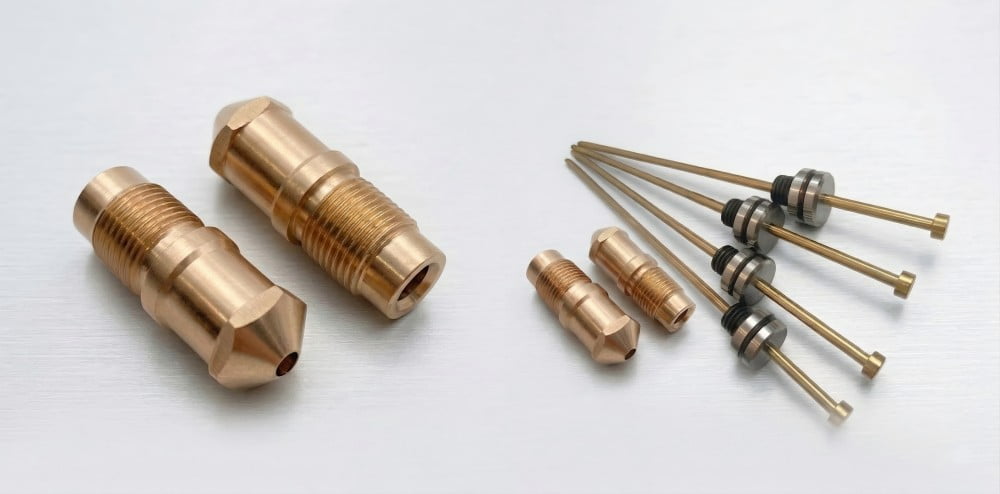
Beryllium copper is softer than stainless steel. High-pressure injection causes rapid wear. The gate hole size increases. You must apply advanced PVD coatings to protect the BeCu and the valve pins.
You must address the lifespan of the tool. BeCu offers excellent thermal conductivity. However, BeCu has a lower physical hardness than hardened stainless steel. The injection machine pushes the PET melt at very high pressure. The PET resin often contains micro-impurities. Sometimes, factories add recycled materials.
The high-pressure melt acts like sandpaper. It washes over the BeCu gate hole millions of times. The soft copper wears down. The gate hole diameter increases. The valve pin cannot seal the enlarged hole. Gate stringing returns.
Top-tier manufacturers solve this wear problem with advanced surface treatments. We do not leave the raw BeCu exposed. We apply Physical Vapor Deposition (PVD) coatings. We coat the BeCu gate inserts and the steel valve pins.
We use Titanium Nitride (TiN) or Diamond-Like Carbon (DLC) coatings. The PVD process deposits a microscopic layer of extreme hardness onto the metal surface. The DLC coating provides incredible wear resistance. It also provides a low-friction surface. The valve pin slides smoothly. The PVD coating acts as armor. It protects the gate geometry while maintaining the extreme thermal conductivity of the BeCu underneath.
Surface Coating Specifications
| Component | Base Material | Coating Type | Hardness (HV) | Primary Benefit |
|---|---|---|---|---|
| Gate Insert | Beryllium Copper | TiN (Titanium Nitride) | ~ 2400 | Wear resistance |
| Valve Pin | H13 / SKD61 Steel | DLC (Diamond-Like Carbon) | ~ 3000 | Low friction, extreme hardness |
| Mold Cavity | S136 Stainless | N/A (Polished) | ~ 500 | Optical clarity |
Process Validation: The 100-Shot Visual and Dimensional Check.
Visual checks often miss internal microscopic stress. The preform looks fine but shatters later. You must enforce the 100-shot validation protocol and use polarized light to guarantee absolute production quality.
You finish the mold testing. You start daily production. You must establish strict quality validation protocols. You cannot check one preform per hour. You must perform continuous sampling.
We enforce the 100-shot continuous visual and dimensional check. The QC inspector collects preforms from 100 consecutive injection shots. The inspector uses a high-magnification loupe. They inspect the injection point precisely.
The gate point must sit flush with the preform base. The inspector measures any stringing residue. The absolute maximum tolerance for stringing residue is 1.0mm. If the residue exceeds 1.0mm, you must stop the machine immediately. You must adjust the valve pin timing or the cooling water flow.
Do not rely entirely on normal light. Normal light hides micro-crystallization. We use polarized light inspection devices. The inspector places the preform between two polarizing filters. The polarized light reveals internal stress patterns.
A perfect amorphous gate shows smooth, even color bands under polarized light. A problematic gate shows sharp, concentrated stress lines. These hidden stress points indicate slow cooling. They indicate impending spherulite formation. They predict a base blowout during stretch blow molding. Scientific inspection prevents catastrophic downstream failures.
5 Frequently Asked Questions (FAQ)
FAQ 1: Why does my PET preform have strings attached to the gate?
Answer: Gate stringing occurs due to a severe thermodynamic and mechanical imbalance in the hot runner nozzle. The gate cooling fails to freeze the PET melt completely before the mold opens. Additionally, slow valve pin actuation or a worn pin fails to cut the semi-molten material sharply. The machine pulls the plastic into a long string.
FAQ 2: What causes a white, milky gate on a clear PET preform?
Answer: Engineers call this thermal crystallization. The mold steel at the gate area dissipates heat too slowly. The 280°C PET melt cools at a slow rate. This allows the polymer chains to organize and form spherulites. The spherulites scatter light and turn the plastic milky white. It proves your mold lacks high-conductivity BeCu inserts.
FAQ 3: How does a crystalline gate affect the bottle blowing process?
Answer: A crystalline gate causes immediate downstream failure. Crystalline PET loses its elasticity completely. It becomes extremely hard and brittle. It cannot undergo biaxial stretching. During two-stage stretch blow molding, the stretch rod impacts the brittle gate area. The material shatters. The 40 Bar high-pressure air escapes, causing a base blowout.
FAQ 4: Why use Beryllium Copper (BeCu) in PET preform molds?
Answer: Beryllium Copper offers superior thermal conductivity compared to traditional stainless steel. BeCu transfers heat 4 to 6 times faster. In the small, high-heat gate area, BeCu inserts achieve instant thermal quenching. They drop the melt temperature rapidly, prevent spherulite formation, keep the PET amorphous, and reduce the overall cycle time.
FAQ 5: Can I fix gate stringing just by lowering the hot runner nozzle temperature?
Answer: No. Do not do this. Blindly lowering the nozzle temperature increases the material viscosity severely. The stiff plastic can jam the valve pin mechanism. It also creates cold slugs at the gate, which ruin the preform structure. You must upgrade the gate cooling hardware with BeCu and optimize the pneumatic valve pin actuation pressure.
Gate Quality Control Summary Matrix
| Failure Mode | Root Physical Cause | Engineering Solution | QC Validation Method |
|---|---|---|---|
| Gate Stringing | Slow mechanical pin closing | Increase pneumatic valve pin pressure | Measure residue (<1.0mm limit) |
| Milky White Gate | Slow thermal dissipation | Install Beryllium Copper (BeCu) inserts | Visual check under normal light |
| Internal Stress | Uneven thermal quenching | Optimize turbulent water flow in bubblers | Inspect under polarized light |
| Cold Slugs | Nozzle temperature too low | Calibrate hot runner thermal controllers | 100-shot continuous visual check |
| Base Blowout | Crystalline shattering | Eliminate spherulite formation at injection | Two-stage SBM stretch testing |