Hello. I am Vivian, the founder of PETmolder.com. I have been building molds in Zhongshan, Guangdong for 20 years.
China has excellent mold manufacturing bases, such as Taizhou in Zhejiang and Zhongshan in Guangdong. There are many high-quality factories here. But for overseas buyers, the biggest challenge is distinguishing between a "real factory" and a "trading company" on the internet.
Yesterday, a client from Vietnam asked me for advice. He contacted a supplier in Taizhou online. Their website had a huge range of products, from preforms to big bucket molds. But whenever he asked to see the workshop, they made excuses. He worried they were just middlemen.
This is common. Traders do not have manufacturing capability. They outsource orders to different small workshops. This leads to unstable quality control. Today, my team and I will share practical ways to judge the true identity and technical strength of a partner remotely.
1. Why should you ask for a video call of the CNC workshop, not just the showroom?
Showrooms are often beautifully decorated, but they do not prove manufacturing ability. Traders usually have offices and showrooms. A real factory's core is the workshop.
Traders have quiet offices. Real factory workshops are full of the sound of machines running. The most direct verification method is to ask for a live video call. Ask them to walk to the CNC machining center. If they refuse to show the production floor, or if there are no running precision machines, you need to be careful.
Deep Dive: Focus on Core Equipment
Mold precision depends on processing equipment. During the video call, do not look at the office decoration. Focus on these points:
- Processing Equipment: Look for 5-axis or high-speed CNC machining centers (brands like Makino or Mazak).
- Raw Materials: Check if there is mold steel stock with labels on the floor.
- Operators: Check if technical workers are operating the machines.
Real factory managers are happy to show their production equipment to clients. This is the proof of their strength.
2. Does your mould maker have an in-house Injection Machine for trial runs?
Many small mold workshops do not have their own injection machines. They send molds to third-party "testing centers." This causes slow communication and makes it hard to control testing details.
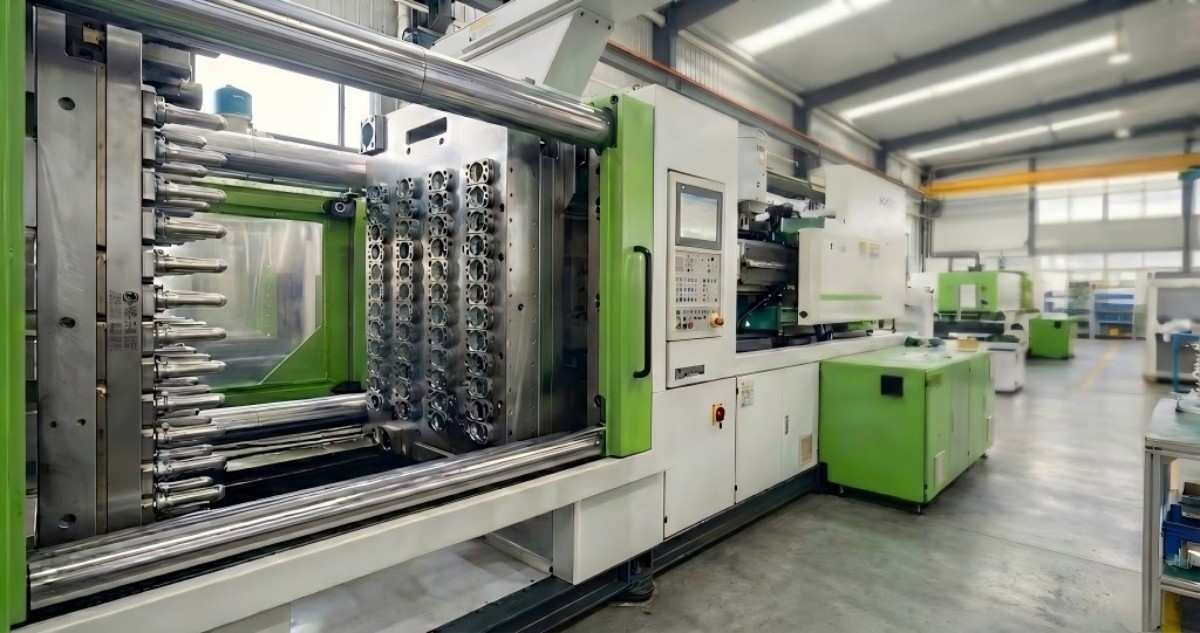
This is critical. Having an in-house injection department means the factory controls the entire process. A real preform mould manufacturer is usually equipped with Husky or other high-speed injection machines. We complete T0 to T1 tests internally. If we find dimensional deviation, we can unload the mold and adjust it within hours until the product is perfect.
Deep Dive: The Value of Internal Testing
Making the mold is only the first step. Trial validation is the key to stable mass production.
- Immediate Correction: If the preform has eccentricity or flash, internal testing allows engineers to analyze the cause on-site and modify it immediately in the tool room.
- Simulate Mass Production: Before shipping, we can simulate the actual production cycle of your factory. We ensure the water cooling efficiency meets the standard.
- Video Acceptance: We record a complete video of the mold running automatically on the machine for you, not just show you a few static samples.
3. Why are some mold quotes far below the market average?
We often meet clients asking about very low prices. Usually, the huge price difference comes from the choice of steel. The cost gap between S136 stainless steel and P20 steel is large.
Steel accounts for a large part of the mold cost. Some ultra-low-priced molds on the market often use P20 or 45# steel instead of S136 stainless steel. P20 steel has lower hardness and poor rust resistance. It works initially, but after long-term contact with cooling water, the internal channels rust easily. This lowers cooling efficiency. A real premium mold should use S136 or higher grade stainless steel.
Deep Dive: Material Determines Lifespan
Visually, newly machined P20 and S136 look similar. But their lifespan is very different.
- Rust Resistance: Preform molds need chilled water. If P20 steel is not specially treated, it rusts easily when touching water. Rust blocks the water channels and slows down the cycle time. S136 is stainless steel and has excellent corrosion resistance.
- Polishing Performance: Preforms require a high-gloss finish. S136 is pure and can be polished to a mirror level that lasts. Low-end steel often develops pits after polishing.
- Verification Method: Real factories purchase steel from formal mills (like ASSAB). Upon delivery, we recommend clients use a portable hardness tester. Heat-treated S136 hardness is usually HRC 48-52. Untreated P20 is usually much softer.
4. Can the maker upgrade your mould to be compatible with HUSKY or NETSTAL systems?
If your factory uses European brand high-end injection machines (like Husky HyPET or Netstal PET-Line), you must confirm the supplier has the corresponding engineering design capability.
This is a high-level capability test. Husky and Netstal machines have complex mold interfaces, cooling layouts, and pneumatic valve timing. They are different from standard Chinese machines. Only manufacturers with rich experience can design a perfectly compatible mold. This is not just a machining issue; it is an engineering issue.
Deep Dive: Interface Matching
Many factories focusing on the local market only know the standards for Haitian or Huayan machines.
- Water Matching: European machines often have water interfaces integrated into special backplates. The precision requirement is extremely high.
- Hot Runner Interface: The socket definition and voltage standard of the temperature controller must match the machine exactly.
Before cooperation, ask the supplier if they have cases for similar machines. Ask to see screenshots of relevant design drawings.
5. How do they handle "Spare Parts" availability after 3 years?
Molds are durable goods. They often last more than 10 years. During this time, wear parts like valve pins, heaters, or cores may need replacement. Factory stability is very important.
Traders or temporary workshops might change businesses or disappear after a few years. You will not be able to buy matching parts. Legitimate factories have a complete data management system. We permanently archive the 2D and 3D drawings of every mold. Even if you need to replace parts 5 years later, we can produce them quickly based on archived data and ship via DHL.
Deep Dive: Data Archiving
Buying a mold is not just buying steel. It is buying long-term technical support.
- Standard Parts: We try to use international standard wear parts. This makes it easy for clients to purchase locally.
- Non-Standard Parts: For core parts like cavities and cores, we back up our CNC programs. Whenever you need them, we retrieve the data from that year for machining. This ensures 100% interchangeability.
6. Why does a "low price" often indicate a difference in Hot Runner configuration?
The hot runner system is the "heart" of the preform mold. The price difference often shows up here.
Some low-priced molds use unknown brands or even refurbished hot runner components. This can lead to unstable heating, leakage, or black spots. We insist on using brand-new top-tier brands (like Yudo, Moldmaster) or our long-tested high-end proprietary brand. A stable hot runner system is the foundation of preform quality.
Deep Dive: Configuration Determines Stability
- Heating Stability: High-quality heaters and thermocouples ensure temperature control within ±1℃. This is critical for controlling AA levels (Acetaldehyde).
- No Leakage: Precision manifold machining and seal design prevent plastic leakage under high pressure.
During the inquiry stage, verify the brand and origin of the hot runner. Ask for warranty terms in the contract.
7. Do they offer on-site engineers for installation, or just send a manual?
Usually, a qualified mold should be "Plug & Play" when it arrives at the client's factory. It should not need complex debugging. However, for special cases, extra service guarantees are necessary.
For standard preform molds, we aim for a delivery standard that requires no debugging. However, for large systems (like 48+ cavities) or new factories, we offer the option of overseas engineer service. If the client faces difficulties adjusting machine process parameters, we can send experienced engineers to the site for training and guidance.
Deep Dive: Remote vs. On-Site Support
- Remote Support: 90% of issues (like water connection, temperature setting) can be solved via video conference. We provide detailed operation manuals and parameter guides.
- On-Site Support: If you are new to the PET industry, our engineer can fly to your factory. We do not just install the mold. We train your team on how to maintain the mold and how to clean vents. We ensure you can run independent production smoothly.
8. Why do we invite you to inspect the "Water Flow Test" before shipping?
Cooling efficiency directly decides the production cycle. If mold channels are blocked internally, the naked eye cannot see it.
Before packing and shipping, we connect the mold to a high-pressure water pump for a full inspection. We check for O-ring leaks. We verify that water flow in every channel is smooth. We record a test video for the client. This process prevents the embarrassment of water leaks or uneven cooling after the mold arrives at your factory.
Deep Dive: The Final Defense Before Factory Exit
Many factories only do simple open/close movement tests. We insist on the "Water Test":
- Pressure Holding: We apply water pressure and hold it for 30 minutes. We ensure no pressure drop and no seepage.
- Flow Verification: We confirm water comes out of every outlet. This prevents metal chips from the machining process blocking the channels.
This is responsible behavior towards the client. It ensures the mold is usable immediately upon installation.
FAQ: 5 Questions to Ask Your Potential Supplier
Q1: Can I see your business license?
Yes. Check the "Scope of Business." If it includes "Production/Manufacturing," they are usually a factory. If it only says "Sales/Trading," they are likely a trader.
Q2: Do you own your machining equipment?
Yes. Our machining workshop is open to clients. You can video call anytime to see the equipment running.
Q3: What if the mold breaks within the warranty period (non-human damage)?
We offer a 1-year injection mould warranty. For parts damaged by non-human causes, we send replacement parts via international courier for free.
Q4: what test reports will I receive before shipping?
We provide mold trial videos, preform dimension measurement reports (CMM reports), and water flow test videos.
Q5: Can you help me design the preform?
Yes. We have a professional engineering team. We do not just build molds. We optimize the preform design based on your bottle design and blowing machine characteristics. This helps you save resin costs and improve blowing success rates.
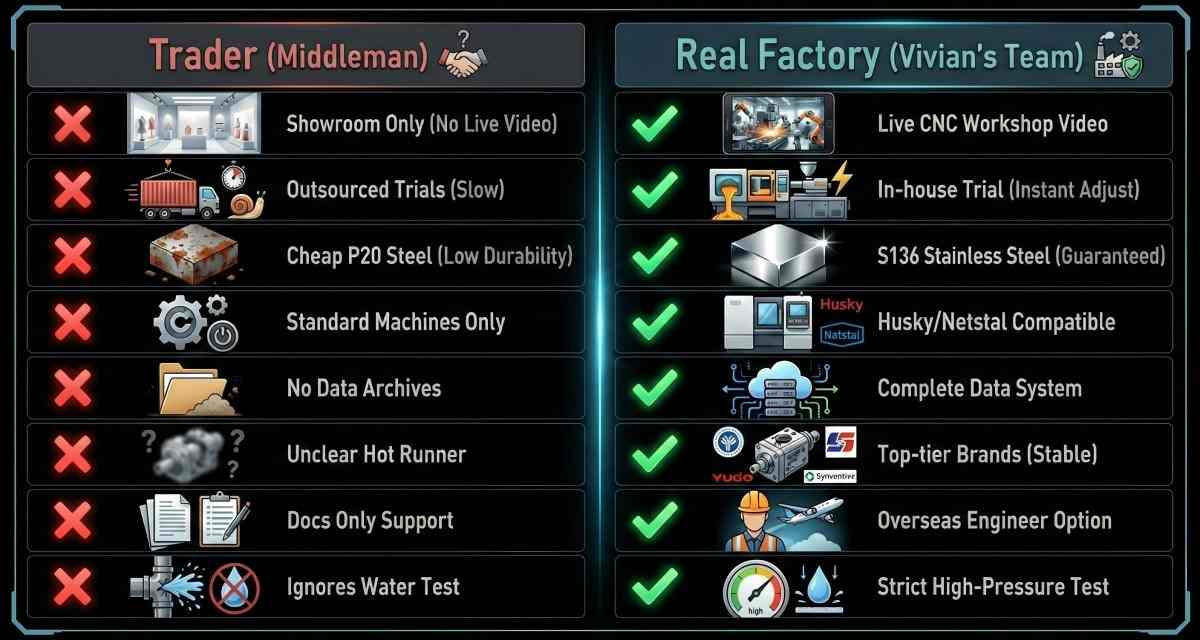
Summary Table: Trader vs. Real Factory
| Feature | "Trader" (Middleman) | Real Factory (Vivian's Team) |
|---|---|---|
| Workshop Show | Often refuses video, or only shows showroom. | Accepts video calls anytime, shows live CNC workshop. |
| Trial Capability | Relies on outside centers. Slow feedback. | Owns in-house injection workshop. Instant adjustment loop. |
| Steel Material | Low-price molds use P20. Low durability. | Insists on S136 stainless steel. Guarantees material quality. |
| Compatibility | Only knows standard local machines. | Capable of matching high-end European machines (Husky/Netstal). |
| Long-term Support | High staff turnover. No data archives. | Complete data archiving system. Ensures spare parts interchangeability. |
| Hot Runner | Unclear config. Stability questionable. | Uses brand new famous brands or proven high-end systems. |
| After-sales | Only provides documents. | Offers remote guidance and overseas engineer options. |
| Factory Exit Test | Often ignores water testing. | Strictly performs high-pressure water flow and seal tests. |
Are you ready to work with a solid, rigorous manufacturing factory? Contact Vivian today to book a video tour of our Zhongshan workshop.