Hello. I am Vivian, the founder of PETmolder.com. I have worked in mold manufacturing in Zhongshan, China for 20 years.
The global economy is tough right now. Cash is tight. Many clients have shifted from ordering new molds to repairing old ones. I understand this perfectly.
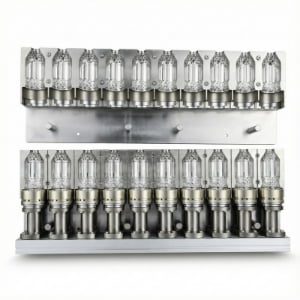
I have a client in Vietnam. His factory runs several 8-cavity linear blowing machines. He has 12 sets of blow molds that are over 5 years old. These molds had problems: blocked water channels, thick parting lines, and surface rust spots (pitting).
He wanted to save money. He asked: "Vivian, can I send these molds back to China for repair?" I told him: "No. The shipping cost plus repair fees is higher than the cost of a new mold. It is not realistic."
We took a more practical approach: diagnosis via photos and measurements.
- The Result: We evaluated that 7 sets could be maintained locally in Vietnam (e.g., acid cleaning channels). However, 5 sets had severe steel fatigue and dimension issues. They had to be scrapped.
Today, let's look at your old molds from a purely technical perspective: Which ones are worth saving, and which ones must be replaced?
1. The 50% Rule: Comparing Repair Costs to New Mold Investment
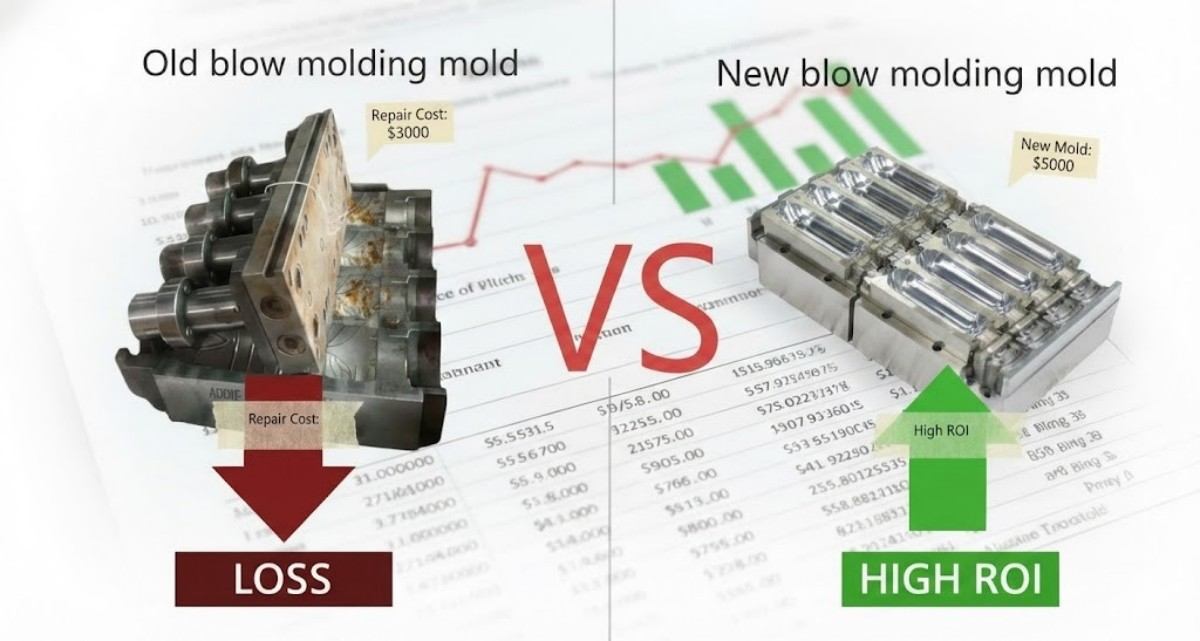
I saw a factory spend $3,000 repairing an old mold that cost $5,000 when new. This is a bad decision.
If the repair quote exceeds 50% of a new mold's price, or if the refurbished mold will last less than 50% of a new mold's lifespan, stop. From a financial ROI perspective, directly purchasing a new mold is the smarter choice. Do not repair steel that suffers from metallographic fatigue.
Deep Dive: The Hidden Cost of Manual Labor
Manufacturing a new mold is highly automated CNC machining. It is fast and precise.
Repairing an old mold is intensive manual labor (argon welding, manual fitting, hand polishing). Labor is expensive.
If your mold is 8 years old and the main parting line is worn out, even if you pay a high price for welding repair, the base metal fatigue still exists. Cracks or deformation may reappear in 3 months.
Vivian's Advice:
Get a quote for a new mold first. If the repair budget is more than half of that number, buy the new one. A new mold comes with fresh steel performance and a warranty. Repair does not.
2. Cycle Time Drift: Is Your Old Mold Slowing Down Your Machine?
I measured the cycle time at a client's factory. The actual time was 3.0 seconds, but the machine's setting capability was 2.5 seconds. This 0.5-second delay comes from thermal failure inside the old mold.
Old molds accumulate mineral scale (calcium) and rust inside cooling channels. This dirt acts like an insulation layer, causing heat transfer efficiency to drop significantly. To set the bottle shape, the operator must extend the cooling time. If the cycle drifts from 2.5s to 3.0s, you lose 20% of your hourly output. This "invisible loss" often costs more than a new mold.
Deep Dive: Calculating Capacity Loss
Do not ignore the cooling channels. Over 5 years, due to water quality issues, the channel diameter gets smaller due to scale, and flow speed drops.
The Math of Loss:
- Old Mold (Scaled Channels): 3.0 sec cycle = 1,200 cycles/hour.
- New Mold (Clean Channels): 2.5 sec cycle = 1,440 cycles/hour.
- Difference: 240 cycles fewer per hour.
If you have an 8-cavity machine, that is 1,920 fewer bottles per hour.
In one month (20 hours x 26 days), you lose nearly 1 million bottles in capacity.
If professional acid cleaning cannot restore the flow, it means the channels are blocked internally. You must replace the mold.
3. Severe Surface Pitting & Thick Parting Lines: When Polishing Destroys Dimensions
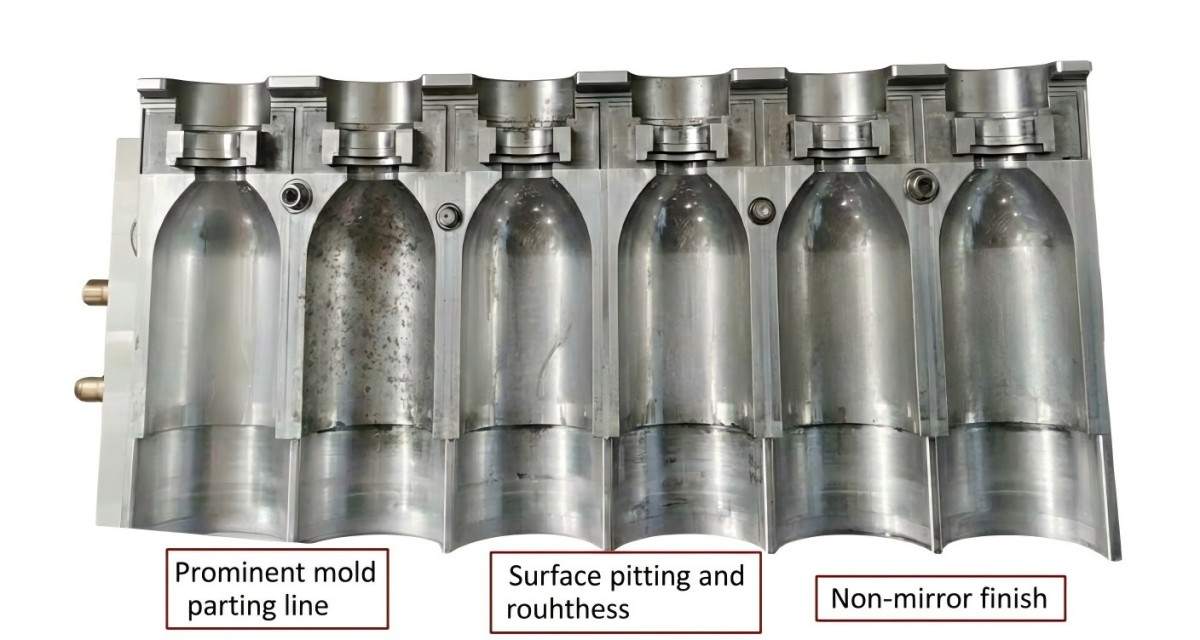
I saw bottles with very obvious seam lines. They felt rough and scratched my hand. The factory tried to fix it by polishing the parting line, but the gap got bigger.
After millions of high-pressure closing impacts, the sharp edge of the parting line becomes round due to fatigue (chamfer effect). This causes the parting line (seam) to become thick and wide. This physical wear is irreversible. Polishing only removes material, making the gap bigger. The only fix is welding and re-CNC machining, which risks cavity thermal deformation. Replacement is recommended.
Deep Dive: You Can't "Polish" Metal Back
Defect 1: Surface Pitting (Rust)
In humid environments, deep rust (pitting) on the cavity surface requires heavy polishing to remove. If the pit is >0.05mm deep, polishing will enlarge the cavity diameter. This increases the bottle volume. If you have a volumetric filling line, the bottle will look underfilled, hurting your brand image.
Defect 2: Thick Parting Lines & Misalignment
Thick lines often come with mold misalignment due to worn guide pins.
- Misalignment: You feel a "step" on the bottle seam.
- Thick Line: The seam looks like a wide white line.
When you try to polish the edge of the parting line, you are actually making the edge rounder. The plastic under 30-bar pressure will squeeze deeper into this wedge gap, making the line wider and uglier.
4. Lightweighting Potential: Can a New Design Save You 2g of Resin?
I weighed a client's preform. It was 28g. The bottle shape was standard. By optimizing the mold design, we used a 26g preform to blow a bottle with the same strength.
Old molds often run outdated, heavy preform designs. Modern mold design technology optimizes the base geometry (like better rib distribution), allowing you to use lighter preforms for the same pressure resistance. Saving 2g of resin per bottle usually pays for the new mold in just 3 to 6 months.
Deep Dive: Resin is Your Biggest Cost
The cost of the mold is one-time. The cost of PET resin is continuous.
Savings Calculation:
- Saving: 2 grams per bottle.
- Production: 10,000 bottles/hour.
- Run time: 20 hours/day.
- Daily Resin Saved: 400 kg.
If PET resin is $1.00/kg, you save $400 every day.
The investment in a new mold is quickly recovered through resin savings. At this point, replacing the mold is an investment, not a repair expense.
5. Water Channel Corrosion: The Silent Killer of Efficiency
I cut open a scrapped mold base. The water channels were rotten and perforated. Cooling water was leaking into the cavity.
Internal water channel corrosion is "mold cancer." Acidic water eats through the steel walls over time. Once micro-cracks (pinholes) appear between the channel and the cavity, cooling water leaks out, causing water marks on the bottle or sticking issues. Welding can only fix the surface, not the deep internal rot. You must replace the mold parts.
Deep Dive: Irreparable Structural Damage
Poor water quality management is the main reason for short mold life.
When internal corrosion is severe, there is a risk of leakage. Also, the rough internal walls drastically reduce water flow speed, causing a sharp drop in cooling efficiency.
- Symptom: Bottles turn white (crystallization) or deform upon ejection.
- Action: This internal structural damage cannot be solved by repair. You must replace the damaged mold insert or base.
6. Volume Consistency: Are Your Bottles Varying in Capacity?
I measured bottles from an 8-cavity machine. Cavity 1 was 500ml, but Cavity 8 was 508ml. The liquid levels on the shelf looked uneven. This was caused by excessive manual polishing.
Different wear levels in each cavity, combined with human error from multiple manual repairs, lead to severe "Multi-Cavity Inconsistency." Manual polishing cannot control the thickness of material removal (one worker removes 0.05mm, another removes 0.15mm). Only a new CNC-machined mold guarantees 100% volume consistency (high CPK value).
Deep Dive: Manual vs. CNC
When you repair molds locally, even if the same worker does it, it is hard to ensure the polishing force is identical across 8 cavities.
The Shelf Problem:
Inconsistent volume leads to different fill heights after quantitative filling. On the supermarket shelf, consumers visually perceive lower-level bottles as "underfilled." This severely damages brand reputation. The only way to solve this is to replace the cavities with new ones machined by unified CNC programming.
7. Compatibility Check: Can the Old Mold Handle Your New Machine?
Many clients upgrade to new high-speed blowing machines but try to keep using old molds. The result? Molds crack or vibrate violently during high-speed runs.
If you have just upgraded to a higher capacity machine, your old molds may not match in structural strength or cooling efficiency. Old molds might be designed for 25 bar pressure, while the new process requires 35+ bar. Also, old straight-through water designs may not handle the heat removal needed for high-speed production.
Deep Dive: Structural Fatigue & Cooling Bottlenecks
- Structural Fatigue: Old molds have undergone millions of stress cycles. The internal structure of the aluminum or steel is fatigued. Under the higher clamping force and blowing pressure of a new machine, old shells are prone to cracking.
- Cooling Bottleneck: A key advantage of new machines is speed. If the old mold's water design is outdated, it becomes the bottleneck of the production line. Slowing down a new machine to accommodate an old mold is a huge waste of resources.
8. Case Study: How Replacing a 5-Year-Old Mold Increased Output by 20%
I helped a client replace a severely worn 5-year-old mold. Although he didn't want to spend the money initially, the results proved it was worth it.
The new mold solved the thick parting line and surface pitting issues, upgrading the bottle's appearance. More importantly, the brand-new, scale-free cooling channels reduced his cycle time by 0.6 seconds. Output increased from 10,000 BPH to 12,000 BPH. The profit from increased production covered the mold cost in just 2 months.
Deep Dive: Real ROI
For my Vietnamese client, replacing those 5 sets of molds brought immediate results:
- Speed Up: Cooling efficiency restored; machine runs at full speed.
- Stable Quality: Reject rate dropped from 5% to under 0.5%.
- Visual Upgrade: Clean bottles with fine parting lines improved product competitiveness.
Sometimes, clinging to old molds looks like saving money, but it is actually losing money.
FAQ: Repair vs. Replace Decision Matrix
Q1: Can I weld the parting line if it is damaged?
For blow molds, large-area welding on the parting line is very risky. The high heat of welding warps the mold cavity, and the bottle may become oval. Only very small dents can be attempted with laser welding. Extensive wear requires replacement.
Q2: My mold has scale. Should I replace it?
Not immediately. Try professional acid cleaning (descaling) first. If flow returns to normal and there are no leaks, keep using it. If internal cross-leaks or external leaks appear after cleaning, it must be replaced.
Q3: How many times can I polish a mold?
Polishing is subtraction. Usually, a mold can only withstand 2-3 light polishes in its life. Once the total removal increases the bottle diameter by more than 0.2mm, or the volume deviation exceeds tolerance, the mold is dead.
Q4: Can I replace just one cavity in a multi-cavity mold?
This depends on your mold structure.
- Rotary Machine Molds: Usually independent single cavities. You can replace just the broken one.
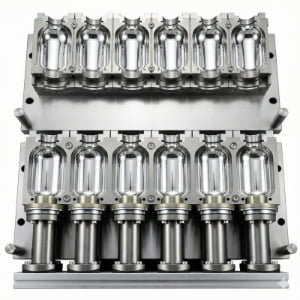
- Linear Machine Molds: Many use a "Monoblock" structure (several cavities in one block of metal). You cannot replace a single middle cavity; you usually have to replace the entire cavity block.
Q5: Can I change the Logo on an old mold?
It depends on the Logo size.
- Small Logo: Like a date code or recycle symbol on the base. We can use a "Logo Insert" to change it.
- Large Logo: If it is a large brand logo on the body, I do not recommend modifying it. Welding over the old logo creates porosity (pinholes), leaves ugly insert lines, and affects cooling. For large logo changes, replacing the cavity is the only way to ensure quality.
Summary Table: Vivian's Decision Guide
| Defect Symptom | Repair Strategy | Replace Strategy (Check Machine Type) |
|---|---|---|
| Light Surface Rust | YES. Light hand polish. | Not needed. |
| Deep Pitting (Rust) | No. Polishing ruins volume accuracy. | YES. Rotary: Replace insert. Linear: Replace cavity block. |
| Thick Parting Line/Misalignment | No. Welding causes warping. Polishing widens gap. | YES. Rotary: Replace cavity halves. Linear: Replace cavity block. |
| Slow Cycle (Scale) | Try professional acid cleaning first. | YES. If acid cleaning fails or causes internal leaks. |
| Volume Inconsistency | No. Manual labor cannot restore consistency. | YES. Requires unified CNC machining. |
| Resin Waste (Heavy Preform) | No. Old design limits weight reduction. | YES. New design saves money via lightweighting. |
| Logo Change | No. Welding causes pinholes/defects. | YES. Small logo: Use Insert. Large logo: Replace cavity. |
Do you have old molds in your factory? Send me a photo. I will tell you honestly from a technical perspective: fix it or trash it. Contact Vivian for factory service today.