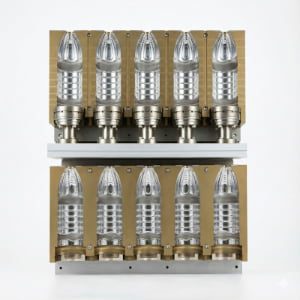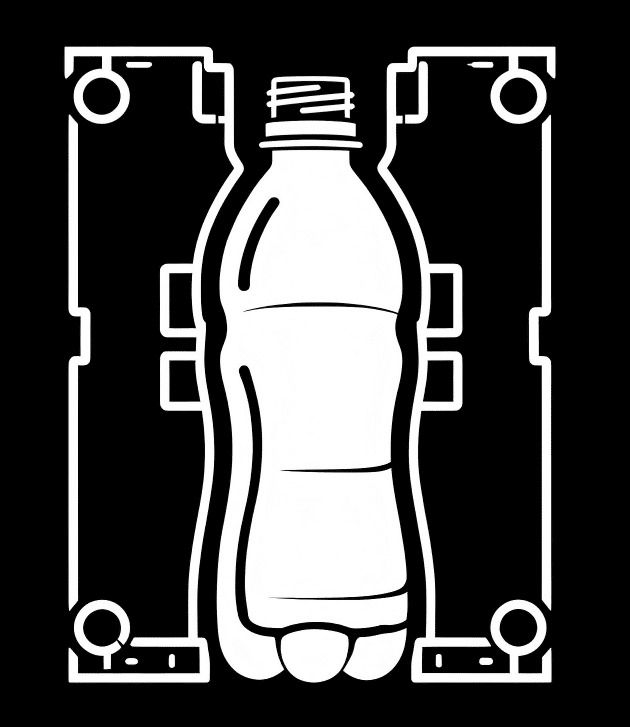
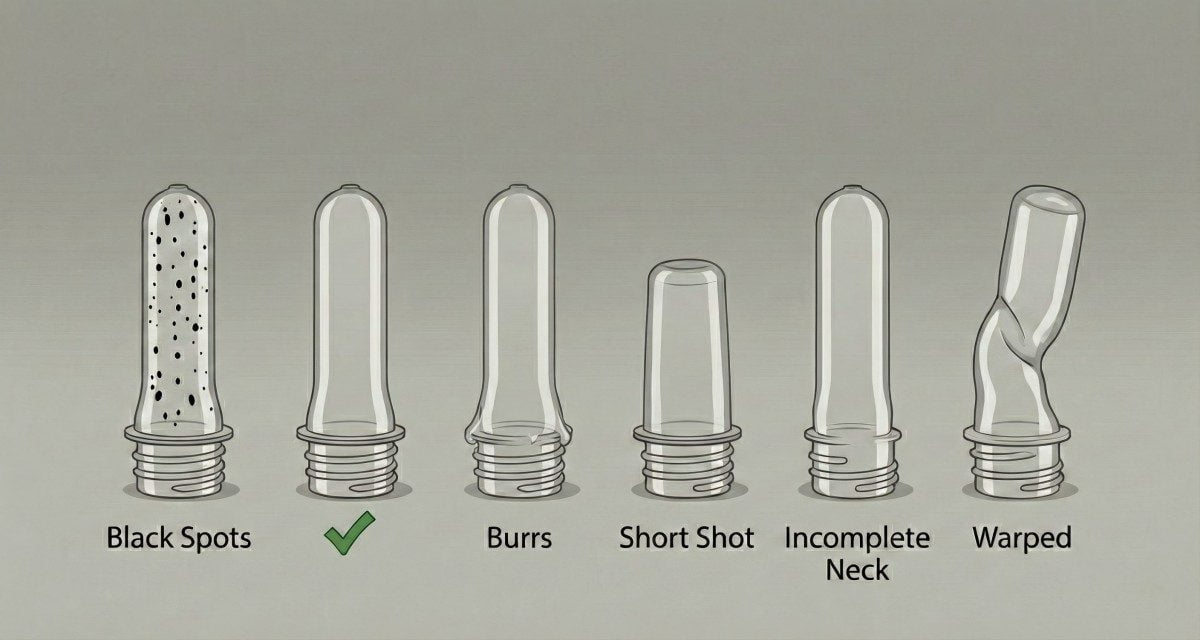
Hello. I am Vivian, the founder of PETmolder.com. I have worked in mold manufacturing in Zhongshan, China for 20 years. I see mold prices vary widely. Many new buyers only look at the price. They ignore mold quality. This is a huge mistake.
I saw a client from the Middle East lose a lot of money. He bought a cheap 48-cavity 25g preform mold. He spent two weeks testing it. He got zero good parts. The preforms had shrink marks and turned white. The cheap supplier blamed the machine operator. The client hired an expensive mold expert. The expert said the mold itself was defective.
Many factories face this exact problem. Today, my team and I will explain these hidden defects. We want to help you avoid these traps. Stop buying cheap molds that destroy your profit. Stop wasting your money.
1. Why does microscopic "Core Shift" cause preform eccentricity after 500,000 shots?
I saw a client lose $5000 because of bad wall thickness. They blew the preforms into bottles. The bottles burst. This happens because of a bad taper lock. As a buyer, you must demand precision CNC machining in your contract.
Cheap preform molds use soft steel for the taper lock. After 500,000 cycles, the steel wears down. The core shifts position. Plastic pushes the core to one side. This causes uneven wall thickness. When you buy a mold, you must demand hardened S136 steel and ask for CMM reports to ensure the core stays perfectly centered.
Deep Dive: Core Shift Ruins Preforms
In my workshop, I measure preforms every day. A good preform has equal wall thickness. A bad preform is thin on one side and thick on the other. Do not blame your injection machine. The mold you bought is the problem.
Preform molds use a "Taper Lock." This is a cone-shaped structure. It holds the core in the exact center of the cavity. Good molds use high-hardness steel here. Cheap molds use soft steel.
Soft steel wears out fast. The mold opens and closes. Metal hits metal. After 500,000 shots, the soft cone deforms. It creates a small gap. Plastic enters the mold under high pressure. The pressure pushes the core into that gap. The core moves. We call this "Core Shift."
This is a terrible defect. Uneven preforms make bad bottles. The thin side stretches too much. The bottle pops during blowing.
Why You Cannot Buy Cheap Steel:
- Low Hardness: Cheap steel is only HRC 30. It deforms easily.
- Bad Friction: Soft steel rubs together. It drops metal flakes.
- No CNC Precision: Cheap factories use manual machines. The taper lock does not fit perfectly from day one.
The Buyer's Action Guide:
Stop buying molds with soft taper locks. In your purchase contract, you must specify S136 stainless steel. You must demand the hardness reaches HRC 48 or higher. Before delivery, demand a steel hardness report from the mold factory.
Taper Lock Quality Comparison
| Feature | Cheap Mold | Premium Mold |
|---|---|---|
| Steel Type | P20 or cheap steel | S136 Stainless Steel |
| Hardness | HRC 30 | HRC 48-52 |
| CNC Precision | Low (Manual check) | High (CMM check) |
| Core Shift Starts | 500,000 shots | > 6,000,000 shots |
| Factory Waste Rate | High | Low |
Do not save money on steel. You will waste more money on rejected plastic.
2. How does poor valve pin thermal conductivity trigger gate crystallization?
In my workshop, I saw white gates on many preforms. This looks terrible. The bottom cracks easily. Cheap valve pins cool too slowly. When you inspect the mold, you must check for Beryllium Copper inserts.
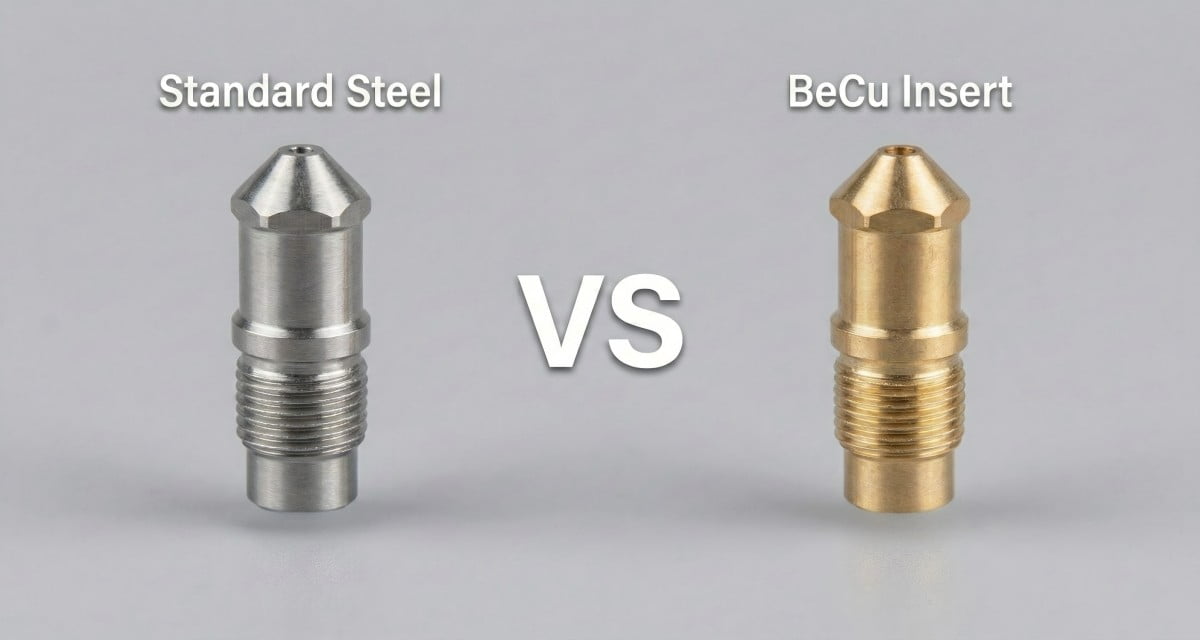
Cheap valve pins use standard steel. Standard steel has bad thermal conductivity. It cannot remove heat fast enough. The plastic at the gate stays too hot. It cools slowly and turns white (crystallizes). When buying top-tier molds, specify Beryllium Copper (BeCu) inserts. BeCu removes heat instantly and keeps gates clear.
Deep Dive: Stop Gate Crystallization
My client told me a sad story. His customers rejected all his preforms. The gate area was white. The bottom of the bottle was brittle. It cracked when dropped on the floor.
PET plastic changes color with heat. If you cool it fast, it stays clear. If you cool it slow, it turns white. We call this crystallization. The gate is the last place to cool. It holds the most heat.
Cheap molds use standard steel for the valve pin and gate insert. This is a mistake. Standard steel blocks the heat. It holds the heat inside the plastic. Your cycle time increases. The plastic turns white.
The Physics of Cooling:
- Standard steel conducts heat at 30 W/m·K.
- BeCu conducts heat at 130 W/m·K.
- BeCu pulls heat out 4 times faster.
Stop accepting standard steel for gate inserts. Open the mold when it arrives. Good preform molds use Beryllium Copper (BeCu) tips. BeCu is a yellow alloy. It grabs the heat from the hot plastic. The gate freezes fast. The PET stays clear and strong.
How BeCu Saves You Money:
- Fast Cooling: You cut 1 to 2 seconds off the cycle time. This is pure profit.
- No White Gates: You get 100% clear preforms.
- Strong Bottoms: The base does not crack.
I always tell my buyers to check the gate inserts. If they are not yellow BeCu, tell the factory to replace them. You need maximum thermal conductivity.
3. Can sharp runner bends degrade IV and increase Acetaldehyde (AA) levels?
My client complained his water bottles tasted strange. Sharp corners in the hot runner burned the plastic. Acetaldehyde (AA) ruined the water. When approving mold drawings, you must reject sharp runner designs.
Cheap hot runners have sharp 90-degree bends. Plastic hits the sharp corner. High shear stress creates heat. This breaks the PET molecular chains. Intrinsic Viscosity (IV) drops. Acetaldehyde (AA) gas increases. High AA ruins water taste. As a buyer, you must audit the 3D drawings to ensure the runner uses smooth, curved channels.
Deep Dive: Do Not Burn the Plastic
PET plastic is sensitive. It hates sharp corners. It hates staying hot for too long.
In the hot runner system, liquid plastic flows to the cavities. Cheap hot runners have sharp angles. The plastic hits a 90-degree wall. This creates extreme friction. Friction creates heat. This is "Shear Stress."
The extra heat damages the plastic. The Intrinsic Viscosity (IV) drops. Low IV means the plastic is weak. Your PET blow mold will not shape the bottle correctly.
Worse, the heat creates Acetaldehyde (AA). AA is a gas. It gets trapped inside the preform. When you fill the bottle, AA leaks into the water. The water tastes sweet and bad. This kills water bottle brands.
Dead Spots Trap Plastic:
Sharp corners also create "Dead Spots." Plastic gets stuck in the corner. It sits there for 10 cycles. It burns. Then, a black burned piece shoots into your preform. You waste raw material.
The Buyer's Solution:
Before you pay the deposit, ask the mold maker to show you the hot runner 3D drawing. Do not buy hot runners with sharp bends. You need smooth, curved channels. The plastic must flow like a river. No corners. No dead spots.
Hot Runner Comparison
| Feature | Cheap Hot Runner | Premium Hot Runner |
|---|---|---|
| Channel Bends | Sharp 90 degrees | Smooth curves |
| Shear Stress | High | Low |
| IV Drop | Large (Bad for blowing) | Small (Good) |
| AA Generation | High (Bad water taste) | Low (Good water taste) |
| Dead Spots | Yes | No |
If you make water bottles, you must inspect the runner design personally. AA control is your top priority.
4. Why does HRC 32 steel cause neck-ring flash under high-speed injection?
I saw neck flash cut a worker's hand. Plastic leaked out. The bottle caps did not fit. Soft steel bends under high pressure. You must test the neck ring hardness when the mold arrives at your factory.
Low-grade steel (HRC 32) lacks rigidity. Under high injection pressure, the mold "breathes." It elastically deforms. A gap opens between the neck rings. Plastic escapes into the gap. This causes flash. When buying premium molds, you must demand hardened S136 steel (HRC 48+). Hard steel does not bend.
Deep Dive: Stop Neck Ring Flash
Neck flash is terrible. It looks like a thin blade of plastic around the thread. It blocks the cap. The bottle leaks. It will cut your workers' fingers.
Do not blame the injection pressure. Blame the soft steel mold you bought.
Injection machines push plastic with tons of force. The mold must resist this force. Cheap molds use P20 steel or HRC 32 steel. This steel is too soft.
When the plastic hits the mold, the soft steel bends. We call this "Mold Breathing." The neck ring halves push apart by a tiny fraction of a millimeter. The plastic finds this gap. It flows out. You get flash.
How Hard Steel Prevents Flash For You:
You need extreme rigidity. Good molds use S136 stainless steel for the neck rings. We harden it to HRC 48 or HRC 52.
Hard steel does not breathe. It stays locked shut. Even under high pressure, the neck rings do not move. The plastic stays inside. The parting line remains perfect.
Buyer's Inspection Rules:
- Check Material Certs: Specify S136 steel in the contract.
- On-site Testing: Use a portable hardness tester when the mold arrives. It must be HRC 48+.
- Check Clamping Force: Ensure your machine has enough clamping force.
If your mold flashes at the neck, the steel is deforming. Stop letting workers waste time with sandpaper. Buy a rigid mold next time.
5. How do sub-micron venting gaps trap air and cause "Diesel Burn" spots?
In my workshop, I smelled smoke. The preforms had black burn spots. Trapped air got too hot. It burned the plastic. You must demand self-cleaning vents from your mold supplier.
Clogged venting slots trap air inside the cavity. The injection machine compresses this air quickly. The air reaches auto-ignition temperature. It burns the PET plastic. This is the "Diesel Effect." As a buyer, you must purchase molds with precise, self-cleaning vents and enforce a weekly cleaning schedule in your factory.
Deep Dive: The Diesel Effect
Preform cavities are full of air. You must push the plastic in. You must push the air out. If the air cannot escape, you have a big problem.
Cheap molds have bad vent designs. Or your workers do not clean the vents. The air gets trapped at the end of the preform.
The machine injects plastic at high speed. The trapped air gets compressed into a tiny space. Physics says compressed air gets very hot. The temperature jumps to 400°C or 500°C.
This works exactly like a diesel engine. The hot air ignites. It burns the PET plastic. Black spots appear on your products. You see smoke. You smell acid gas. This gas will rust and ruin your newly purchased mold.
Venting is Critical:
- Vents must be 0.015mm to 0.02mm deep.
- If vents are too big, plastic leaks (flash).
- If vents are too small, air traps (burns).
Buyer's Solution:
During purchasing, ask the supplier: "How is your venting system designed?" Only buy self-cleaning vent designs. After the mold arrives at your factory, do not ignore maintenance. Train your workers to clean the vents regularly with mold cleaner. A clean mold makes money.
6. Why is holding pressure failing to pack out your preform threads?
I saw 200,000 preforms with short threads. Caps fell off. Factory workers increased holding pressure. It failed. The gate froze too fast. You must ask the mold factory for a thermodynamic balance analysis.
Short threads happen when the gate freezes too quickly. Bad cooling channel design causes extreme temperature differences. The gate solidifies. Holding pressure gets blocked. It cannot reach the neck thread area. The threads stay empty. This is a thermodynamic problem, not a pressure problem. Buyers should request a Mold Flow analysis before production.
Deep Dive: Thermodynamics, Not Pressure
This is a common mistake in your factory. The threads at the top of the preform are not full. They look short. Factory operators always do the same thing: they turn up the holding pressure on the machine.
Stop doing this. High pressure will not fix a frozen gate.
Plastic enters the bottom (gate). It flows to the top (threads). To fill the threads, you need holding pressure for several seconds.
If you bought a mold with a bad cooling layout, the gate area gets too cold, too fast. The plastic at the gate freezes solid. It becomes a plug.
Once the gate freezes, no more plastic can enter. Your holding pressure is blocked. It pushes against hard plastic. The threads at the top cool down and shrink. No new plastic arrives to fill the shrink. The threads end up short, ruining your bottle design.
How Buyers Can Avoid Unfilled Threads:
- Demand Reports: Before machining, ask the supplier for Mold Flow analysis on cooling and packing.
- Verify Temperature: Ensure the gate stays warm enough, long enough.
- Check Water Layout: Ensure water flows properly around the neck and body.
You must make your mold supplier control the "Gate Freeze-off Time." A good supplier will balance this thermodynamic problem for you.
7. How does "Mold Sweating" in tropical factories ruin preform transparency?
My client in Southeast Asia told me his mold was dripping water. Preform surfaces were foggy. Cold water met hot wet air. You must install a dehumidifier in your injection workshop.
In humid factories, chilled water cools the mold below the air's Dew Point. The mold cavity sweats. Water drops form inside. These drops hit the hot PET plastic. The rapid chill causes surface haze and ugly water marks. The buyer's solution is to upgrade the factory environment and dehumidify the mold area.
Deep Dive: Stop Mold Sweating
This happens in hot, wet places. Countries like Vietnam, India, and Indonesia have high humidity.
Your injection machine needs cold water to cool the mold. You set the chiller to 8°C. Your factory air is 30°C and 80% humidity.
When hot wet air touches your 8°C cold mold steel, water drops form. This is condensation. We call it "Mold Sweating."
Water inside the cavity is bad. The 280°C hot plastic hits the cold water drops. It creates steam. It shocks the plastic. The preform surface gets foggy, cloudy, and full of water marks. This is not the mold's fault. It is your workshop environment.
Dew Point Mathematics:
The Dew Point is the temperature where air drops water. If your chiller is set lower than the Dew Point, the mold sweats.
Temperature vs Humidity (Dew Point Example)
| Air Temp | Humidity | Dew Point | Mold Chiller Temp | Result |
|---|---|---|---|---|
| 20°C | 50% | 9.3°C | 10°C | Dry (Good) |
| 30°C | 80% | 26.2°C | 10°C | Sweats (Bad) |
| 30°C | 80% | 26.2°C | 10°C + Dehumidifier | Dry (Good) |
Buyer's Factory Upgrade Plan:
Stop using open air in humid zones. You must enclose the molding area. You must invest in an industrial dehumidifier. It dries the air around the mold. No moisture means no sweating. Your factory will produce crystal clear preforms.
8. How does a 0.5-second cooling delay destroy your annual profitability?
I saw a factory waste $100,000 in one year. They bought a cheap mold with bad cooling. The cycle was slow. They made fewer parts. As a smart business owner, you must increase your budget for conformal cooling molds.
A 0.5-second delay per cycle destroys your annual profits. In a 48-cavity mold, slow cooling means 400 fewer cycles per day. You lose 19,200 preforms daily. Over a year, this totals millions of lost preforms. Paying extra for advanced conformal cooling channels pays for itself in just 3 months.
Deep Dive: Time is Money
In PET molding, cycle time is everything. Preform walls are thick. They take time to cool. Cooling is 70% of the total cycle time.
The cheap mold you bought drills straight water lines. Straight lines cannot reach the curves of the preform tip. The plastic cools slowly. The cycle time is 15 seconds.
If you buy a premium mold, it uses Conformal Cooling. The water lines curve around the preform shape. Water gets very close to the hot plastic. The cycle time drops to 12 seconds.
The Cost of 0.5 Seconds:
Let us do the math for a 48-cavity mold running 24 hours.
- Fast Mold: 12.0 seconds cycle = 7,200 cycles/day = 345,600 preforms.
- Slow Mold: 12.5 seconds cycle = 6,912 cycles/day = 331,776 preforms.
- Loss per day: 13,824 preforms.
- Loss per year (300 days): 4,147,200 preforms.
If you make 2 cents per preform, you lose over $80,000 every year just because of 0.5 seconds.
Do not save money on cooling channels. Good steel and smart water layouts are expensive on day one. But on day 100, they make you rich. Cheap molds make you poor.
FAQ: 5 Core Questions for PET Preform Mold Buyers
Q1: After I buy the mold, how often should my workers clean the venting slots?
Your workers should clean the vents every week. If you run recycled PET, clean them every 3 days. Do not ignore maintenance. Dirty vents cause air traps and diesel burn.
Q2: What steel should I specify in the purchase contract?
Always specify S136 stainless steel for the cavity and core. It resists rust and keeps a high polish. Require the mold factory to harden it to HRC 48-52 for long life.
Q3: Why is my preform weight unstable during production?
Weight variation comes from bad hot runner temperature control. If one nozzle in your mold is hotter than the other, plastic flows differently. Check your temperature controller and demand the supplier fix the thermal balance.
Q4: Can I use tap water to cool the PET mold to save money?
Absolutely not. Tap water has minerals. Minerals block the cooling channels and ruin your mold. You must install a professional chiller system with treated, clean water in your factory.
Q5: How do I stop the gate from stringing and making scrap?
Gate stringing means the valve pin closes too slowly, or the temperature is too high. Check the air pressure supply in your factory that drives the mold cylinder. Try lowering the nozzle tip temperature.
Summary Table: Defects, Causes, and Buyer's Action Guide
| Defect Issue | Root Cause | Buyer's Action Guide (Vivian's Advice) |
|---|---|---|
| Eccentric Preform | Soft steel wears out taper lock. | Specify HRC 48+ S136 steel in the contract and ask for CNC reports. |
| White Gate | Bad thermal conductivity in tip. | Inspect upon delivery to ensure yellow Beryllium Copper (BeCu) inserts are used. |
| High AA (Bad Water Taste) | Sharp corners in hot runner. | Reject 90-degree bends during drawing approval. Demand smooth runners. |
| Neck Ring Flash | Soft steel causes mold deformation. | Use a portable hardness tester upon mold arrival. Reject HRC < 48. |
| Black Burn Spots | Blocked vents trap hot air. | Buy molds with self-cleaning vents. Enforce weekly factory cleaning rules. |
| Short Threads | Gate freezes too fast. | Demand a Mold Flow analysis for thermodynamic cooling before production. |
| Cloudy Preform Surface | Mold sweats in your humid factory. | Upgrade your factory. Install a dehumidifier for the injection zone. |
| Slow Cycle Time | Straight water lines cool slowly. | Increase budget to purchase a high-end mold with "conformal cooling." |
Would you like me to audit your current mold design to see how much cycle time you can save? Contact Vivian for factory service today.
-4-300x300.jpg)