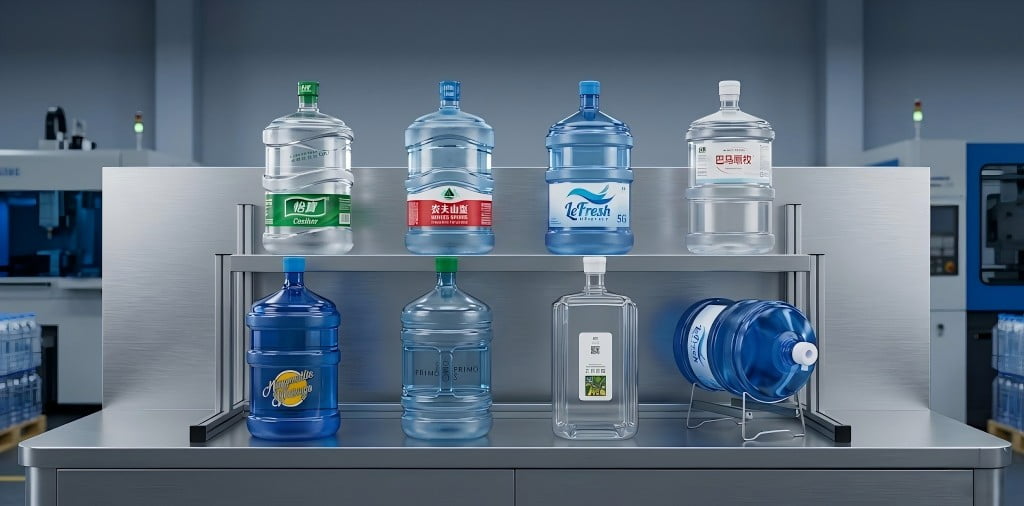
Designing a 5-gallon PET bottle mold requires precise engineering to handle 650g to 800g preforms. This guide examines crucial stretch ratios, specialized base geometries for drop-test durability, and the strategic use of aviation aluminum bodies with stainless steel inserts to maximize cooling efficiency and long-term production stability.
In my 20 years of experience manufacturing PET molds in Guangdong, I have observed a significant transition in the large-volume water packaging sector. Many buyers are unfamiliar with the material characteristics and production processes of 5-gallon containers. A client of mine from Nigeria recently experienced this exact situation. Previously, 5-gallon water jugs in his market were predominantly manufactured from Polycarbonate (PC) using single-stage injection-blow molding equipment. The capital expenditure for PC machinery and molds is exceptionally high, creating a steep entry barrier for investors with controlled budgets.
However, utilizing PET preforms to manufacture 5-gallon bottles via the two-stage stretch blow molding process significantly reduces the required capital investment. Semi-automatic PET blow molding machines offer a lower cost of entry, straightforward operation, and high reliability. After reviewing videos of our PET 5-gallon bottle production lines, my Nigerian client procured a semi-automatic system. He has since commenced production and reported that the operational workflow is highly manageable.
Throughout his equipment selection, preform sourcing, and bottle design process, my technical team and I provided data-driven engineering recommendations. Today, my team and I will share these specific technical guidelines to provide a comprehensive understanding of 5-gallon PET mold manufacturing.
1. Introduction: The Shift from PC to PET in 5-Gallon Bottles
The transition from Polycarbonate (PC) to Polyethylene Terephthalate (PET) for 5-gallon water containers is driven by health compliance and production economics. PET provides a BPA-free packaging solution, while the two-stage stretch blow molding process requires less initial equipment expenditure compared to legacy PC extrusion or injection-stretch manufacturing methods.
For decades, Polycarbonate was the industry standard for reusable 19-liter (5-gallon) water jugs due to its extreme rigidity and clarity. However, heightened regulatory scrutiny regarding Bisphenol A (BPA)—a chemical compound utilized in PC manufacturing—has prompted global beverage brands to phase out PC containers. PET, by its chemical nature, does not contain BPA, making it an internationally compliant material for food-grade liquid packaging.
From an industrial manufacturing perspective, the shift to PET completely alters the factory floor layout. PC bottles are typically produced on massive, energy-intensive single-stage machines. Conversely, PET utilizes a two-stage process: preforms are injection-molded separately, and then reheated and blown in a stretch blow molding machine. This decoupling allows water factories to purchase pre-made preforms and invest solely in blow molding equipment and air compressors. This strategy reduces the electrical load, lowers machine acquisition costs, and simplifies maintenance protocols.
However, blowing a massive volume of PET requires highly specialized tooling. The blow mold must dictate the final mechanical strength of the bottle. If the mold design does not account for the specific thermal and rheological properties of PET, the resulting bottles will fail under the immense hydrostatic pressure of 19 liters of water. For further understanding of how tool material affects production, you can reference our guide: Why Are Most PET Blow Molds Made of Aluminum? 4 Engineering Reasons Explained.
2. Understanding the 5-Gallon Preform (650g to 800g)
A 5-gallon PET container utilizes massive preforms weighing between 650 grams and 800 grams. Engineering the blow mold requires calculating specific axial and radial stretch ratios. Suboptimal stretch ratio calculations result in uneven wall thickness, severely compromising the structural integrity of the final 19-liter water jug.
Before cutting steel or aluminum, a mold engineer must analyze the preform. In standard 500ml beverage production, a preform weighs approximately 15 to 20 grams. In 5-gallon production, we are manipulating a polymer mass of up to 800 grams. This substantial amount of material behaves differently under infrared heating and high-pressure air.
The core of blow mold engineering is managing the Stretch Ratio (SR). The SR is the product of the Hoop Stretch Ratio (radial expansion) and the Axial Stretch Ratio (vertical elongation). For large-volume PET containers, maintaining a balanced stretch ratio ensures that the polymer chains orient correctly, known as strain hardening. If the blow mold cavity is too wide relative to the preform diameter, the PET will stretch beyond its elasticity limit, creating dangerously thin sections in the bottle wall.
In my workshop, we classify 5-gallon preforms into two primary categories based on the container's lifecycle. Understanding the intended use dictates both the preform selection and the mold's internal volume calculations.
| Bottle Lifecycle | Typical Preform Weight | Wall Thickness Objective | Blow Mold Design Considerations |
|---|---|---|---|
| Single-Use (One-way) | 350g - 450g | Thinner walls, lightweight | Moderate ribbing, standard base cooling |
| Returnable (Multi-trip) | 650g - 800g | Thick walls, high rigidity | Aggressive ribbing, extended base cooling systems |
When clients send us 5-gallon bottle concepts, our initial engineering step is to align the internal volume of the mold cavity with the precise dimensions of their chosen preform. Failing to do so results in heavy material accumulation at the base or an overly thin shoulder section.
3. Base Design: The Secret to Passing the Drop Test
The base of a 5-gallon PET bottle must withstand the kinetic energy of 19 kilograms of water during a 1.5-meter drop. Engineering involves specialized base geometries, deep structural grooves, and reinforcing ribs designed to absorb mechanical shock and prevent stress cracking upon impact.
The most rigorous quality control metric for a 5-gallon water bottle is the drop test. A filled bottle weighs approximately 19 kilograms. When dropped from a height of 1.5 meters, the kinetic energy transferred to the base is immense. If the base design is inadequate, the hydrostatic shockwave will cause the PET material to fracture or shatter instantly.
Unlike standard carbonated bottles that utilize a petaloid base to manage internal gas pressure, a 5-gallon bottle must manage external impact force and static weight. Documentation from industry equipment leaders indicates that impact resistance in large PET containers relies on geometric force dispersion.
In our mold designs, we engineer the base with a central push-up (an inverted dome) surrounded by a series of deep, intersecting reinforcing ribs. The central push-up serves a dual purpose: it raises the injection gate off the floor to prevent localized wear, and it acts as a shock absorber. When the bottle strikes the ground, the inverted dome flexes slightly inward, dissipating the kinetic energy throughout the thicker structural ribs rather than allowing it to concentrate at a single stress point.
Furthermore, the transition radius from the standing ring (the part that touches the floor) to the vertical sidewall must be calculated precisely. A sharp corner in this transition zone creates a stress riser. We utilize large-radius fillets in the mold tooling to ensure a smooth, continuous flow of PET material, maintaining structural integrity across the entire base profile.
4. Body Ribs: Preventing Vacuum Collapse and Stacking Deformation
When water is dispensed from a 5-gallon bottle, negative vacuum pressure builds internally. Blow molds must integrate precisely calculated horizontal ribs along the bottle body. These structural features provide critical topload strength for warehouse stacking and prevent inward deformation caused by dispensing vacuum.
The cylindrical body of a 5-gallon container is subjected to two opposing physical forces during its lifecycle: vertical compression (topload) and internal vacuum.
First, consider the logistics of a water bottling plant. Filled 5-gallon bottles are routinely stacked on pallets, often four or five layers high. The bottles at the bottom of the pallet must bear the collective weight of the bottles above them. Without structural reinforcement, the PET sidewalls will buckle under this compressive load.
Second, consider the usage scenario. When the bottle is inverted onto a water dispenser, water flows out, creating a vacuum inside the sealed system until air bubbles up to equalize the pressure. If the bottle body is completely smooth and flat, this temporary vacuum will cause the sidewalls to suck inward, a phenomenon known as vacuum collapse.
To counteract both forces, we engineer horizontal ribs (hoop rings) into the blow mold cavity. These ribs act exactly like the corrugated structure in cardboard or the I-beams in construction. They significantly increase the moment of inertia of the sidewall. The depth, width, and spacing of these ribs are mathematically modeled. Deep, sharp ribs offer high rigidity but can cause material thinning during the blowing process. Therefore, we utilize trapezoidal or semi-circular rib profiles to ensure even material distribution while maximizing mechanical strength.
5. Neck and Shoulder Precision: Ensuring a Leak-Proof Seal
The shoulder geometry of the 5-gallon mold directs the pouring mechanics and top-load distribution. While the 55mm neck finish is injection-molded, the blow mold's shoulder design dictates how the cap seals under pressure, preventing leakage during transit and water dispensing.
The interface between the water bottle and the dispenser is critical. Most 5-gallon PET preforms utilize a standard 55mm neck finish designed for a snap-on cap. As a fundamental rule of two-stage PET manufacturing, the blow mold does not shape these threads or the locking ring. The neck finish is entirely formed during the preform injection stage.
However, the blow mold is responsible for securing the preform by the neck ring during the high-pressure blowing phase. The clamping mechanism must be meticulously machined. If the mold's neck insert is misaligned by even a fraction of a millimeter, the preform will tilt during the injection of 30-40 bar blowing air. This misalignment results in a warped shoulder, causing the bottle to sit off-center on the water dispenser, inevitably leading to water leakage.
The shoulder profile—the transition from the 55mm neck down to the main cylindrical body—must be engineered with a gradual slope. A steep shoulder prevents the PET material from stretching adequately, leaving a heavy ring of un-stretched plastic near the neck. A well-designed, sloped shoulder ensures that the material is drawn downward efficiently, contributing to the overall axial stretch ratio and enhancing the vertical load-bearing capacity of the final container.
6. Advanced Cooling Systems for Massive PET Molds
Cooling a stretched 700-gram PET mass requires aggressive thermodynamic management. 5-gallon blow molds utilize large-diameter, strategically routed cooling channels. Efficient thermal dissipation prevents material crystallization and whitening, significantly shortening the cycle time and increasing the manufacturing throughput.
In thermodynamics, cooling time is directly proportional to wall thickness. A standard 500ml bottle cools almost instantaneously upon contact with the mold wall. A 5-gallon bottle, retaining significantly more thermal mass from the 700g preform, requires a dedicated thermal management strategy.
PET is a thermoplastic polymer. If it remains at elevated temperatures for an extended period after stretching, it will begin to crystallize. Crystallization in blow molding manifests as a milky, opaque haze (pearlescence) and localized brittleness, severely compromising the bottle's transparency and impact resistance.
To extract heat rapidly, the blow mold must feature highly engineered cooling channels. Standard straight-line drilling is insufficient for a mold of this size. In our factory, we design aggressive, conformal-style cooling circuits that trace the external geometry of the bottle cavity. We utilize large-diameter channels to maximize the flow rate of chilled water (typically 10°C to 12°C).
Special attention is directed to the base area. The base contains the injection gate, which is the thickest and hottest part of the preform. Our bottom mold components feature independent, high-flow cooling circuits to rapidly freeze the gate area. Effective thermal management in the mold design directly reduces the cycle time. Saving just 3 seconds per cycle on a semi-automatic machine translates to a substantial increase in daily production output for the factory owner.
7. Material Selection: The "Aluminum Body + Stainless Steel Inserts" Strategy
Constructing a 5-gallon mold requires a hybrid material approach. High-grade aviation aluminum serves as the primary body for rapid heat dissipation. Hardened stainless steel inserts are engineered into the high-wear neck and base sections, ensuring long-term durability and dimensional stability.
When clients consult us regarding mold materials, they often ask whether to use pure aluminum or pure stainless steel. For standard small bottles, either choice is viable depending on the production volume. For a 5-gallon mold, utilizing a single material presents engineering compromises.
A solid stainless steel 5-gallon mold is exceedingly heavy, placing undue strain on the blow molding machine's mechanical linkages. Furthermore, stainless steel has a relatively low thermal conductivity coefficient compared to aluminum, which slows down the cooling process and extends the cycle time. Conversely, a solid aluminum mold offers exceptional heat dissipation but is softer. The high-impact areas, specifically the neck clamping area and the bottom base mechanism, would wear down prematurely over millions of cycles.
To resolve this, we employ an advanced hybrid construction strategy:
- Mold Body (Cavity Blocks): We utilize high-strength aviation-grade aluminum (such as 7075 or AL-QC). This maximizes thermal transfer, drawing heat away from the massive PET body rapidly to ensure a fast cycle time and excellent bottle clarity. It also reduces the overall weight of the tooling block.
- Neck Inserts & Base Block: We machine the neck interface and the entire base unit from hardened stainless steel (such as S136 or 316L). The stainless steel neck insert resists the constant friction of clamping onto the preform support ledge. The stainless steel base withstands the mechanical stress of the bottom mold actuation and provides the rigid structural definition required for the complex drop-test base geometry.
This combination leverages the thermodynamic advantages of aluminum and the mechanical resilience of stainless steel, delivering a mold that operates quickly and endures rigorous industrial usage.
| Component | Optimal Material | Engineering Justification |
|---|---|---|
| Main Cavity Body | Aviation Aluminum (e.g., 7075) | Superior thermal conductivity; enables rapid cooling of 700g PET mass; lightweight. |
| Neck Insert (Top) | Hardened Stainless Steel (e.g., S136) | High wear resistance against clamping friction; maintains tight 55mm dimensional tolerance. |
| Base Block (Bottom) | Hardened Stainless Steel | Withstands mechanical actuation stress; allows for precise machining of complex drop-test ribs. |
8. Conclusion: Custom 5-Gallon Molds to Dominate Your Market
Manufacturing 19-liter PET bottles demands precision tooling to prevent high scrap rates. By focusing on stretch ratios, structural ribbing, and hybrid cooling materials, manufacturers can achieve efficient production. Aligning with experienced mold engineers ensures your tooling meets the strict mechanical demands of large-volume water packaging.
Entering the 5-gallon PET market presents an excellent opportunity to reduce overhead costs and provide compliant, BPA-free packaging. However, the physical demands placed on a 19-liter water bottle are unforgiving. A mold design that fails to account for hydrostatic pressure, vacuum collapse, or thermal cooling parameters will result in elevated scrap rates and costly product returns due to breakage in transit.
By implementing specialized base geometries for drop testing, integrating horizontal ribs for top-load strength, and utilizing the "Aluminum Body + Stainless Steel Insert" construction strategy, you ensure stable, high-yield production. My team and I specialize in these exact engineering challenges. If you are preparing to transition your production line or launch a new 5-gallon PET project, we welcome you to forward your 3D concepts or preform specifications for a comprehensive technical evaluation.
FAQ
Q1: Why are manufacturers switching from PC to PET for 5-gallon bottles?
A: PET does not contain BPA, aligning with global food safety compliance for liquid packaging. Additionally, PET raw materials are highly cost-effective compared to PC. The two-stage stretch blow molding process for PET utilizes less energy and requires lower initial equipment expenditure, significantly reducing the overall manufacturing cost per unit.
Q2: What is the standard preform weight for a 5-gallon PET bottle?
A: Depending on the required wall thickness and the specific lifecycle of the container, 5-gallon PET preforms typically range from 650 grams to 800 grams. Single-use water jugs may utilize lighter preforms, while multi-trip returnable bottles demand the upper end of this weight spectrum.
Q3: How do you prevent a 5-gallon PET bottle from failing the drop test?
A: Passing the drop test requires highly accurate wall thickness distribution and an engineered base geometry. Our mold designs incorporate specialized central push-ups and deep reinforcing ribs that flex to absorb kinetic impact energy, preventing the hydrostatic shockwave from shattering the PET base.
Q4: Why do some 5-gallon bottles collapse when placed on a water dispenser?
A: This deformation is caused by the internal vacuum pressure generated as water is drawn out of the sealed container. To prevent this, the blow mold cavity must be engineered with precisely calculated horizontal ribs along the cylindrical body, providing critical structural rigidity against vacuum collapse.
Q5: What is the recommended material for manufacturing a 5-gallon PET blow mold?
A: The optimal approach utilizes a hybrid material strategy. We deploy high-grade aviation aluminum for the primary mold body to ensure rapid heat dissipation and shorter cycle times. For high-wear zones—specifically the neck finish insert and the base block—we utilize hardened stainless steel. This combination ensures maximum cooling efficiency and long-term mechanical durability.
Key Takeaways Summary
| Design Parameter | Engineering Solution | Manufacturing Benefit |
|---|---|---|
| Preform Handling | Calculated axial and radial stretch ratios for 650g-800g mass. | Ensures uniform wall thickness and prevents material thinning. |
| Drop Test Durability | Central push-up dome and deep structural intersecting ribs. | Absorbs 19kg kinetic impact, eliminating base shattering. |
| Vacuum Resistance | Mathematical placement of horizontal hoop ribs on the body. | Prevents sidewall collapse during dispensing and pallet stacking. |
| Thermal Management | Aggressive, conformal large-diameter cooling water channels. | Rapidly cools PET, preventing crystallization and reducing cycle time. |
| Tooling Material | Hybrid: Aluminum main cavity + Stainless Steel neck/base inserts. | Maximizes heat extraction while protecting high-friction wear zones. |
Related Articles:
- PET Bottle Lightweighting: A 7-Step Engineering Guide to Reducing Weight Safely
- Comprehensive Analysis: How Much Does a PET Blow Mold Cost?
- PET Blow Mold Preventive Maintenance: A Complete Guide for Aluminum and Stainless Steel Tooling
- Why Are Most PET Blow Molds Made of Aluminum? 4 Engineering Reasons Explained
- The Ultimate Guide to Preform Neck Finishes: How to Choose the Right Standard for Your Bottle