Last week, a client from South Africa contacted me regarding establishing a PET plastic bottle manufacturing business. His anxieties are highly representative of newcomers to the industry: he was eager to enter the packaging sector but deeply concerned about the perceived requirement for massive capital investment and complex mechanical operations. In regions where economic development is ongoing, capital security and rapid Return on Investment (ROI) are the primary engineering constraints for any entrepreneur.
As a factory founder and overseas manager with 20 years of experience in PET mold and machinery manufacturing in Guangdong, China, I thoroughly understand this perspective. Many individuals outside the industry incorrectly assume that producing plastic bottles mandates multimillion-dollar automated production lines. In reality, the spectrum of blow molding equipment is vast, ranging from entry-level semi-automatic systems to ultra-high-speed continuous rotary machines. Today, my engineering team and I will technically deconstruct the "small-scale turnkey PET bottle production line," detailing how a factory can be initiated rapidly with minimized capital risk and highly efficient semi-automatic configurations.
1. Introduction: Is It Hard to Start a PET Bottle Business? (Spoiler: No!)
Starting a PET bottle manufacturing business does not require multimillion-dollar automated lines. Through a small-scale turnkey solution, investors can utilize minimal capital and factory space to quickly initiate production, transitioning from raw materials to finished containers to efficiently capture local packaging market demands.
In industrial manufacturing, production scale and capital cost do not always increase at a linear ratio. For regional water bottling plants or startup beverage brands, operational flexibility frequently supersedes the need for absolute maximum output. I have observed numerous clients exhaust their working capital during the commissioning phase because they blindly pursued large, fully automated equipment. Furthermore, production lines often remain idle due to the inability to recruit highly compensated automation engineers required to maintain such complex systems.
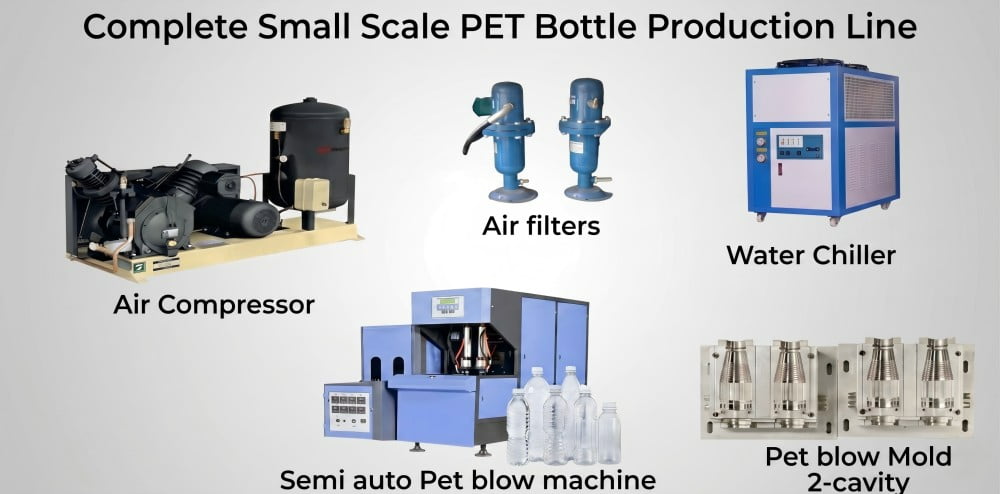
The core engineering value of a turnkey solution lies in its simplified deployment. The systems we engineer not only include the primary stretch blow molding machines but also integrate all necessary auxiliary equipment. Assuming the facility possesses standard industrial power, water access, and concrete flooring, a turnkey system can be installed, calibrated, and produce the first batch of commercial-grade bottles within 24 hours. This modular approach significantly mitigates the psychological and financial barriers to entering the packaging industry.
2. The Smart Strategy for Startups: Outsource Preforms, Focus on Blowing
The most intelligent strategy for startup facilities is to bypass expensive injection molding equipment and procure ready-made PET preforms directly from the market. This decoupled model reduces initial capital expenditure by approximately 60% and eliminates the technical risks associated with maintaining complex hot-runner injection molds.
When consulting with new investors, I strictly advise against attempting to manufacture PET preforms during the initial startup phase. The injection molding process requires high-pressure hydraulic machinery, precise hot-runner molds, and large-scale resin dehumidification systems. If the objective is simply to manufacture water bottles, the Capital Expenditure (CAPEX) for a preform injection system can be three to five times higher than that of the blow molding equipment. It also places a massive load on the facility's electrical infrastructure.
By purchasing standardized neck finish preforms (such as PCO 1881 for carbonated drinks or 29/25 for mineral water), a facility leverages the economies of scale from large preform manufacturers to reduce unit costs. The factory then focuses its mechanical efforts solely on the "blowing" phase. This strategy minimizes the requirement for specialized injection engineers and maintains a lean asset profile. When you are prepared to evaluate these supply chains, you must verify the manufacturer's capabilities; our criteria for spotting a trader vs. a real factory provides a strict framework for supplier auditing.
| Operational Metric | In-House Preform Injection | Outsourced Preform Procurement |
|---|---|---|
| Initial CAPEX | Exceptionally High (Injection machines, molds, dryers) | Very Low (Only blow molders and compressors) |
| Technical Requirement | High (Requires dedicated polymer injection engineers) | Low (Standard machine operators) |
| Electrical Load | Massive (Often requires transformer upgrades) | Moderate (Standard industrial power) |
| Production Flexibility | Must manage raw resin, colorants, and drying times | Rapidly switch preform weights and colors via suppliers |
| Core Equipment Risk | Hot-runner maintenance, long mold changeover times | Reliant strictly on supplier delivery schedules |
3. The 2000 BPH Golden Setup: Your First Commercial Production Line
The 2000 Bottles Per Hour (BPH) golden setup consists of two semi-automatic blow molding machines and one high-performance infrared heater. This "2+1" configuration maximizes labor efficiency and equipment output by precisely synchronizing the heating cycle with the blowing cycle, making it a proven commercial standard.
Why is 2000 BPH considered the golden standard for small-scale operations? The thermodynamics of PET processing dictate that the infrared heating of the preform requires significantly more time than the pneumatic blowing phase. If a factory pairs one heater exclusively with one blow molding machine, the blowing unit experiences excessive idle time waiting for the preforms to reach the required glass transition temperature (approximately 75-85°C). This results in wasted mechanical capacity and decreased electrical efficiency.
In the standardized "2+1" configuration:
- Centralized Heating: Two operators share a single, continuous-track infrared (IR) heating oven.
- Asynchronous Operation: The first operator extracts a thermally conditioned preform and loads it into the first blow molding machine. Simultaneously, the second operator executes the same process for the second blow molding machine.
- Efficiency Optimization: The continuous rotation of the IR oven ensures a constant supply of properly heated preforms to both machines without interruption.
This configuration provides highly stable output and introduces mechanical redundancy. If one blow molding machine requires a mold changeover or routine maintenance, the second machine continues to operate, ensuring the facility does not experience a total production halt.
4. The Ultra-Small Starter Kit: Testing the Waters (The 1+1 Setup)
For clients with strict budget constraints testing local markets, the micro "1+1" setup—comprising one blow molding machine and one heater—is the ideal entry point. This highly scalable configuration allows investors to seamlessly upgrade to higher capacities by adding another blowing unit as order volumes increase.
Many clients do not require an immediate 2000 BPH output. For those operating under strict capital limitations, the "1+1" equipment profile represents a low-risk commercial testing strategy. The spatial footprint for this machinery is exceptionally small, requiring less than 20 square meters of factory floor space.
Although the output capacity is reduced (averaging 800-1000 BPH depending on operator speed and bottle volume), the system executes the exact same core physical processes as large-scale industrial equipment: precise infrared heating, mechanical longitudinal stretching, and high-pressure transverse blowing. Therefore, the structural integrity and optical clarity of the finished bottles are identical to those produced in massive facilities. Furthermore, the blow molds used in the 1+1 system are fully compatible with the 2+1 configuration. When specifying these molds, adherence to precise platen dimensions is critical. Engineers should review our documentation regarding why custom blow molds fail to fit the blowing machine to prevent installation failures.
5. Essential Auxiliary Equipment: What Else Do You Need?
A complete turnkey solution must include high and low-pressure air compressors, air tanks, filtration systems, and an industrial chiller. These auxiliary units are mandatory, providing the pneumatic power for bottle expansion and the chilled water required to stabilize mold temperatures and lock in polymer geometry.
Unprofessional machinery suppliers frequently quote only the main blow molding machine and the IR heater. Upon delivery, the client discovers production is impossible without the necessary supporting infrastructure. In the PET stretch blow molding process, the technical specifications of the auxiliary equipment directly dictate the quality of the final container.
- High-Pressure Air Compressor (30-40 bar): This is the mechanical lifeline of the process. Without sufficient air pressure and volumetric flow, the PET material will not be forced completely into the intricate details of the mold cavity, leading to unformed base corners and uneven wall thickness.
- Industrial Chiller System: The heated PET polymer must be instantly cooled upon contacting the mold surface to lock its molecular structure. If the mold temperature exceeds operational parameters, the ejected bottle will suffer from volumetric shrinkage and severe dimensional deformation. A standard turnkey setup incorporates a 3HP to 5HP chiller to maintain a continuous chilled water supply (8-15°C) flowing through the mold's internal channels.
- Air Filtration Systems: The high-pressure air injected directly into the bottle must be strictly free of oil, moisture, and particulate matter. Contaminated air will leave residues inside the container, violating food safety standards and destroying the product.
| Auxiliary Unit | Core Engineering Function | Recommended Spec (Small Scale Line) |
|---|---|---|
| High-Pressure Compressor | Provides expansion force for the PET matrix | 3.0 Mpa (30 bar) / 1.0-1.2 m³/min |
| Air Receiver Tank | Stabilizes pneumatic pressure, absorbs pulsation | 0.6 m³ Capacity |
| Industrial Chiller | Removes latent heat from molds to prevent shrinkage | 3HP or 5HP (Air or Water cooled) |
| Precision Air Filters | Extracts oil aerosols and moisture from blowing air | 3-Stage Microfiltration |
6. High Flexibility: Produce Up to 3L Water and Beverage Bottles
Semi-automatic blow molding equipment features exceptional tooling flexibility, requiring only 30 to 45 minutes for a complete mold changeover. This turnkey system produces standard 500ml bottles and can be rapidly reconfigured to blow large-capacity 3-liter water or beverage containers, maximizing order acceptance capability.
For a small-scale manufacturing facility, operational survival depends on order flexibility. While fully automated, high-speed rotary machines are incredibly fast, executing a complete mold changeover on them can require 4 to 8 hours of downtime. This renders them highly inefficient for processing small-batch, diverse production runs.
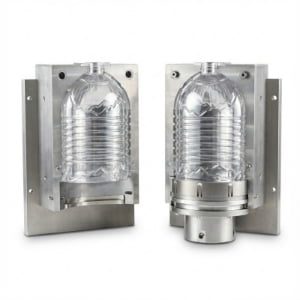
Semi-automatic blow molding machines feature an open mechanical architecture that simplifies mold extraction and installation. An operator can process an order for 330ml custom-branded water bottles during the morning shift, perform a rapid mold changeover, and manufacture 1.5L or 3L large-capacity edible oil or juice containers in the afternoon. This versatility ensures the machinery does not sit idle. When selecting tooling for these diverse runs, evaluating the thermal conductivity of the mold material is required; we detail this engineering analysis in our article on why most PET blow molds are manufactured from aluminum.
7. Easy Operation: No Experienced Engineers Needed
Small-scale semi-automatic setups are engineered to minimize operational complexity, eliminating the requirement for highly paid automation engineers. Utilizing intuitive PLC interfaces and straightforward mechanical designs, standard factory workers can master the complete heating and blowing workflow after a few hours of training.
High levels of machinery automation inherently correlate with high maintenance complexity. In many emerging markets, locating an electromechanical engineer proficient in diagnosing software faults on a continuous rotary blow molder is both exceptionally difficult and cost-prohibitive.
Our turnkey solutions utilize a mechanically modular and simplified design philosophy:
- Streamlined Workflow: The operator's physical responsibilities are reduced to loading the heated preform and extracting the finished bottle.
- Visualized Parameters: Heating zone temperatures and pneumatic blowing durations are displayed on digital PLC interfaces, allowing for rapid, straightforward adjustments without entering complex code.
- Low Maintenance Load: The primary kinetic movements utilize standard pneumatic cylinders rather than complex servo-driven kinematics. In the event of component wear, replacing a cylinder seal or a pneumatic valve is a simple process that requires minimal technical background, keeping the Operating Expenses (OPEX) strictly controlled.
8. Fast ROI: Why Semi-Automatic Solutions Win for Small Scale
Compared to the extended payback periods of fully automated lines, small semi-automatic setups offer a vastly superior Return on Investment (ROI). Due to minimized capital expenditure, controlled energy consumption, and low facility requirements, investors can recover equipment costs rapidly by securing localized manufacturing orders.
To evaluate the commercial viability, we must analyze the financial modeling of the equipment.
If a fully automated linear machine requires a capital expenditure of $150,000 USD, a comprehensive semi-automatic turnkey solution (the 2+1 configuration) typically requires less than one-tenth of that investment. Assuming the profit margin per bottle remains relatively constant in the local market, the financial pressure to service the equipment debt on the semi-automatic line is practically nonexistent.
| Financial Metric | Fully Automated Line | Semi-Automatic Turnkey Setup |
|---|---|---|
| Initial Capital Investment | Very High | Extremely Low |
| Facility Lease Requirements | High (Requires large industrial space) | Low (Can operate in light-industrial garages) |
| Downtime Financial Impact | Severe | Minimal |
| Estimated ROI Timeframe | 24 to 36+ Months | 4 to 8 Months (Depends on order volume) |
The semi-automatic solution provides superior risk mitigation. Even if market demand fluctuates, the low depreciation rate of the asset ensures the facility remains solvent.
FAQ
Q1: Do I need to buy an injection molding machine to make PET preforms?
A: No. For small-scale production, the most cost-effective and easiest way is to buy ready-made PET preforms from the market. You only need our turnkey blow molding line to blow them into final bottles, saving you huge investment and technical learning time.
Q2: What is the maximum bottle capacity this production line can make?
A: Our semi-automatic blow molding setup is highly versatile and can stably produce PET water and beverage bottles ranging from small 100ml volumes all the way up to 3 Liters.
Q3: Is the semi-automatic machine hard to operate for beginners without experience?
A: Not at all. The turnkey solution is designed for easy entry. With simple installation and just a few hours of basic training, any standard factory worker can easily master the operation of the heater and blowing machine.
Q4: What auxiliary equipment is included in this turnkey solution?
A: Besides the blow molding machine and infrared heater, the complete line includes all necessary support units: a high-pressure air compressor system (to provide expansion air) and an industrial chiller (to cool the molds and ensure bottle geometry). You can start production once connected to power and air.
Q5: How long does it take to change a bottle mold if I have different orders?
A: Mold changing on our semi-automatic machines is very straightforward due to the open mechanical architecture. It usually takes only about 30 to 45 minutes to switch to a new bottle design, giving you maximum flexibility to handle various localized orders.
If you are planning to establish your first PET bottle production line, or require a customized machinery configuration based on your specific capital and facility constraints, contact our engineering team at petmolder.com. We provide objective, data-driven manufacturing solutions based on 20 years of factory operations in Guangdong, China.
Related Articles:
- What is PET Two-Stage Molding? The Ultimate Beginner's Guide to the Factory Process
- The Ultimate Guide to Preform Neck Finishes: How to Choose the Right Standard
- Looking for a Preform Mould Maker in China? 5 Ways to Spot a Trader vs. a Real Factory
- Custom Blow Molds: 4 Reasons Your New Mold Won't Fit Your Blowing Machine
- Why are Most PET Blow Molds Made of Aluminum? 4 Engineering Reasons Explained