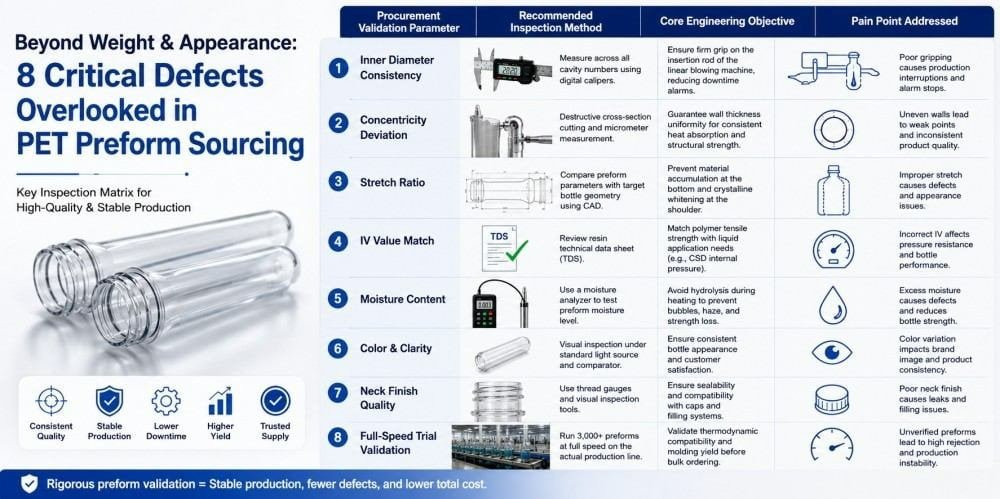
How do you successfully procure PET preforms and avoid production halts? Securing reliable PET preforms requires verifying inner diameter consistency for machine handling, executing destructive concentricity tests to ensure uniform wall thickness, matching Intrinsic Viscosity (IV) values to the liquid application, and conducting full-speed trial runs before mass production.
Yesterday, a client from Denmark contacted me regarding a severe mechanical stall on their blowing line. They had procured a new batch of preforms, which resulted in continuous machine alarms, material waste, and prolonged production downtime. Upon reviewing their procurement process, it became evident they bypassed critical mechanical verifications. They assumed that if the theoretical weight and external neck thread matched, the preform was ready for production. This is an engineering fallacy.
Sourcing PET preforms requires a precise match of thermodynamic and mechanical properties. Preforms that appear visually acceptable can easily fail during the high-speed stretching phase, leading to issues such as localized wall thinning, base rupture, or even mechanical jams in the blow molding machine. Over my nearly 20 years in the PET mold industry, I have observed that overseas buyers often share the same fundamental misconceptions. Today, together with my technical team, I will provide an in-depth analysis of eight key parameters; verifying these parameters is essential to ensuring that your sourced preforms are perfectly compatible with your blow molding equipment.
1. What is Preform Inner Diameter Consistency and Why it Causes Blowing Machine Alarms?
Preform inner diameter consistency refers to the precise uniformity of the preform’s internal opening. Linear bottle blowing machines utilize mandrels that insert into this diameter for heating and transport. If dimensional tolerance fluctuates across multi-cavity molds, the mandrels fail to grip the preforms, triggering continuous mechanical alarms and downtime.
Many procurement managers focus entirely on the external neck finish (the threads) and ignore the internal geometry. For factories utilizing a linear bottle blowing machine, the inner diameter is arguably the most critical mechanical interface. The machine transports the preforms through the infrared heating oven using steel or aluminum mandrels (plugs) that insert directly into the preform’s opening.
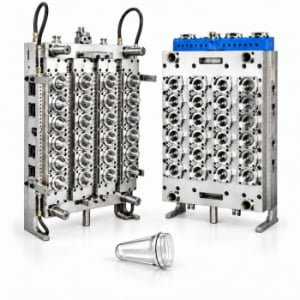
If you purchase preforms manufactured from a 48-cavity or 72-cavity injection mold, the internal core pins of that mold experience wear over millions of cycles. If core pin #14 is heavily worn, the preforms produced in cavity #14 will possess a slightly larger inner diameter. When this specific preform reaches your blowing machine, the mandrel will fail to secure it. The preform will either wobble during rotation (causing uneven heating) or fall off the rail entirely, triggering a machine alarm and halting the production line.
To mitigate this, do not accept bulk deliveries based on a single sample. You must require the supplier to provide 48 physical samples—one from each specific cavity, labeled 1 through 48. Your engineering team must measure the inner diameter of every sample using a digital vernier caliper, ensuring the dimensional tolerance across all cavities remains strictly within $\pm 0.05\text{ mm}$. For an understanding of how to audit multi-cavity tooling, refer to our PET preform mold FAT checklist.
2. How to Test Preform Concentricity Accurately
Testing preform concentricity accurately requires a destructive physical audit. Buyers must cut the preform transversely and measure the wall thickness on opposite sides using a micrometer. High eccentricity causes uneven thermal absorption, resulting in blown bottles with asymmetrical wall thickness and compromised structural top-load resistance.
Visual inspection is an invalid method for assessing preform quality. You cannot determine concentricity (the alignment of the inner core relative to the outer cavity) by looking at the plastic against a light source. If a preform is eccentric—meaning one side of the wall is $2.8\text{ mm}$ thick while the opposite side is $2.2\text{ mm}$ thick—it will react poorly during the blow molding process.
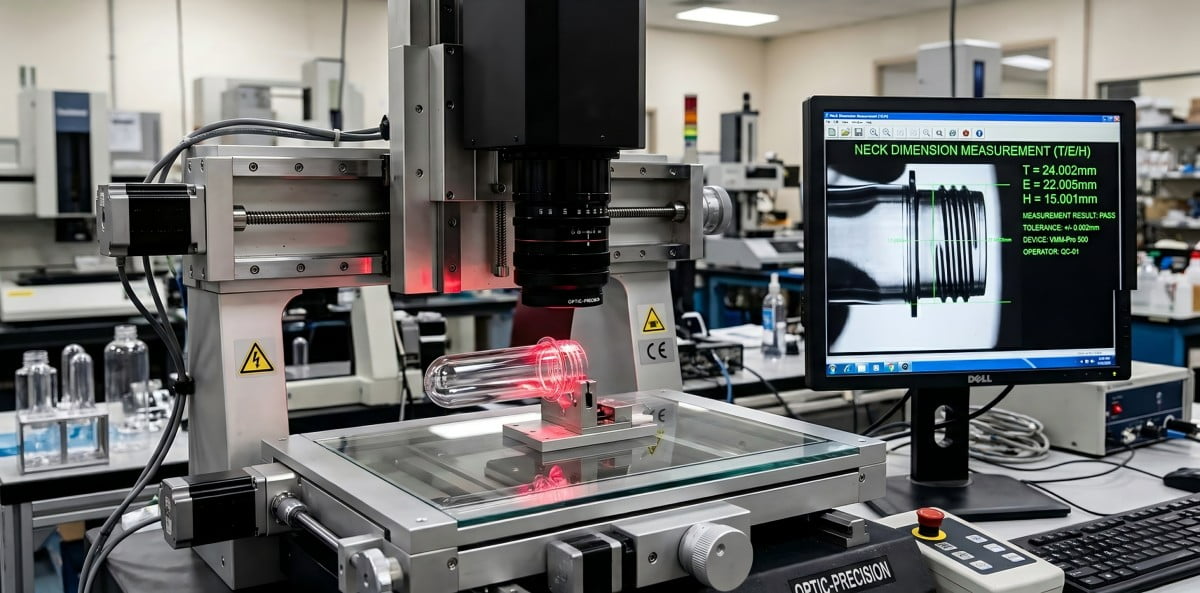
Visual inspections of the neck finish are necessary, but destructive testing is mandatory to measure the true concentricity of the preform body before mass production.
During the heating phase, the thinner side of the eccentric preform will absorb infrared radiation faster and become hotter than the thicker side. When high-pressure air is introduced, the hotter, softer side will stretch rapidly, resulting in a blown bottle with one extremely thin, structurally weak side panel.
To test this accurately, instruct your quality control department to execute destructive testing. Use a fine-tooth saw to cut the preform transversely near the middle of the body. Use a micrometer to measure the wall thickness at four opposing points along the cross-section. The variance between the maximum and minimum thickness should not exceed $0.1\text{ mm}$. If the concentricity deviation is high, the injection mold possesses severe core shift issues, and you should reject the batch.
3. Preform Stretch Ratio vs. Preform Weight: The Hidden Compatibility Trap
Preform weight alone does not dictate bottle quality; the stretch ratio is equally critical. The axial and radial stretch ratios must match the final blow mold geometry. Incorrect ratios lead to excessive base thickness, localized polymer crystallization on the shoulder, and uneven mechanical stress distribution in the container.
A common procurement error is purchasing a preform based solely on its weight. A buyer might assume, "I need a 16-gram preform for a 500ml bottle," and proceed to purchase the cheapest 16g option available. This ignores the physics of bi-axial orientation.
The relationship between the preform’s original dimensions and the final bottle’s dimensions is defined by the stretch ratio.
- Axial Stretch Ratio: The final bottle length divided by the preform length (below the neck ring).
- Radial Stretch Ratio: The maximum bottle diameter divided by the internal preform diameter.
If you purchase a short, wide 16g preform for a tall, slender 500ml bottle design, the axial stretch ratio will be excessive. The stretch rod will push the polymer past its natural elasticity limit, causing the material to thin out dangerously at the base, while the shoulder area may crystallize (turn white) due to insufficient stretching. To ensure mechanical compatibility, you must evaluate the preform dimensions against your specific blow mold schematics. For further details on base integrity, review our guide on preventing bottle stress cracking via base geometry.
4. Case Study: Why You Must Execute a Pre-Production Trial Run
Executing a pre-production trial run mitigates the financial risk of incompatible bulk orders. Buyers must request 3,000 to 5,000 sample preforms and process them on their actual linear bottle blowing machine at full speed. This validates the preform’s thermal behavior and mechanical handling before authorizing mass production.
The Danish client mentioned earlier experienced a severe operational halt because they skipped the trial run phase. They approved a digital drawing, checked five physical samples with a caliper, and immediately ordered a 40-foot container of preforms. When the bulk order arrived, they discovered that the preforms required a substantially different heating profile than their previous supplier’s stock.
Theoretical calculations cannot fully simulate the thermodynamic reality of your specific linear bottle blowing machine. The ambient factory temperature, the age of your infrared lamps, and the chilling capacity of your mold water all interact with the preform’s polymer chain.
Before signing off on a bulk order, mandate that the supplier ships a test batch of 3,000 to 5,000 preforms. Run this batch through your blowing machine at standard production speeds. This trial run reveals hidden variables: Does the preform gate align smoothly with the mold base? Does the neck ring transfer easily along your air conveyors? If the defect rate remains below your acceptable threshold during this full-speed trial, you can safely authorize the mass production run.
5. What is the PET IV Value (Intrinsic Viscosity) Standard for Different Applications?
The PET Intrinsic Viscosity (IV) value dictates the polymer’s mechanical strength and thermal stability. Standard water bottles require an IV of 0.78-0.80, while Carbonated Soft Drinks (CSD) demand an IV of 0.82-0.84 to withstand internal pressure. Selecting an incorrect IV value causes bottle deformation during logistics.
PET is not a uniform material; its mechanical properties are heavily defined by its Intrinsic Viscosity (IV). The IV value measures the polymer’s molecular weight and chain length, which directly correlates to the physical strength and thermal resistance of the final blown bottle.
If you are packaging still mineral water, a standard IV resin (0.78 to 0.80) provides adequate top-load strength for pallet stacking. However, if you are packaging a Carbonated Soft Drink (CSD), the internal pressure from the carbon dioxide exerts severe outward stress on the bottle walls. Utilizing a 0.78 IV preform for a CSD application will cause the bottle base to invert (bulge outward) and the sidewalls to expand, leading to catastrophic failure on the retail shelf. For hot-fill applications (like juices filled at $85^\circ\text{C}$), the resin requires an even more specialized structural matrix to prevent vacuum collapse.
| Beverage Application | Required IV Value Range | Mechanical Property Focus |
|---|---|---|
| Still Water | 0.78 – 0.80 | Standard clarity, moderate top-load resistance. |
| Carbonated Soft Drinks | 0.82 – 0.84 | High tensile strength to resist internal gas pressure. |
| Edible Oil | 0.80 – 0.82 | High impact resistance for heavy volumetric weights. |
| Hot-Fill Juice | 0.80+ (Specialized Resin) | Thermal stability to resist deformation during hot filling. |
6. Common Problems of PET Preform Gates and AA Value Control
Common problems in preform injection include excessive gate length and elevated Acetaldehyde (AA) values. A protruding gate interferes with the blow mold base mechanism, causing mechanical jamming. Poor injection temperature control elevates AA values, which migrates into the liquid and imparts a distinct plastic taste.
The injection point at the bottom center of the preform—known as the gate—is a critical indicator of injection molding quality. If the supplier’s valve pin timing is poorly calibrated or if they utilize outdated hot runner technology, the preform will feature a long, protruding gate (stringing).
When a preform with a long gate enters the blow mold, the stretch rod pushes this protrusion directly into the base insert. The excess plastic can be crushed, pushed off-center, or cause the stretch rod to deflect, leading to severe base eccentricity and structural weakness.
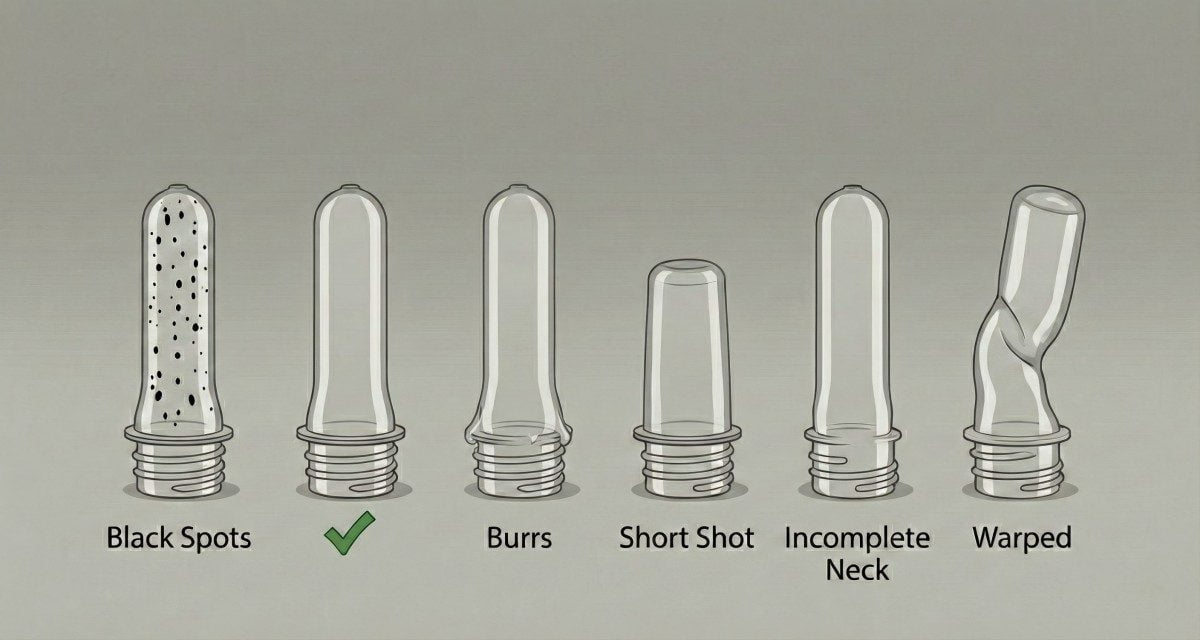
Excessive gate length on a preform directly disrupts the stretch rod alignment during blow molding, leading to base eccentricity and mechanical failure.
Simultaneously, the injection temperature must be strictly controlled to limit the generation of Acetaldehyde (AA). AA is a natural byproduct of melting PET resin. If the injection temperature is too high, or the residence time in the barrel is too long, the AA levels spike. While AA is not inherently toxic at these levels, it has a distinct, sweet plastic odor. If high-AA preforms are used for mild-tasting liquids like pure mineral water, the chemical migrates into the fluid, altering the taste profile and resulting in consumer rejection.
7. Cost of Cosmetic Preform Packaging: Bulk Packaging vs. Individual Isolation
The cost of cosmetic preform packaging is higher due to the mandatory requirement for individual isolation. High-end PET preforms are highly susceptible to friction. Storing them in bulk sacks causes micro-scratches that amplify during blow molding. Premium preforms require individual film sleeves or netting to prevent physical abrasion.
When procuring preforms for standard mineral water, packaging them in bulk corrugated octabins or woven sacks with internal poly-liners is standard industrial practice. The minor scuffing that occurs during transport is usually masked by the water and the label.
However, if you are procuring preforms for high-value personal care products, cosmetics, or premium spirits, bulk packaging is a critical error. PET is a relatively soft polymer, and the external surface of the preform is easily scratched when thousands of units rub against each other during ocean freight vibration. When the preform is heated and stretched in the blowing machine, a microscopic scratch on the preform expands into a highly visible, cloudy streak on the final bottle, ruining the premium optical clarity.
For high-end applications, you must mandate that the supplier utilizes individual isolation packaging. Each preform must be inserted into a separate protective film sleeve or foam netting, and then arranged neatly in grid-partitioned cartons. While this increases the per-unit packaging cost and container loading volume, it is the only method to ensure zero-defect optical clarity on the retail shelf. To understand the complexities of cosmetic packaging components, refer to our guide on the cosmetic packaging trap regarding pump compatibility.
Preform Packaging Cost & Risk Matrix
| Packaging Method | Cost Impact | Transportation Risk | Best Application |
|---|---|---|---|
| Bulk Octabin / Sacks | Baseline (Lowest Cost) | High friction; micro-scratches likely. | Standard water, budget CSD bottles. |
| Grid-Partitioned Cartons | Moderate Increase | Minimal contact; prevents heavy abrasion. | Mid-tier juices, edible oils. |
| Individual Sleeves / Netting | High (Labor & Material) | Zero contact; preserves optical purity. | High-end cosmetics, premium spirits. |
8. How to Manage Cross-Border Shipping Humidity for PET Preforms
Managing cross-border shipping humidity requires utilizing aluminum foil moisture-barrier bags within the preform cartons. PET is a hygroscopic polymer. If preforms absorb moisture during sea freight, the absorbed water vaporizes during infrared heating, causing micro-bubbles and structural whitening in the blown bottle.
PET is hygroscopic, meaning it naturally absorbs moisture from the surrounding environment. When shipping preforms across international waters, the cargo is subjected to extreme temperature fluctuations and high humidity inside the shipping container.
If the preforms are packed in standard, unsealed plastic bags, they will absorb atmospheric moisture over a 30-to-40-day transit period. When these moisture-laden preforms enter the infrared oven of your blowing machine, the internal temperature of the plastic rapidly exceeds $100^\circ\text{C}$. The absorbed moisture instantly vaporizes, creating microscopic steam bubbles within the polymer wall. This manifests as severe whitening (haziness) and structural brittleness in the final bottle.
To prevent this, strictly mandate that your supplier utilizes heavy-duty aluminum foil moisture-barrier bags, vacuum-sealed with desiccant packs inside every carton. Furthermore, adhere to a strict First-In-First-Out (FIFO) inventory system. Preforms possess a finite shelf life; depending on storage conditions, they should be processed within 6 to 12 months to avoid moisture degradation and dimensional settling. For troubleshooting hazy defects, see our protocol on repairing localized whitening on the neck.
Frequently Asked Questions (FAQs)
Q1: Why does my linear bottle blowing machine frequently trigger alarms or fail to grip the preforms recently?
The highly probable cause is inconsistent preform inner diameters. Evaluate if this specific batch of preforms was produced from a multi-cavity injection mold (e.g., 48 or 72 cavities). If the core pins for specific cavity numbers are heavily worn, the resulting preforms will have internal diameters that deviate beyond the mechanical tolerance of your machine’s heating mandrels, causing grip failure and alarms.
Q2: How can I quickly identify severe concentricity issues on the workshop floor?
The most accurate method is to cut the preform transversely with a saw and use a micrometer to compare the maximum and minimum wall thickness of the cross-section. Without tools, observe the blown bottles as they exit the machine; if the bottles exhibit a distinct "hard on one side, soft on the other" structural variance or lean to one axis, it indicates uneven thermal absorption caused by preform eccentricity.
Q3: What are the consequences of shipping high-quality cosmetic preforms in bulk packaging?
Shipping in bulk causes the preforms to collide constantly during transit, leaving microscopic scratches on the external surface. When the preform is biaxially stretched in the blowing machine, these tiny scratches are magnified exponentially, forming highly visible optical defects and hazy streaks on the final bottle. High-end cosmetic clients will reject these containers, necessitating individual protective film packaging.
Q4: Can I bypass the pre-production sample test and place a bulk order based entirely on digital drawings?
Do not bypass physical testing. Theoretical CAD data cannot fully simulate the actual thermal absorption efficiency and stretching dynamics within your specific blowing machine environment. You must require the supplier to send a test batch to run through a full production cycle on your equipment to verify the yield rate before authorizing mass production.
Q5: Why are some preforms of the exact same weight priced significantly lower than others?
Price discrepancies frequently mask hidden technical deficiencies. A lower price often indicates the use of high-percentage recycled PET (rPET) without transparency, poor concentricity due to degraded injection tooling, a lack of individual cavity dimensional inspection, or substandard packaging without moisture barriers. These hidden costs will inevitably manifest as high scrap rates on your blow molding line.
Summary: The PET Preform Procurement Checklist
| Verification Parameter | Inspection Method | Engineering Goal |
|---|---|---|
| Inner Diameter | Digital caliper across all cavity numbers. | Ensure secure grip by linear blowing machine mandrels. |
| Concentricity | Destructive cross-section cutting and micrometer check. | Guarantee uniform wall thickness and even thermal absorption. |
| Stretch Ratio | CAD comparison against target bottle geometry. | Prevent base accumulation and shoulder crystallization. |
| IV Value | Resin data sheet verification. | Match polymer tensile strength to the liquid application (e.g., CSD). |
| Trial Run | Full-speed processing of 3,000+ samples. | Validate thermodynamic compatibility before bulk ordering. |
Related Technical Guides:
- From Concept to Production: What Are the 8 Steps to Custom PET Bottle Molds?
- Why Are Stubborn PET Bottle Defects Draining Your Blowing Line Profits?
- The Ultimate Guide to Preform Neck Finishes: How to Choose the Right Standard for Your Bottle
- PET Bottle Lightweighting: A 7-Step Engineering Guide to Reducing Weight Safely
- Looking for a Preform Mould Maker in China? 5 Ways to Spot a Trader vs. a Real Factory