PET preform concentricity dictates the final bottle quality. When blow molding defects occur, overseas buyers often suspect the blow mold or blowing machine. This is an incorrect sequence. The first step is always to verify preform concentricity. If the preform wall thickness is uneven, no blow mold adjustment can salvage the production run.
What is PET Preform Concentricity?
PET preform concentricity refers to the absolute uniformity of wall thickness across the preform’s cross-section. In high-cavitation systems, maintaining this geometric alignment is mandatory. A minor dimensional tolerance deviation compromises the stretch ratio, leading directly to structural weaknesses and mechanical failures during the downstream stretch blow molding process.
In the field of PET injection molding, concentricity is the quantifiable measurement of how perfectly centered the inner core is relative to the outer cavity. When manufacturing a 32-cavity preform mold, the expectation is that every single preform ejected from the machine shares identical geometric parameters. If the wall thickness on one side of the preform measures $2.50\text{ mm}$ and the opposite side measures $2.60\text{ mm}$, the concentricity is compromised by $0.1\text{ mm}$.
Do not dismiss a $0.1\text{ mm}$ deviation as acceptable tolerance. In my workshop, I constantly remind engineers and overseas buyers that PET acts as an amplifier during the biaxial stretching phase. A microscopic variance in the preform wall will multiply exponentially when blown into a 500ml or 1-liter bottle. This thickness disparity shifts the center of gravity of the bottle, reduces the top-load capacity, and disrupts the overall material distribution. High concentricity requires rigorous mechanical alignment, ensuring that the dimensional tolerance between the core and cavity remains strictly within $\pm 0.02\text{ mm}$ under static and dynamic loading. If you are experiencing unexplained blow molding issues, you must first inspect the preform concentricity before auditing your blow molding equipment.
Core Shift: The Root Cause of Uneven Wall Thickness
Core shift occurs when high injection pressures deflect the mold core laterally. This micron-level displacement is the primary mechanical cause of uneven wall thickness in PET preforms. If the mold lacks adequate rigidity and precise interlock mechanisms, the pressurized PET melt will force the core out of alignment.
During the injection phase, PET melt enters the cavity at extreme velocities and pressures, often exceeding $100\text{ MPa}$. The mold core functions mechanically as a cantilever beam supported at one end. If there is a slight imbalance in the melt flow or if the mold components possess micron-level machining flaws, the physical force exerted by the plastic will bend the core. We refer to this physical phenomenon as "core shift."
Stop assuming that high injection pressure alone guarantees a fully packed preform without consequences. When the core shifts, the gap between the core and cavity narrows on one side and widens on the other. The molten PET follows the path of least resistance, flowing faster into the wider gap and slower into the narrower gap. This exacerbates the pressure differential, locking the core into a deflected state as the plastic cools and solidifies. As detailed in our analysis on hidden PET preform mold defects, understanding the physics of core deflection is critical for evaluating mold longevity.
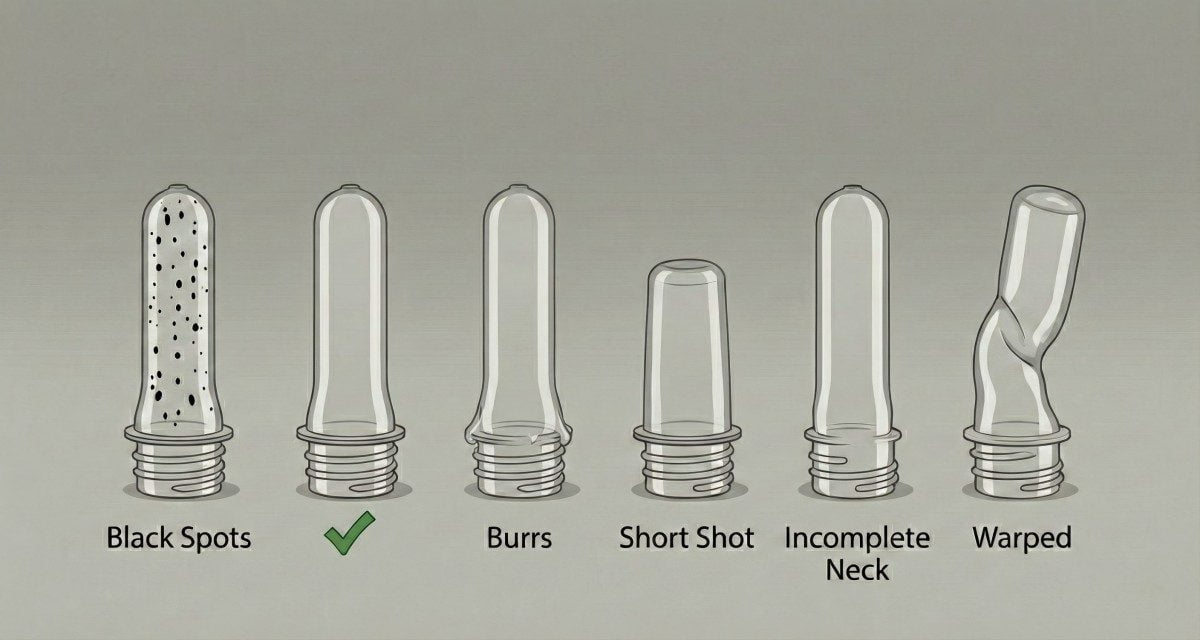
Below is an engineering breakdown of the factors contributing to core shift and their physical manifestations in the mold:
| Core Shift Variable | Mechanical Cause | Physical Result in Preform |
|---|---|---|
| Machining Tolerance | Cavity and core mismatch ($>0.03\text{ mm}$) | Static eccentricity prior to injection. |
| Injection Pressure | Melt pressure exceeding core rigidity limits | Dynamic deflection of the core tip during filling. |
| Interlock Wear | Degradation of taper lock surfaces | Loss of centering capability under clamping force. |
| Gate Alignment | Orifice off-center relative to the cavity tip | Asymmetrical melt wavefront pushing the core laterally. |
CNC Machining and Tolerances: Preventing Core Shift
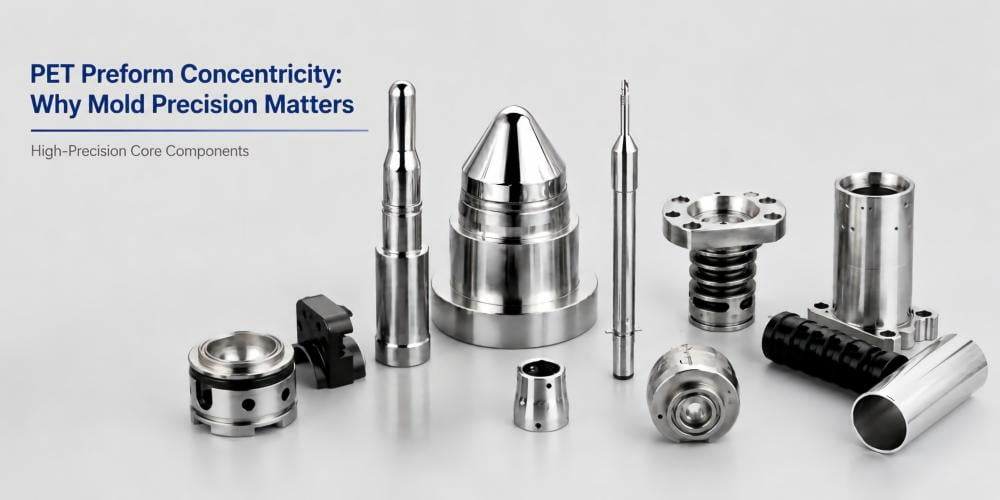
Preventing core shift requires uncompromising CNC machining capabilities and stringent dimensional tolerances. Utilizing 5-axis milling and precision grinding ensures that taper interlock designs achieve exact concentric alignment. The physical integrity of the mold relies entirely on the micron-level accuracy cut into the raw tool steel.
You cannot achieve high concentricity with standard milling equipment. In my 20 years of overseeing PET mold manufacturing, I have observed that the difference between a functional mold and a high-performance mold lies entirely in the machining tolerances. To prevent core shift in a multi-cavity system, the mold relies on a taper interlock design. This mechanical feature ensures that when the mold closes under tonnage, the core is guided and locked rigidly into the exact center of the cavity.
If the taper angles deviate by even a fraction of a degree, the interlock fails to engage uniformly. The steel components will experience premature wear, leading to clearance gaps. We utilize S136 stainless steel hardened to 48-52 HRC, machined to tolerances of $\pm 0.01\text{ mm}$ or tighter. CMM (Coordinate Measuring Machine) verification is mandatory for every single core, cavity, and neck ring insert before assembly. Do not accept tooling where the manufacturer cannot provide dimensional inspection reports. The rigidity required to withstand millions of injection cycles is established on the CNC machine bed, not through manual adjustments on the assembly bench.
Hot Runner Precision: Ensuring Balanced Material Flow
A precision hot runner system ensures rheological balance, delivering PET melt to all cavities at identical pressures and temperatures. Imbalances in the manifold cause asymmetrical filling patterns. If the melt flow is uneven, dynamic pressure differentials will force the core off-center, destroying preform concentricity.
Even if the steel is machined to exact tolerances, the mold will still produce eccentric preforms if the hot runner system is improperly balanced. In a 32-cavity preform mold, the molten PET must travel from the machine nozzle through a complex network of channels to reach each individual gate simultaneously. We evaluate this through the lens of rheology and fluid dynamics.
When the hot runner manifold lacks thermal uniformity or geometric balance, the melt viscosity varies across the system. Warmer melt flows with less resistance than cooler melt. Consequently, cavities receiving higher-temperature material will fill faster. Within a single cavity, if the melt enters asymmetrically, the uneven pressure distribution creates a lateral load on the core pin.
| Hot Runner Parameter | Impact of Imbalance | Threat to Concentricity |
|---|---|---|
| Temperature Profile | Viscosity variations ($\Delta T > 2^\circ\text{C}$) | Uneven filling speeds inducing lateral core pressure. |
| Manifold Geometry | Unequal shear heating rates | Differential pressure drops across flow paths. |
| Valve Pin Timing | Asynchronous gate opening | Premature pressure spikes in specific cavities. |
| Nozzle Heat Control | Localized cold spots at the gate | Deflection of the melt front upon entering the cavity. |
Precision Cooling Channels: Locking in Concentricity
Precision cooling channels dictate the volumetric shrinkage of the PET preform. If the cooling layout is asymmetrical or inefficient, thermal gradients will cause localized shrinkage variations. This uneven thermal contraction induces internal stress and warpage, pulling the preform out of concentric alignment during solidification.
Cooling accounts for over 70% of the injection molding cycle time, but its function extends far beyond productivity. Cooling is the mechanism that "locks in" the dimensions of the preform. When PET transitions from a molten state at $280^\circ\text{C}$ to a solid state, it undergoes volumetric shrinkage.
In our engineering reviews with overseas buyers, I emphasize that the cooling channels inside the core and cavity must provide uniform heat extraction. If one side of the cavity features a restricted water flow rate, that side of the preform will cool slower than the opposite side. The region that cools slower will experience higher shrinkage rates. This differential shrinkage induces severe internal stresses, causing the preform to warp immediately upon ejection. The physical manifestation is a loss of concentricity, even if the mold steel and hot runner performed as designed. Advanced molds utilize conformal cooling techniques, positioning the water channels at an equidistant offset from the molding surface to guarantee a homogeneous cooling rate across the entire preform geometry.
The Downstream Impact: How Concentricity Affects Blow Molding
Preform concentricity directly controls blow molding stability. Uneven wall thickness causes differential heat absorption in the infrared oven. During the stretch blow process, this thermal variance results in off-center gates, bottle rupture, localized material thinning, and the formation of pearlescence on the bottle surface.
Do not attempt to fix a concentricity issue by adjusting the blowing machine parameters. When an eccentric preform enters the stretch blow molding machine, the infrared heating oven exposes the rotating preform to intense radiation. The thicker side of the preform wall absorbs heat at a different rate than the thinner side. By the time the preform reaches the blow station, it possesses a severe thermal gradient.
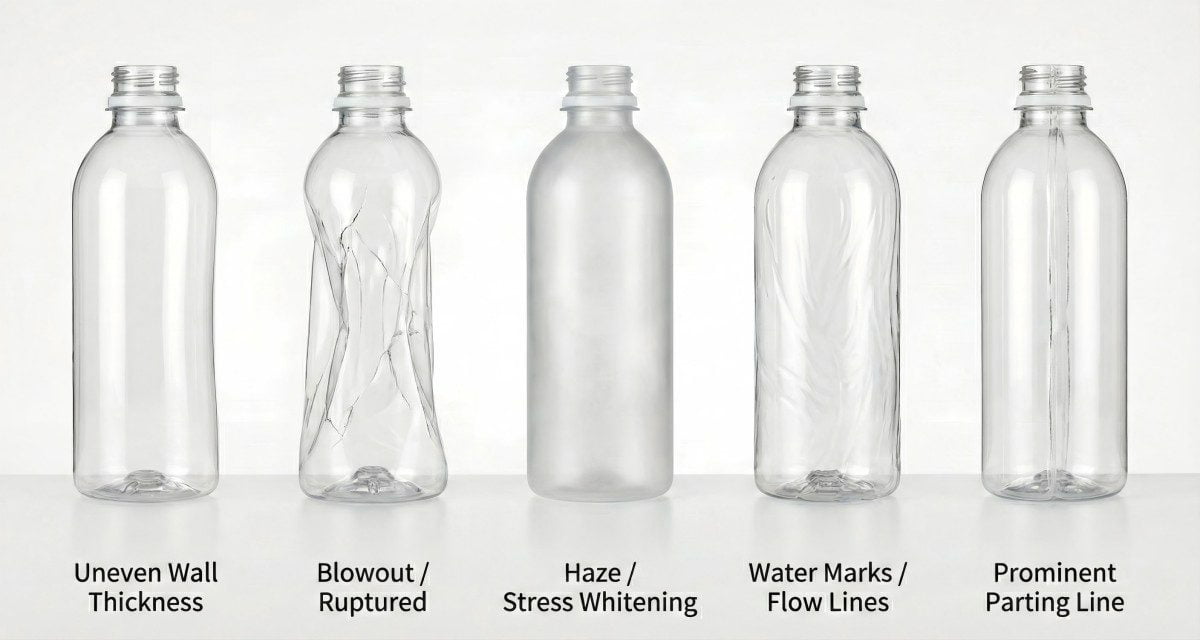
When the stretch rod extends and high-pressure air is introduced, the hotter, thinner section of the preform yields instantly, over-stretching before the thicker section begins to move. This physical cascade results in critical blow molding failures. The bottom gate will visually shift off-center, reducing the stability of the bottle base (a phenomenon we detail in our bottom gate off-center troubleshooting protocol). Furthermore, the over-stretched thin sections often exceed the natural stretch ratio of the PET material, resulting in structural rupture or micro-cracking visible as a white haze, which is comprehensively explained in our guide on PET bottle pearlescence.
Calculating the Cost of Poor Mold Precision
Poor mold precision generates compounding financial losses through elevated scrap rates, continuous machine downtime, and wasted PET resin. Calculating the Return on Investment (ROI) reveals that purchasing low-cost, low-precision tooling severely diminishes operational profitability over the lifecycle of the injection molding cell.
I frequently hear from factory owners who attempt to reduce initial capital expenditure by purchasing cheaper molds with relaxed tolerances. This is a fundamentally flawed procurement strategy. The initial cost of the mold represents a fraction of the total operational cost. When you operate a 32-cavity mold running at a 12-second cycle time, a mere 3% increase in scrap rate due to concentricity failures equates to massive raw material waste.
To understand the economic impact, we must look at the data. Let us analyze the hidden costs associated with precision failures. If a mold consistently produces eccentric preforms, the downstream blowing line experiences frequent jams and bottle blow-outs.
| Cost Factor | Low-Precision Mold Impact | High-Precision Mold Benefit |
|---|---|---|
| Resin Waste | 3-5% increase due to rejected preforms/bottles | Scrap rate maintained below 0.5%. |
| Machine Downtime | Frequent stops for blow molding parameter tuning | Stable, continuous operation at maximum speed. |
| Mold Maintenance | Rapid wear on interlocks requiring replacement | Extended lifecycle due to precise component alignment. |
| Quality Control | High labor cost for sorting defective outputs | Automated sorting with high confidence in yield. |
For a deeper financial breakdown on mold acquisition, refer to our comprehensive analysis on PET blow mold costs.
Partnering with a Proven Preform Mold Expert
Partnering with a proven manufacturer requires verifying their internal machining infrastructure and metrology capabilities. Ensure the supplier utilizes multi-axis CNC centers and CMM inspection for every component. Verify their industry tenure and technical transparency to avoid traders posing as direct manufacturing facilities.
In international trade, separating legitimate engineering facilities from trading companies is a necessary step for securing your production line. Do not rely solely on digital catalogs. A genuine mold manufacturer will provide dimensional inspection reports, steel certificates, and detailed hot runner schematics. With 20 years of experience in Guangdong's tooling sector, I advise overseas buyers to demand transparency regarding the factory's CMM equipment and quality control protocols.
If you are evaluating suppliers, utilize our checklist on how to spot a trader vs. a real factory. High concentricity cannot be guaranteed by verbal promises; it is strictly a byproduct of superior machining equipment, rigorous quality control, and deep engineering expertise. If you require an objective evaluation of your current preform drawings or are experiencing persistent blow molding defects, send us your technical parameters. We will provide a data-driven engineering assessment to optimize your tooling strategy.
Frequently Asked Questions (FAQs)
Q1: How is PET preform concentricity measured in the factory?
Concentricity is typically measured using precise ultrasonic thickness gauges or optical inspection systems. Quality control engineers will measure the wall thickness at multiple points around the circumference of the preform. In high-precision manufacturing, the maximum variance between the thickest and thinnest points must be strictly kept to a minimum (often under 0.1mm) to ensure uniform quality.
Q2: Why is concentricity more challenging to control in a 32-cavity mold?
As the number of cavities increases, the complexity of the hot runner system grows significantly. In a 32-cavity mold, ensuring that the PET melt reaches every single cavity with the exact same pressure and temperature requires a perfectly balanced manifold and ultra-precise machining. Any slight imbalance can lead to core shift in specific cavities, compromising concentricity.
Q3: Can a perfectly concentric preform fix issues in my blow molding process?
While high-quality, concentric preforms are the foundation of a good bottle, they are only half the equation. A highly precise preform mold guarantees uniform material distribution, which significantly reduces the defect rate (like blowouts or pearlescence) during blowing. However, you still need properly calibrated heating and blowing parameters on your equipment to achieve the perfect final product.
Q4: Does concentricity affect the lightweighting of PET bottles?
Absolutely. When packaging brands aim to reduce the weight of their bottles to save material costs, the preform walls become much thinner. With thin-walled preforms, even a microscopic core shift is magnified during the blow molding stretch phase, causing the bottle to burst. High mold precision is mandatory for successful lightweighting projects.
Q5: How long does a precision PET preform mold maintain its accuracy?
With proper maintenance and the use of premium mold steel (such as S136 or equivalent high-grade stainless steel), a well-designed preform mold can maintain its strict dimensional accuracy for millions of shots. Robust interlock designs and high-precision CNC machining during the manufacturing process ensure that the core remains perfectly centered over the long term.
Related Technical Guides:
- Why Do Hidden PET Preform Mold Defects Kill Your Factory Profits?
- PET Bottle Pearlescence (White Haze): A 6-Step Troubleshooting Guide
- Bottom Gate Off-Center? A 6-Step Protocol to Fix PET Bottle Eccentricity
- Comprehensive Analysis: How Much Does a PET Blow Mold Cost?
- Looking for a Preform Mould Maker in China? 5 Ways to Spot a Trader vs. a Real Factory
-1-300x300.jpg)