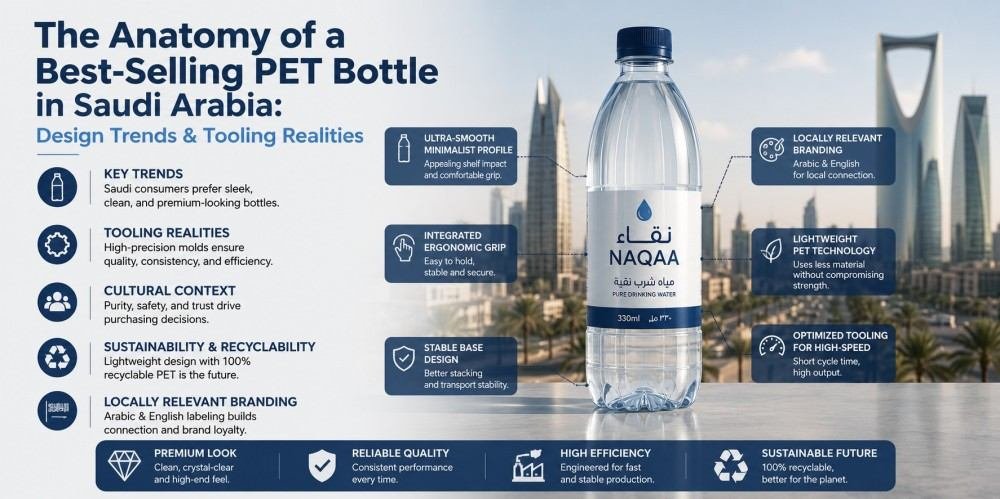
In my daily operations managing PET mold and preform mold engineering in Guangdong, I regularly review technical blueprints submitted by procurement directors from the Middle East. Just yesterday, I received an inquiry from a premium beverage brand in Saudi Arabia. Their engineering team proposed a highly minimalist container design, explicitly requesting a glass-like optical clarity.
I frequently observe overseas buyers assuming that a simple, unribbed bottle geometry translates to a simpler manufacturing process. The physical reality of blow molding dictates the exact opposite. A plain, unribbed cylinder acts as a magnifying glass for any tooling deviation. Producing these premium geometries requires heavier preform weights to maintain structural rigidity and demands optical-grade polishing on high-density mold steel. Today, my technical team and I will dissect the engineering parameters and material metallurgy required to execute these premium Saudi Arabian bottle designs on high-speed rotary platforms.
1. What is the Saudi Beverage Market: Where Premium Aesthetics Meet Mega-Volume Production
The Saudi Arabian beverage market demands high-volume PET production combining glass-like aesthetics with structural rigidity. Facilities process millions of units daily, requiring continuous-motion rotary platforms. Achieving premium visual clarity without compromising line efficiency relies on utilizing high-thermal-conductivity aviation aluminum and precise preform thermal conditioning.
Saudi Arabia operates as one of the most volume-intensive bottled water and hydration markets globally. The climate necessitates continuous consumption, driving mega-volume production facilities. According to equipment specifications from major OEMs like Sidel and Krones, these regional plants utilize continuous-motion rotary blow molding machines designed for extreme output velocities.
The engineering challenge arises from the regional consumer preference for premium aesthetics. A mass-market water bottle in this region must convey the visual weight and clarity of a luxury product. Balancing these two opposing variables—mega-volume output and premium optical clarity—requires strict adherence to thermodynamic principles during the stretch blow molding (SBM) process.
In my workshop, we analyze the thermal diffusivity required to process heavier preforms at high speeds. When a client requests a glass-like finish, the blow mold must extract latent heat from the bi-axially oriented polymer rapidly enough to prevent post-mold volumetric shrinkage, while simultaneously maintaining a surface finish that transfers zero machining marks to the PET. To understand the foundational thermodynamic sequence required for this process, review what is PET two-stage molding.
2. How to Achieve "Sleek & Minimalist" Cylinders Without Parting Line Dimension Mismatch
Producing minimalist, unribbed cylindrical PET bottles requires maintaining strict dimensional tolerances at the mold carrier interface. Any parting line dimension mismatch becomes highly visible on a plain surface. Utilizing 5-axis CNC machining and 6013 aviation aluminum provides the optical-grade polishing required to achieve glass-like container clarity.
The prevailing design trend among premium hydration brands in the Middle East favors clean, cylindrical, or slightly tapered profiles. Structurally, these designs lack the horizontal reinforcing ribs commonly used to absorb vertical top-load pressure during palletization.
Stop utilizing unreinforced mold alloys when processing plain cylindrical designs. Without structural ribs to mask physical deviations, any parting line dimension mismatch (often incorrectly referred to as "flash" in injection molding contexts) becomes immediately visible to the consumer. If the alignment pins and guide bushings wear down due to high-frequency clashing on a rotary machine, the 35 to 40 bar blowing pressure will force the mold halves slightly apart, creating a pronounced, weakened seam on the container.
To prevent this deviation, we specify 6013 aviation-grade aluminum for the primary cavity blocks. This specific alloy offers superior machinability and takes an optical-grade polish, which is directly transferred to the heated PET during radial expansion. We then reinforce the parting line interfaces with hardened steel sleeves. If you are transitioning a premium product from glass to polymer, analyze the tooling requirements detailed in 4 crucial mold design rules for your premium packaging conversion.
3. Cost of Premium Lightweighting: Structural Geometry
The cost of PET lightweighting balances resin savings against the capital expenditure for complex conformal cooling molds. Optimizing geometric ribs maintains top-load strength for lighter preforms. High-speed rotary stations require identical cavity dimensions to prevent structural deviation when reducing polymer mass by fractions of a gram.
Facilities producing millions of units daily must evaluate the cost of PET resin continuously. Reducing a preform's weight by merely 0.5 grams yields substantial financial savings over an annual production cycle. However, lightweighting is a complex mechanical variable.
When extracting polymer mass from the preform, the blow mold must compensate by inducing structural rigidity into the bottle's geometry. This is achieved through carefully mapped reinforcing ribs and optimized petaloid base geometries. In a rotary machine utilizing 20 to 24 separate mold stations, every individual cavity must feature identical volumetric and geometric dimensions. A deviation of ±0.05 mm in a lightweight ribbed section will lead to localized polymer thinning, causing the container to collapse under vertical palletizing loads.
Do not attempt a lightweighting program without recalculating the fluid dynamics of your mold's cooling channels. Thinner PET walls cool faster, but uneven cooling across the bottle geometry induces internal stress. We utilize precise conformal cooling channels to ensure uniform thermal extraction. To evaluate the engineering steps required for resin reduction, consult our 7-step engineering guide to reducing weight safely.
| Lightweighting Parameter | Standard Bottle Design | Lightweight Bottle Design | Engineering Requirement for Tooling |
|---|---|---|---|
| Preform Mass | High | Low | Requires highly optimized preferential heating profiles. |
| Wall Thickness | Uniform / Thick | Variable / Thin | Demands strict conformal cooling fluid dynamics. |
| Top-Load Support | Provided by material mass | Provided by geometric ribs | Requires 5-axis CNC machining for precise rib radii. |
| Blowing Pressure | Standard (25-30 bar) | High (35-40 bar) | Base inserts must utilize S136 heat-treated steel. |
4. Common problems of the 330ml "Everyday Carry": Ergonomics for the Middle East Consumer
Common problems with 330ml ergonomic PET bottles include delayed venting and difficult ejection during high-speed production. The waisted grip sections require precise cam-actuated mold opening strokes. Tooling engineered for 2,000 to 2,500 BPH per cavity must facilitate instant air exhaust to prevent container scuffing upon ejection.
In the Saudi Arabian market, the 330ml and 600ml capacities dominate consumer purchasing patterns due to the regional climate. Ergonomics dictate the design; consumers require a secure "waisted" grip section to hold the container comfortably.
Integrating deep grip sections into a blow mold introduces specific kinematic challenges. I hear from overseas engineers who experience container scuffing and ejection jams when running ergonomic designs at high velocities. This occurs when the mold's internal venting system is inadequate. At production speeds reaching 2,000 to 2,500 Bottles Per Hour (BPH) per cavity, the high-pressure blowing air must exhaust instantaneously before the cam-actuated carrier opens.
If the air exhaust is delayed, the residual internal pressure forces the PET against the deep grip contours of the mold cavity as the halves separate, creating friction scuffs. To resolve this, we engineer micro-venting slots along the parting line and base interface, allowing rapid decompression without transferring witness marks to the polymer. Furthermore, deep grip sections require careful attention to the preform heating profile to ensure sufficient material distribution to the indented areas.
5. Petaloid Base vs. Champagne Base: Moving Beyond the Standard
Comparing petaloid and champagne bases reveals differing thermodynamic requirements. Petaloid designs distribute 40-bar pneumatic pressure for carbonation, demanding S136 stainless steel inserts to prevent center gate bulging. Champagne bases offer premium aesthetics for still water but require specialized cooling channels to manage localized polymer accumulation.
As the sparkling water and premium beverage segments expand in the Middle East, procurement directors evaluate base geometries beyond the standard flat water configurations.
The petaloid base is engineered specifically for carbonated soft drinks (CSD). The multi-footed design distributes the internal 40-bar pressure, preventing the container from expanding outward. The base is the most thermodynamically challenging zone of the blow mold. It receives the thickest portion of the stretched polymer and requires massive heat extraction.
Stop utilizing unreinforced aluminum for petaloid base inserts. The continuous kinetic impact of the stretch rod and the high-pressure pneumatic expansion will compress the aluminum matrix. This alters the transition radius, leading to center gate bulging and a "rocker bottom" container that wobbles on the filling conveyor. We strictly utilize S136 stainless steel or 7075 aluminum for these inserts to maintain geometric integrity.
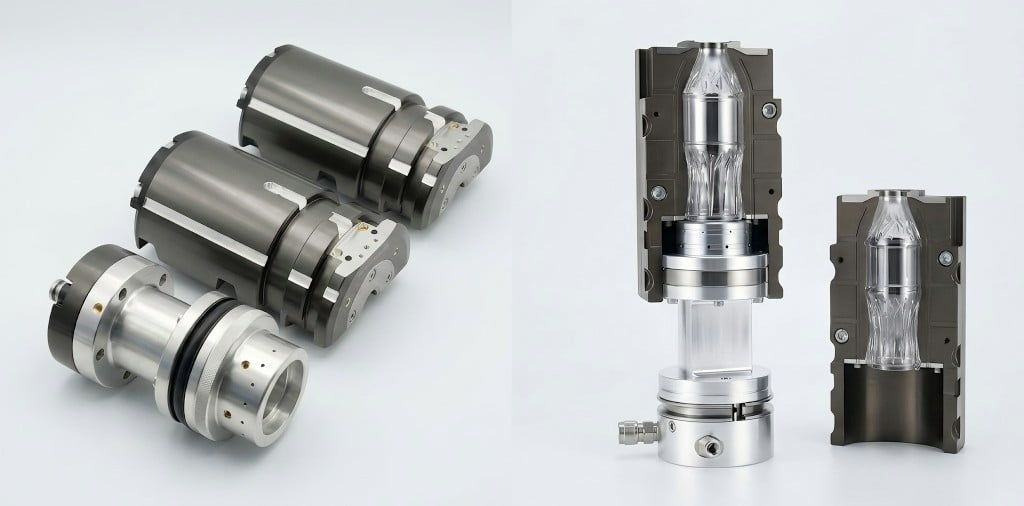
The champagne base offers a flat, elegant profile suitable for premium still water. However, the center push-up forces polymer to accumulate around the gate area. This requires highly localized, intensive cooling circuits within the base insert to prevent the thick PET section from retaining latent heat. For an analysis of base deviation resolution, read our 6-step guide to fixing center gate bulging and rocker bottoms.
| Base Design Geometry | Primary Application | Mechanical Function | Tooling Metallurgy Requirement |
|---|---|---|---|
| Petaloid (Multi-foot) | Carbonated Soft Drinks | Resists internal pneumatic pressure | S136 Stainless Steel (Heat Treated) |
| Champagne (Push-up) | Premium Still Water | Provides glass-like visual aesthetic | High-conductivity alloy with targeted cooling |
| Flat Ribbed | Standard Still Water | Offers maximum conveyor stability | 6013 Aviation Aluminum |
6. Case Study: Plug-and-Play Precision for Rotary Machines
A Saudi facility transitioned to drop-in compatible shell molds for their rotary platform, reducing changeover times significantly. The engineered tooling matched OEM carrier interfaces precisely, utilizing exact-match quick-release fluid connectors. This integration bypassed machine modifications while maintaining continuous output rates of 2,500 BPH per station.
High-speed beverage facilities operate on strict utilization schedules. Time spent adjusting mold carriers during a product changeover directly impacts the facility's overall equipment effectiveness (OEE).
Last quarter, my engineering team analyzed technical requirements for a major bottling plant operating a 24-station rotary platform. They required new tooling for a rebranded 600ml container but could not accommodate extended installation downtimes. Their primary concern was integrating third-party molds into their proprietary European carrier blocks.
Incompatible carrier dimensions cause severe delays. To ensure fluid integration, we mapped the external geometry of the OEM shell molds. We CNC machined the new 6013 aviation aluminum shells to match the existing carrier's alignment pins, mechanical locks, and guide rails precisely.
Furthermore, we equipped the tooling with exact-match quick-release connectors for the chilled water circuits and pneumatic exhaust lines. This allowed the facility to utilize their existing Quick Mold Change (QMC) systems. The transition functioned as a direct drop-in replacement, requiring zero modifications to the machine's rotating carousel. The facility maintained their target output of 2,500 BPH per station without mechanical interruption. To evaluate integration parameters before purchasing, review 4 reasons your new mold won't fit your blowing machine.
7. Verifying Dimensional Accuracy: The Power of Micro-Level CMM Inspection
Verifying continuous rotary mold accuracy requires Coordinate Measuring Machine (CMM) inspections. A 24-station platform demands identical volumetric capacity across all cavities to prevent filling line disruptions. Micro-level 3D scanning of machined aluminum and steel inserts provides empirical data to ensure strict geometric adherence before installation.
When a rotary machine processes tens of thousands of bottles per hour, volumetric consistency is paramount. The liquid filling valves on the downstream packaging line are calibrated to a specific fluid level. If the volumetric capacity among the 24 mold cavities varies, the fill levels in the retail containers will appear uneven, triggering rejection by automated inspection cameras.
Do not rely on manual caliper measurements for complex 3D geometries. The optical clarity and dimensional stability required by Saudi Arabian brands demand rigorous metrology.
Before any mold set leaves our facility, the quality control department executes a comprehensive inspection utilizing a Coordinate Measuring Machine (CMM). A ruby-tipped probe maps thousands of data points across the machined aluminum cavity and the steel base inserts. The software compares the physical tool against the approved 3D CAD blueprint, verifying the concentricity of the neck ring, the angle of the petaloid feet, and the total volumetric capacity. We provide these detailed inspection reports to the procurement directors, ensuring the tooling meets the strict ±0.02 mm tolerance required for continuous rotary production. To understand how to audit a facility's metrology protocols, consult 5 ways to spot a trader vs a real factory.
| Inspection Protocol | Standard Visual Check | CMM Micro-Level Scanning | Impact on Rotary Production |
|---|---|---|---|
| Volumetric Accuracy | Estimated via fluid displacement | Calculated via 3D geometric mapping | Ensures consistent fill levels on packaging line. |
| Parting Line Tolerance | Assessed via manual closure | Verified to ±0.02 mm across carrier | Prevents high-pressure pneumatic leaks. |
| Base Geometry Radius | Subjective visual inspection | Measured against original CAD data | Guarantees top-load and conveyor stability. |
8. Conclusion: Elevating Saudi Arabia’s Beverage Production
Securing continuous, high-volume beverage production in Saudi Arabia requires integrating premium aesthetics with rigorous tooling metallurgy. By utilizing 6013 aviation aluminum and heat-treated steel inserts, procurement teams optimize cycle times and maintain structural integrity, achieving efficient mega-volume output on advanced rotary blow molding platforms.
The intersection of premium aesthetic design and mega-volume production dictates the future of liquid packaging in the Middle East. Bottlers can no longer rely on unreinforced tooling to process complex, minimalist cylindrical designs or lightweight ergonomic containers.
The physical demands of continuous 2,000+ BPH per cavity production require a composite metallurgical architecture. By specifying 6013 aviation aluminum for rapid thermal diffusivity and S136 stainless steel for mechanical yield strength, facilities secure tooling capable of sustained, high-speed operation. Zhongshan Jindong Machinery Co., Ltd. was established in 2010, building upon the industrial foundation of our predecessor factory founded in 2004. With over 16 years of accumulated engineering data, we provide the technical infrastructure and CMM-verified precision required for your high-speed platforms. We invite your engineering teams to submit their 3D CAD files for an objective tooling evaluation.
Frequently Asked Questions (FAQ)
Q1: Can your molds handle the high ambient temperatures of our factories in Saudi Arabia?
A: Yes. We standardize the use of 6013 aviation-grade aluminum for the primary mold body, which offers superior thermal conductivity (approximately 130-150 W/m·K). Combined with our optimized conformal cooling channels, the fluid dynamics ensure rapid and even thermal extraction, maintaining cycle times and preventing bottle deformation even in elevated ambient temperature environments.
Q2: What is the maximum production speed your molds can support on a rotary machine?
A: Our high-precision composite molds are engineered specifically for continuous high-speed production. The tooling supports mechanical outputs of 2,000 to 2,500 Bottles Per Hour (BPH) per cavity, matching the kinematic capabilities of premium European continuous-motion blow molding equipment.
Q3: Are your shell molds compatible with Sidel and Krones quick-change systems?
A: Yes. Our compatible shell molds feature precise water and air quick-release connectors designed to integrate directly with your existing carrier blocks. It functions as a direct drop-in replacement, requiring zero mechanical modifications to your rotary machine's carousel.
Q4: How do you ensure consistency across all stations on a multi-station rotary machine?
A: Every individual mold cavity undergoes rigorous micro-level 3D inspection utilizing Coordinate Measuring Machines (CMM) before packaging. This metrology protocol verifies strict dimensional consistency and volumetric accuracy across all stations (e.g., 20 or 24 stations), preventing uneven fill levels and downstream conveyor disruptions.
Q5: Which materials are used for the high-wear areas like the neck and base?
A: To withstand millions of high-speed pneumatic impacts, we install premium high-quality mold steel (such as S136, heat-treated to 48-52 HRC) or ultra-hard 7075 aluminum as standard inserts for the neck rings and base plates. This composite architecture provides required yield strength and continuous wear resistance.
Recommended Further Reading on PET Mold Engineering
If you are evaluating equipment upgrades or analyzing defect rates on your rotary platforms, I advise reviewing these technical resources from our engineering library:
- Custom blow molds: 4 reasons your new mold won't fit your blowing machine
- PET bottle base rollout analysis: a 6-step guide to fixing center gate bulging and rocker bottoms
- PET bottle lightweighting: a 7-step engineering guide to reducing weight safely
- What is PET two-stage molding? The ultimate beginner's guide to the factory process
- Looking for a preform mould maker in China? 5 ways to spot a trader vs a real factory