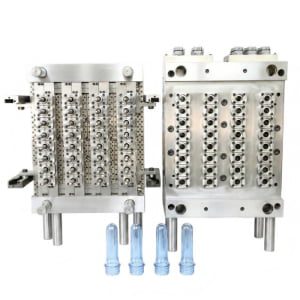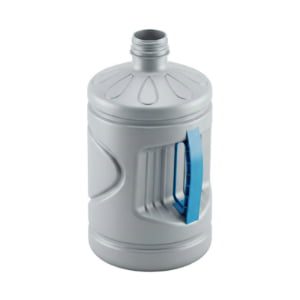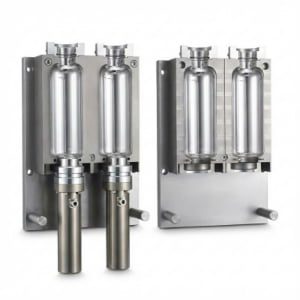
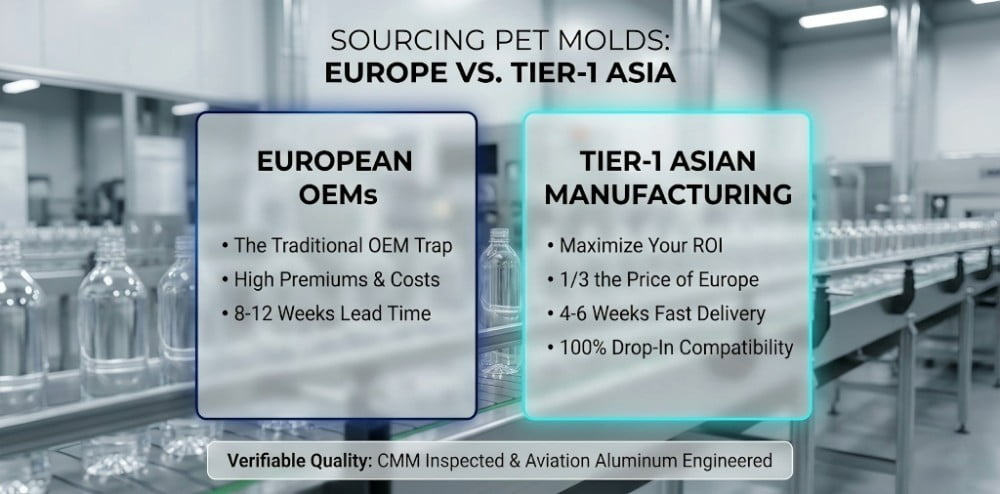
Turkish bottlers are sourcing high-precision PET molds beyond European OEMs to reduce capital expenditure and compress lead times. By partnering with advanced Asian manufacturers utilizing 5-axis CNC machining, these beverage facilities secure composite tooling with S136 steel inserts, ensuring high-speed rotary line compatibility while bypassing traditional OEM premiums.
In my daily operations manufacturing PET molds and preform molds in Guangdong, I regularly review technical blueprints submitted by procurement directors from Istanbul, Bursa, and Izmir. Over my 16 years in this specific engineering sector, I have observed a distinct shift in global supply chain dynamics. Historically, Turkish facilities relied heavily on German and Italian original equipment manufacturers (OEMs) for their tooling requirements. However, escalating operational costs, fluctuating resin pricing, and severe local market competition prompt senior engineers to re-evaluate their sourcing protocols.
Transitioning away from familiar European suppliers requires a rigorous technical evaluation. Procuring tooling based merely on lower initial pricing frequently leads to mechanical deviations on the filling line. This technical whitepaper dissects the engineering parameters, material metallurgy, and cost structures that justify integrating Tier-1 Asian composite molds into high-speed rotary platforms, providing a balanced, data-driven perspective for procurement teams.
1. What is the European OEM vs. Tier-1 Asian Mold Dynamic?
The dynamic involves Turkish bottlers balancing the established reliability of European OEMs against the manufacturing agility of Tier-1 Asian facilities. OEMs provide proprietary aftermarket tooling with significant brand premiums and extended lead times, whereas advanced Asian manufacturers offer precision-matched composite molds with highly compressed delivery schedules.
In the liquid food packaging sector, Turkey acts as a vital manufacturing bridge, exporting bottled water, carbonated soft drinks (CSD), and edible oils across Europe and the Middle East. To sustain high export volumes, Turkish plants utilize advanced, continuous-motion rotary blow molding platforms.
The OEM dynamic involves purchasing aftermarket tooling directly from the machine's manufacturer. The mechanical compatibility is structurally established within their closed ecosystem. The business model, however, relies on centralized European production schedules, which extends delivery timelines significantly.
The alternative involves Tier-1 Asian mold manufacturers. It is critical to differentiate between generalized trading companies and advanced engineering facilities. In our operations, the standard operating procedure avoids manual polishing for critical geometries. We utilize imported 5-axis CNC machining centers and coordinate measuring machines (CMM) to replicate the exact geometric data required for modern beverage packaging. For operators unfamiliar with the foundational thermodynamics required by these systems, reviewing what is PET two-stage molding provides necessary context.
| Sourcing Channel | Machining Infrastructure | Primary Material Architecture | Standard Delivery Timeline |
|---|---|---|---|
| European OEMs | 5-Axis CNC / Automated Cells | Composite (Aluminum + Steel) | 8 to 12 Weeks |
| Tier-1 Asian Factories | 5-Axis CNC / CMM Metrology | Composite (Aviation Alum + S136) | 4 to 6 Weeks |
| Standard Workshops | 3-Axis CNC / Manual Processing | Standard Aluminum | 3 to 5 Weeks |
2. How to Evaluate High-Precision Tooling for Turkish Rotary Lines
Evaluating high-precision tooling requires analyzing Coordinate Measuring Machine (CMM) data rather than standard CAD renderings. Engineers must verify that the mold carrier interfaces maintain ±0.02 mm tolerances and ensure the base inserts utilize heat-treated stainless steel to withstand continuous pneumatic pressure on high-speed lines.
Stop procuring tooling based solely on visual presentations. The mechanical reality of a blow mold is defined by its dimensional tolerance and material yield strength under continuous pneumatic pressure.
When evaluating a new tooling partner for your rotary machines, require documented CMM inspection reports for every cavity. A high-speed rotary machine frequently operates at cycle times below 2 seconds per station. If the dimensional tolerance of the mold carrier interface deviates by more than ±0.02 mm, the mechanical locking cams will experience uneven kinetic wear.
Do not accept unverified claims regarding equipment compatibility. A professional facility will request your exact quick mold change (QMC) specifications and provide engineering drawings detailing the fluid dynamics of the internal cooling channels. For a structured approach to auditing overseas facilities, refer to our technical guide on 5 ways to spot a trader vs a real factory.
Furthermore, require specific metallurgical certifications. The documentation must detail the utilization of heat-treated stainless steel for high-impact zones, rather than relying on generalized alloy descriptions that lack traceable yield strength data.
3. Cost of European OEMs vs. Tier-1 Asian PET Molds
European OEMs maintain substantial global overhead, inflating the initial capital expenditure and introducing high time-to-market costs due to extended lead times. Tier-1 Asian facilities consolidate the supply chain, reducing upfront tooling costs while delivering comparable operational expenditure efficiency through optimized conformal cooling.
Evaluating the financial structure of blow molds requires separating the initial Capital Expenditure (CapEx) from the long-term Operational Expenditure (OpEx).
European OEMs maintain substantial global overhead, service networks, and administrative layers, which inflates the CapEx of a multi-cavity mold set. Furthermore, their standard 8-to-12-week lead time introduces a hidden cost: delayed time-to-market. In the highly competitive FMCG sector, delaying a seasonal summer launch for a new beverage design results in measurable revenue forfeiture.
Tier-1 Asian facilities operate with a highly consolidated supply chain. By maintaining direct control over the CNC machining centers and material procurement, we compress the lead time to 4 to 6 weeks. The reduction in initial CapEx is significant. However, this reduction must not stem from material compromises. For an exhaustive breakdown of CNC machining hours and material pricing models, consult our comprehensive analysis on how much a PET blow mold costs.
| Financial Parameter | European OEM Sourcing | Tier-1 Asian Sourcing | Operational Impact |
|---|---|---|---|
| Initial CapEx | High | Optimized | Frees capital for resin procurement. |
| Time-to-Market Cost | High (8-12 weeks) | Low (4-6 weeks) | Accelerates seasonal product launches. |
| Maintenance OpEx | Moderate | Moderate | Requires scheduled component inspections. |
| Cooling Efficiency | Standardized | Customized | Affects electrical energy consumption per BPH. |
4. Common problems of Incompatible Aftermarket Molds
Incompatible aftermarket molds frequently cause parting line dimension mismatch and base rollout. These mechanical deviations occur when tooling lacks proper hardened steel guide bushings or when the base insert compresses under continuous 40-bar pressure, leading to unstable containers and decreased overall equipment effectiveness.
Integrating aftermarket tooling into proprietary machinery presents mechanical risks if the engineering protocols are subpar. I frequently consult with overseas clients experiencing line disruptions after installing non-compliant molds. Avoid integrating molds that require physical modifications to your machine's carrier blocks.
Parting Line Dimension Mismatch
A frequent deviation in unverified tooling is parting line dimension mismatch. In blow molding physics, we evaluate the closure seam rather than using injection molding terminology like "flash." If the alignment pins and guide bushings lack hardened steel reinforcement, the continuous high-speed clashing of the rotary machine will elongate the guide holes. This prevents the mold halves from achieving a flush seal. The high-pressure blowing air (frequently 35 to 40 bar) forces the halves slightly apart, creating a pronounced seam on the final container that compromises vertical top-load strength.
Base Rollout and Deformation
Another mechanical deviation is base rollout, commonly referred to as center gate bulging. This occurs when the tooling supplier machines the petaloid base insert from standard alloys lacking sufficient yield strength. The continuous impact of the stretch rod and the pneumatic pressure compresses the matrix over millions of cycles, altering the transition radius. The resulting bottle wobbles on the filling conveyor. We detail the thermodynamic and mechanical solutions to this deviation in our PET bottle base rollout analysis.
Suboptimal Thermal Extraction
If the internal cooling circuits are not engineered specifically for the preform's wall thickness, the mold will fail to extract heat rapidly. This causes the PET material to retain latent heat upon ejection, leading to volumetric shrinkage overnight. Operators are forced to slow down the machine's BPH (bottles per hour) output to compensate. Always verify fluid dynamics before installation; review 4 reasons your new mold won't fit your blowing machine.
5. European OEM Tooling vs. Tier-1 Asian Composite Tooling
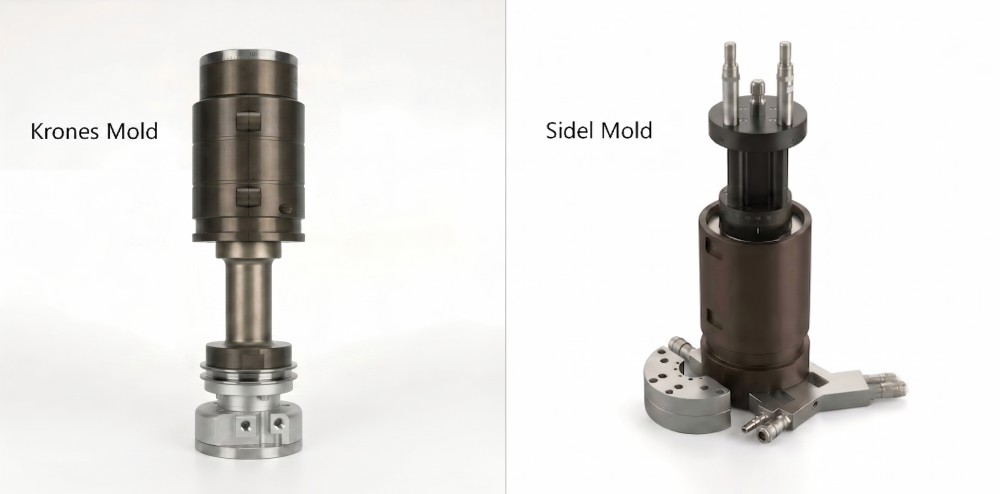
European OEMs and Tier-1 Asian manufacturers both utilize composite metallurgical architectures for high-speed rotary lines. While 6061 aluminum is highly capable for many applications, these fast platforms pair high-thermal-conductivity aviation aluminum bodies with S136 stainless steel inserts to manage kinetic impact and rapid cooling simultaneously.
The industrial standard for high-speed rotary blow molding demands a composite metallurgical architecture. A single material struggles to satisfy the conflicting demands of extreme thermal diffusivity and high mechanical yield strength under continuous operation.
European OEMs established the baseline by combining high-grade aluminum bodies with steel inserts. Tier-1 Asian manufacturers follow this material science protocol. In many scenarios, clients request 6061 aluminum, which is a highly capable and widely respected alloy in the machining industry. It performs admirably for linear blow molding machines, semi-automatic platforms, and applications requiring moderate BPH outputs.
However, for continuous-motion rotary platforms operating at sub-2-second cycle times, thermal diffusivity and yield strength requirements scale up. We specify aviation-grade aluminum for the primary cavity blocks, providing a thermal conductivity of approximately 130 to 150 W/m·K. This enables the chilled water to drop the PET below its glass transition temperature rapidly.
To manage the mechanical clamping force, we insert S136 stainless steel (hardened to 48-52 HRC) into the base plates, and utilize high-strength alloys for the neck rings. S136 steel resists the peening effect caused by repetitive kinetic impact. By matching this metallurgical configuration, Tier-1 Asian tooling achieves mechanical longevity on par with European OEM tooling without the associated brand premium. To understand the physics governing this alloy selection, read why most PET blow molds are made of aluminum.
| Metallurgical Component | Primary Function | Preferred Material | Reason for Engineering Selection |
|---|---|---|---|
| Main Cavity Body | Rapid thermal extraction | Aviation-Grade Aluminum | High thermal diffusivity limits cycle times. |
| Base Insert | Absorb pneumatic impact | S136 Stainless Steel | High yield strength mitigates center gate bulging. |
| Neck Ring Interface | Guide preform verticality | Hardened Steel / 7075 | Resists galling and ensures perpendicular stretching. |
6. Case Study: Upgrading a Turkish Bottling Facility
A Turkish beverage facility upgraded a 36-station rotary line with Tier-1 Asian composite molds to resolve parting line mismatch. By optimizing the base geometry and integrating S136 steel inserts, the plant reduced preform weight by 1.5 grams and maintained top-load stability, achieving rapid deployment.
In the previous fiscal quarter, I managed an engineering project for a mid-sized beverage plant in Turkey. The facility operated a 36-station rotary line primarily producing 500ml and 1.5L carbonated soft drinks. Their objective was twofold: replace aging tooling to eliminate parting line dimension mismatch and execute a lightweighting program to reduce resin consumption.
Their initial inquiry to the European OEM resulted in a 14-week lead time and a CapEx quotation that strained their annual tooling budget. They provided our team with the 3D CAD files for a structural evaluation.
The mechanical challenge of lightweighting CSD containers involves maintaining top-load stability and internal pressure resistance with less polymer mass. Simply thinning the walls leads to structural deformation. Our design team executed a geometric revision of the petaloid base, increasing the depth of the valleys and optimizing the transition radius to distribute the 40-bar pressure evenly.
We manufactured the 36 individual mold shells using our standard composite architecture (aviation-grade aluminum with S136 steel inserts). We integrated precision quick-release water and air connectors matching their proprietary carrier system, ensuring a straightforward drop-in installation.
The facility installed the new tooling within our 6-week delivery window. The results recorded by their engineering team demonstrated a 1.5-gram reduction in preform weight for the 500ml container while maintaining identical conveyor stability. The transition secured their seasonal production targets. For detailed engineering steps on reducing polymer mass, review our 7-step engineering guide to reducing weight safely.
7. Frequently Asked Questions (FAQ)
Q1: Can composite molds withstand the 40-bar blowing pressure of high-speed rotary machines?
A: Yes. Tooling engineered with heat-treated S136 stainless steel base inserts possesses a yield strength that absorbs 40-bar pneumatic impact reliably. Dimensional deviation occurs primarily when suppliers utilize alloys with lower yield strengths for the base structure under continuous high-pressure conditions.
Q2: Will I need to modify my quick mold change (QMC) system to accept your molds?
A: No modifications are required. Professional Tier-1 tooling is manufactured with exact-match quick-release fluid and pneumatic connectors. The external geometry of the shell is CNC machined to interface seamlessly with your existing carrier blocks, functioning as a drop-in component.
Q3: How do you verify the dimensional tolerance of complex base geometries before shipment?
A: We utilize Coordinate Measuring Machines (CMM) prior to packaging. A ruby-tipped probe scans thousands of data points on the machined aluminum and steel inserts, comparing the physical cavity against the approved 3D CAD model. This metrology protocol verifies volumetric accuracy and geometric angles.
Q4: Does utilizing S136 steel for the base insert increase the required cooling cycle time?
A: While steel possesses lower thermal conductivity than aluminum, utilizing it exclusively for the high-stress base insert does not significantly delay the overall cooling cycle. The primary body remains highly conductive aluminum, ensuring rapid global cooling, while the localized steel base manages mechanical stress with targeted, complex water circuits.
Recommended Further Reading on PET Mold Engineering
- Looking for a preform mould maker in China? 5 ways to spot a trader vs a real factory
- What is PET two-stage molding? The ultimate beginner's guide to the factory process
- Comprehensive analysis: how much does a PET blow mold cost?
- PET bottle base rollout analysis: a 6-step guide to fixing center gate bulging and rocker bottoms
- PET bottle lightweighting: a 7-step engineering guide to reducing weight safely