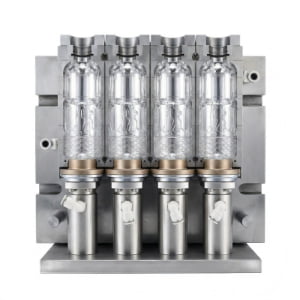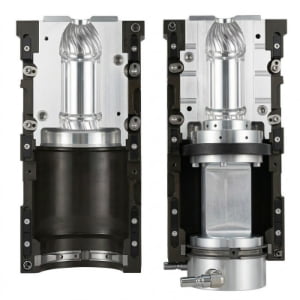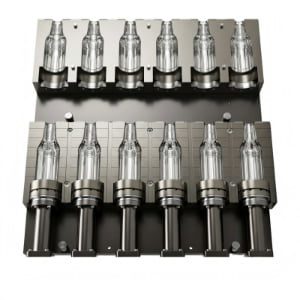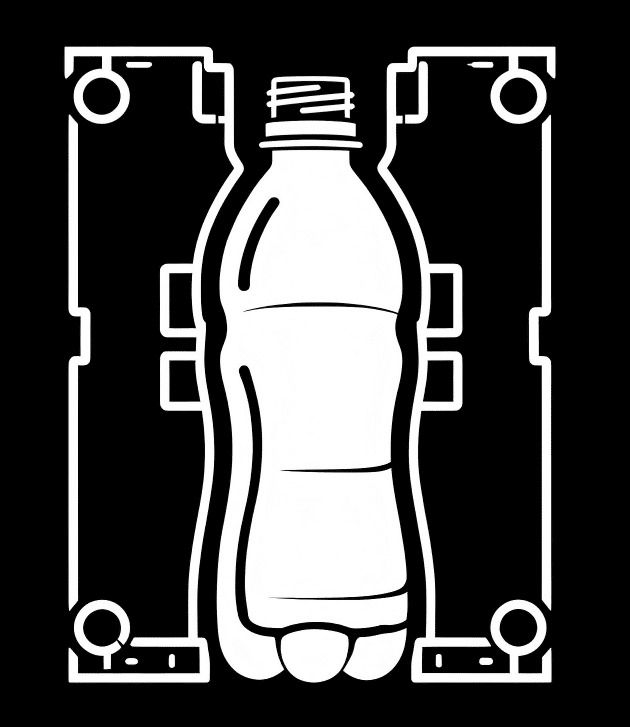
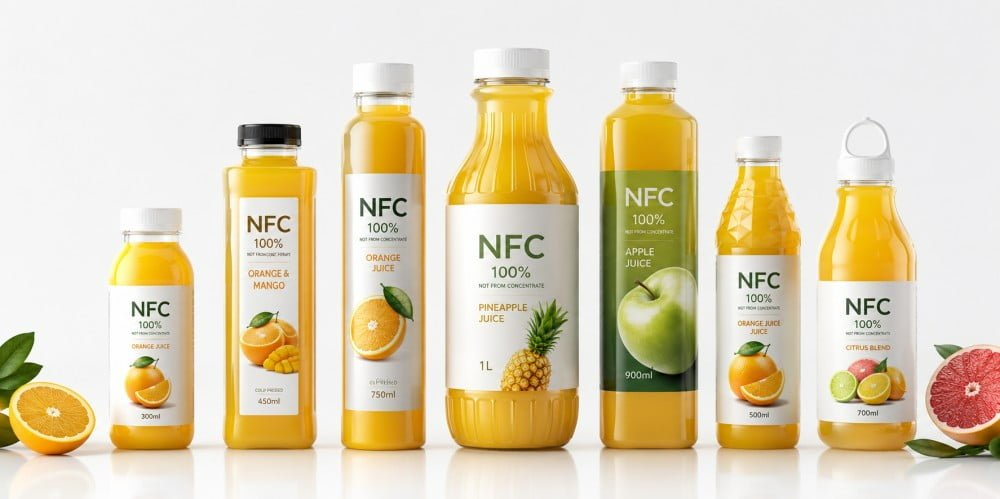
What are the top NFC juice packaging trends for 2026? The primary engineering trends center on structural minimalism and shelf-space optimization, specifically utilizing square footprints, apothecary-style silhouettes, smooth rib-less surfaces, asymmetrical ergonomic grips, and wide-mouth 38mm openings. These physical geometries enhance visual purity, maximize cold-chain storage efficiency, and accommodate 100% rPET material integration without compromising top-load stability.
In the premium beverage sector, consumers demand transparency, health-focused ingredients, and zero additives. The physical packaging must communicate these attributes before the liquid is ever tasted. Recently, a client from Thailand approached my facility to launch a premium, zero-additive coconut water. They spent months rejecting standard bottle designs because the geometric profiles did not reflect the pure nature of their raw liquid. By engineering a custom, rib-less apothecary shape with a heavy-wall base, we aligned their physical packaging with their premium market positioning.
When targeting the NFC (Not From Concentrate) juice market, relying on generic catalog molds limits market penetration. Upgrading your PET packaging requires precise calculation of stretch ratios, mold material selection, and rigorous thermodynamic control during the blow molding process. This whitepaper details the structural designs driving the 2026 market and the manufacturing physics required to produce them.
1. The Shift in NFC Juice Packaging: Why Shape Drives Sales
NFC juice packaging in 2026 relies on distinct geometric shapes to capture consumer attention in highly competitive cold-chain environments. The structural profile of the PET bottle acts as the primary visual indicator of premium quality, directly influencing purchasing decisions by prioritizing minimalist forms over complex, ribbed commodity designs.
The commercial landscape for chilled, zero-additive juices is defined by severe shelf-space limitations and high retail price points. Consumers spending premium capital on healthy beverages visually evaluate the product through the PET wall. If the bottle features standard structural ribs typical of low-cost mineral water, the psychological perceived value decreases. The transition from concentrate-based juices to NFC products necessitates a parallel upgrade in packaging engineering. The bottle must look like a high-value vessel, not a disposable container.
From an engineering standpoint, this shift demands abandoning thin-wall, highly ribbed designs. While ribs increase the section modulus and allow for extreme lightweighting (e.g., a 500ml water bottle weighing only 9 grams), they distort the visual clarity of the liquid. NFC juices often contain natural pulp and distinct color profiles that must be displayed without optical distortion. Achieving a smooth, rib-less cylinder or square requires increasing the preform weight (e.g., 24 grams or 28 grams for 500ml) to ensure the wall thickness remains sufficient to withstand top-load forces during capping and transportation.
We constantly remind overseas buyers that launching a premium liquid in a standard commodity bottle creates a disconnect in the consumer's mind. The geometry must justify the price point. For a deep dive into converting premium designs into physical molds, review our guide on From Concept to Production: What Are the 8 Steps to Custom PET Bottle Molds?.
2. The "Apothecary" Silhouette: Communicating Purity and Health
The apothecary bottle silhouette utilizes a wide base, steep shoulder angles, and a rounded, minimalist body. This specific geometry psychologically mimics vintage medical vials, communicating purity and health. Manufacturing this shape requires precise preform stretching to ensure uniform material distribution across the wide base diameter.
The apothecary design is dominating the cold-pressed juice and NFC segments. Brands utilize this stout, wide-base geometry to evoke feelings of natural remedies and organic purity. However, producing this shape presents specific thermodynamic challenges in the stretch blow molding machine.
The primary engineering challenge lies in the base rollout and the shoulder expansion. An apothecary bottle typically features a base diameter that is significantly larger than its neck diameter. When the stretch rod extends and high-pressure air (up to 3.5 MPa) is introduced, the PET material must travel a longer radial distance to reach the bottom corners of the mold cavity. If the preform heating profile is not optimized, the material will chill upon contact with the mold wall before fully forming the base corners, resulting in an uneven base or a "rocker bottom."
To successfully blow an apothecary silhouette, the preform must have a thick enough wall, and the blow mold must feature highly efficient cooling channels at the base to rapidly freeze the thick amorphous PET in the gate area. If the base geometry is unstable, refer to our technical breakdown on PET Bottle Base Rollout Analysis: A 6-Step Guide to Fixing Center Gate Bulging and Rocker Bottoms.
| Design Parameter | Standard Beverage Bottle | Apothecary Juice Bottle | Engineering Requirement |
|---|---|---|---|
| Height-to-Width Ratio | 3.5 : 1 (Tall & Slender) | 2.0 : 1 (Short & Stout) | Requires wider preform body to reduce radial stretch ratio. |
| Shoulder Angle | Sloped (15° - 30°) | Steep or Rounded (45°+) | Precise preferential heating needed in the upper preform zones. |
| Base Design | Petaloid (Carbonated) | Heavy Flat Base with Push-up | Requires intense base cooling to prevent post-mold deformation. |
| Center of Gravity | High | Low | Provides excellent stability on filling line conveyors. |
3. The Square Bottle Revolution: Dominating the Cold-Chain Shelf
Square PET bottles maximize volumetric efficiency in refrigerated displays, allowing brands to present a continuous visual block of product. Engineering square bottles requires managing unequal radial stretch ratios, as the plastic must stretch further into the corners than to the flat sidewalls, necessitating critical mold corner radii.
NFC juices rely entirely on cold-chain logistics. Supermarket refrigerator space is incredibly expensive. A standard round bottle wastes the interstitial space between units. Square or rectangular profiles eliminate this dead space, allowing a brand to pack more volume into the same footprint. When aligned on a shelf, square bottles create a massive "color block" of pure juice, delivering a superior visual impact compared to isolated round bottles.
Do not assume that blowing a square bottle is as simple as cutting a square cavity. It is a complex mechanical process. The distance from the preform center to the flat side of the square mold is shorter than the distance to the 90-degree corner. As the high-pressure air inflates the heated PET balloon, the plastic hits the flat walls first, freezing instantly upon contact with the chilled aluminum or steel. The remaining plastic must then stretch into the corners. If the process is not controlled, the corners will become dangerously thin, leading to stress cracking or implosion under vacuum.
To prevent corner blowouts, the mold must avoid sharp, 90-degree internal angles. We utilize precise CNC milling to incorporate calculated corner radii, allowing the plastic to flow smoothly into the geometric extremes. For edible oils and juices utilizing these shapes, specific structural parameters must be respected, which we outline in our article on Engineering Square PET Bottles for Edible Oil: Crucial Blow Mold Design Strategies.
To illustrate the spatial advantage, observe the comparison below:
| Metric (per $1m^2$ shelf) | Round Bottle (65mm Dia) | Square Bottle (65x65mm) | Efficiency Gain |
|---|---|---|---|
| Units per Square Meter | ~260 bottles | ~310 bottles | +19% greater density |
| Dead Space (Air Gaps) | High | Minimal | Improved cold air retention |
| Label Display Area | Curved (requires rotating) | Flat (always faces forward) | Enhanced brand visibility |
| Top-Load Strength | High (naturally distributed) | Lower (requires thicker corners) | Demands precise preform heating |
4. Ultra-Clear Minimalist Surfaces: Let the Pulp Speak for Itself
Minimalist, rib-less surfaces eliminate optical distortion, acting as a clear window to display juice color and suspended pulp. Removing structural ribs decreases inherent bottle rigidity, requiring increased wall thickness and highly polished mold cavities to ensure mechanical stability and flawless visual transparency.
High-end NFC brands are actively removing wave patterns, horizontal rings, and structural ribs from their designs. A completely smooth cylinder or flat panel signals confidence in the liquid. However, in blow molding physics, a flat panel is structurally weak. A rib acts as an I-beam, providing stiffness against lateral compression and vacuum deformation (when cold juice absorbs oxygen or experiences temperature fluctuations, creating internal negative pressure).
If you remove the ribs, you must compensate with material mass. You cannot use a 12-gram preform for a 500ml rib-less hot-fill or NFC bottle; the sidewalls will collapse when the consumer grips it. We typically recommend moving to an 18-gram or 24-gram preform, depending on the neck finish and top-load requirements.
Furthermore, to achieve "ultra-clear" optics, the interior of the blow mold cavity must undergo intensive manual polishing. Any CNC machining marks left on the mold surface will be embossed onto the hot PET, creating a frosted or hazy appearance. We utilize aerospace-grade aluminum or S136 stainless steel, polishing the cavity to a mirror finish (Ra $\le 0.1 \mu m$) to guarantee absolute transparency.
Customizing the geometry to remain smooth while supporting the load requires specialized engineering blueprints, as seen in complex structural transitions.
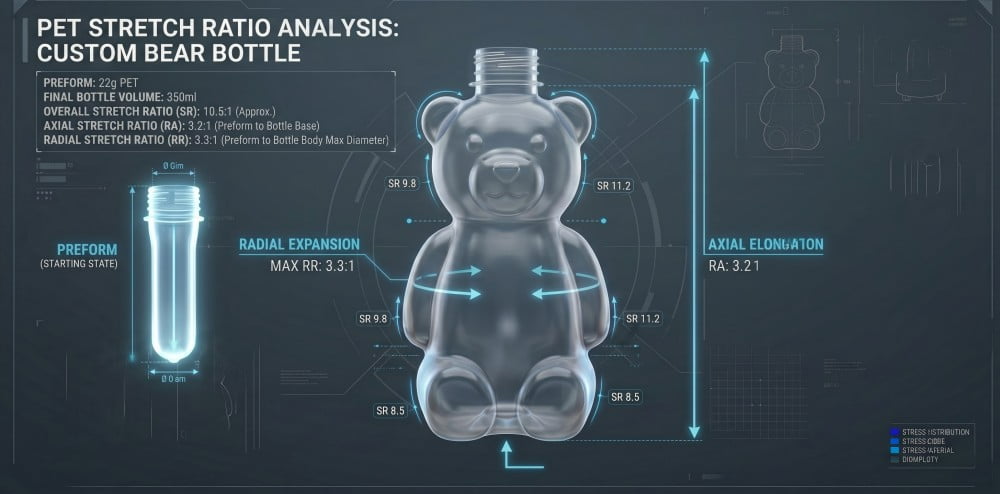
When transitioning a premium product from heavy glass to clear PET, the mold design rules change entirely. The optical clarity of PET can rival glass only if the mold surface and stretch ratios are heavily controlled. Read more about this conversion in From Glass to PET: 4 Crucial Mold Design Rules for Your Premium Packaging Conversion.
5. Ergonomic & Asymmetrical Grips: Art Meets Functionality
Asymmetrical and ergonomic grip designs elevate the bottle into a functional sculpture, tailored for on-the-go consumption. Molding non-symmetrical shapes induces uneven material distribution, demanding advanced preferential heating technology in the blowing machine and customized cooling channels within the mold block.
Modern NFC juice packaging frequently incorporates flowing, asymmetrical indentations that guide the consumer's hand to a specific gripping point. This moves away from the rigid, symmetrical grooves of the past. While visually stunning, asymmetrical shapes are highly antagonistic to the natural physics of blow molding.
When a preform is inflated, the heated polymer chain seeks to expand symmetrically in all directions. If the mold cavity has a deep indentation on the left side and a smooth curve on the right, the plastic will hit the left side first. This stops the stretching process on that side while the right side continues to thin out. The result is an unbalanced wall thickness that can cause the bottle to warp when filled.
To solve this, factories must employ preferential heating (if the machine supports it) or rely on highly engineered custom molds. In the mold, we must design conformal cooling channels that track the asymmetrical contour exactly. If the deep grip area cools at a different rate than the smooth area, the volumetric shrinkage of the PET will be uneven, leading to severe bending after ejection. For complex handling geometries, we employ strategies detailed in our analysis of Large PET Bottles with Handles: Mastering Deep Grip Challenges via Preferential Heating and Active Molds.
6. Wide-Mouth Openings (38mm+): The Perfect Sensory Sip
Wide-mouth openings, typically 38mm or larger, facilitate rapid aroma release and smooth consumption of pulp-heavy juices. Utilizing a wider neck finish requires heavier preforms and precise cooling at the neck ring area to prevent thermal deformation during the blowing and capping phases.
The sensory experience of a premium juice begins the moment the cap is unscrewed. A standard 28mm PCO1881 water neck finish restricts airflow, preventing the volatile aromatic compounds of fresh citrus or berries from reaching the consumer's olfactory sensors. Transitioning to a 38mm neck finish transforms the drinking experience, allowing for maximum aroma dispersion and a smooth flow of high-viscosity liquids containing seeds or fruit pulp.
However, a 38mm neck requires a preform with a significantly larger thread diameter. This increases the mass of the un-stretched PET at the neck area. During the blow molding process, the infrared oven must heat the body of the preform to roughly $105^\circ\text{C}$ while keeping the threaded neck rigidly cool (below $70^\circ\text{C}$). If the heavy 38mm neck absorbs too much heat, it will crystallize or deform under the pressure of the stretch rod, leading to sealing failures on the capping line.
If you are experiencing capping issues with wide-mouth designs, the problem usually originates in the neck cooling parameters, which we troubleshoot extensively in Caps Won't Seal? A 6-Step Protocol to Fix PET Bottle Neck Deformation & Ovality.
The physical dimensions of wide-mouth preforms fundamentally alter the blow molding machine setup, requiring specific mandrel sizes and cooling shields.
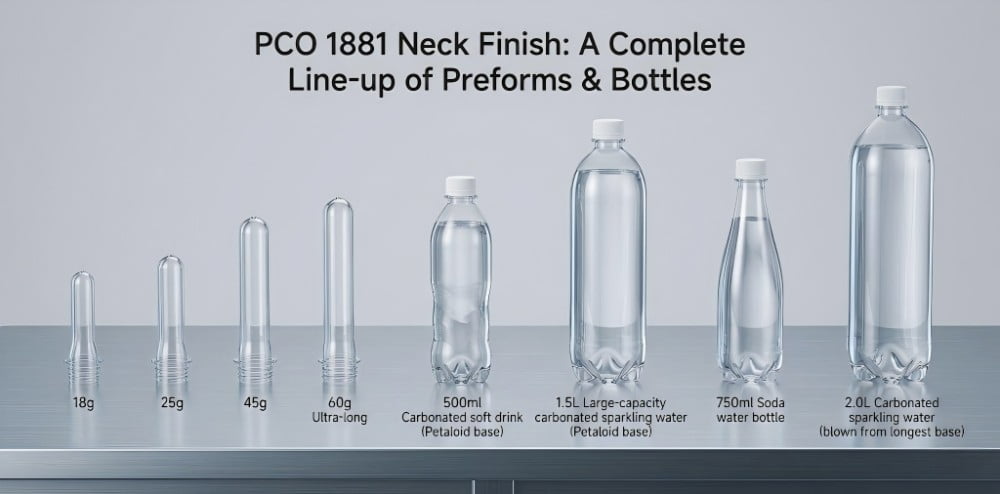
Selecting the correct neck finish is the foundational step before any mold cutting begins. Do not assume a 38mm 3-start thread operates the same as a 28mm finish. Verify your cap compatibility using our technical breakdown: The Ultimate Guide to Preform Neck Finishes: How to Choose the Right Standard for Your Bottle.
7. Designing for Sustainability: The Aesthetic of rPET
Designing for 100% rPET (recycled PET) requires accommodating the material's lower intrinsic viscosity and potential optical haze. Geometric designs must incorporate sharp facet angles or specific curvature to manipulate light refraction, visually masking the natural yellowish or grey tint of recycled resins.
By 2026, sustainability is a mandatory requirement, not a marketing option. High-end juice brands are aggressively adopting 50% to 100% rPET. However, mechanically recycled PET behaves differently than virgin PET resin. Processing rPET often results in a slight drop in intrinsic viscosity (IV), making the material more sensitive to heat and less resistant to environmental stress cracking. Furthermore, rPET frequently carries a faint yellow or grey hue due to multiple heat histories.
If you design a massive, flat, smooth panel using 100% rPET, the haze and color variations will be highly visible. To counteract this physical reality, we engineer specific light-refracting geometries into the mold. By adding vertical facets, sharp diamond cuts, or specific curvature to the shoulder, the bottle catches ambient light and creates internal reflections. This optical manipulation distracts the human eye from the polymer's natural tint, presenting a premium, sparkling appearance even with recycled content.
| Material Property | Virgin PET (IV 0.80-0.84) | 100% rPET (IV 0.72-0.78) | Blow Mold Design Adjustment |
|---|---|---|---|
| Optical Clarity (Haze) | $< 2\%$ | $3\% - 6\%$ (Variable) | Incorporate light-refracting angles; avoid massive flat panels. |
| Color Tone | High transmission, clear | Slight yellow/grey shift | Utilize geometric textures or tinted masterbatch. |
| Thermal Processing | Highly stable heating window | Narrow heating window | Requires molds with highly responsive cooling channels. |
| Tensile Strength | High resistance to stress | Marginally reduced elasticity | Avoid excessively sharp internal corners; increase corner radii. |
8. Turning 2026 Concepts into Reality with Custom Blow Molds
Translating avant-garde 2026 juice packaging concepts into physical bottles demands exceptional blow mold precision. Factories must utilize S136 stainless steel hardened to 48-52 HRC and 5-axis CNC machining to guarantee that intricate geometric shapes endure millions of high-pressure injection and blowing cycles.
Having a beautiful 3D render of an apothecary or square juice bottle is only 10% of the project. The remaining 90% is execution in the machine shop. In my 16 years of managing PET mold manufacturing and international trade, I have seen countless buyers fail because they handed complex geometric designs to low-tier machining facilities.
A custom blow mold for an asymmetrical, rib-less, or square bottle requires extreme dimensional accuracy. We rely on imported 5-axis CNC machining centers to cut precise corner radii and asymmetrical cooling channels. If you use S136 steel, it must be hardened to 48-52 HRC to withstand the continuous mechanical clamping forces without edge degradation. The dimensional tolerance of the parting line must be held within $\pm 0.01\text{ mm}$. If the tolerance slips to $0.05\text{ mm}$, the high-pressure air will force plastic into the gap, creating a sharp parting line on the bottle, which destroys the premium aesthetic.
Stop sending your high-end packaging designs to traders who lack CMM (Coordinate Measuring Machine) verification. The rigidity and thermal conductivity of the mold dictate the cycle time, electrical consumption, and ultimately, the profitability of your production line. If your current mold is extending your cycle times, read our analysis on Is Your Preform Mould Design Stealing Your Cycle Time and Electricity?.
For an objective assessment of whether your supplier is a true manufacturing facility capable of handling complex 2026 designs, refer to our checklist: Looking for a Preform Mould Maker in China? 5 Ways to Spot a Trader vs. a Real Factory. If you have a demanding bottle design that requires engineering validation, send us the blueprints. We provide data-driven assessments to ensure your packaging concept is mechanically viable for mass production.
Frequently Asked Questions (FAQs)
Q1: Why are square PET bottles becoming the top choice for premium NFC juices?
Square bottles offer a dual advantage. Visually, they stand out against the sea of traditional round bottles, giving the product an immediate premium and modern feel. Functionally, square bottles maximize efficiency on supermarket cold-chain shelves, allowing brands to display more products in limited refrigerated spaces.
Q2: What is the "apothecary bottle" trend in juice packaging?
The apothecary trend involves designing PET bottles that mimic the shape of vintage glass medicine bottles—typically featuring a wider base, rounded shoulders, and a minimalist profile. This design psychologically communicates health, natural remedies, and purity, which aligns perfectly with the brand message of fresh NFC juices.
Q3: How does a wide-mouth (38mm) design enhance the NFC juice product?
A wide-mouth opening significantly improves the sensory experience of drinking premium juice. It allows the natural aroma of the fresh fruit to escape as soon as the bottle is opened. Additionally, for juices containing pulp, the wider opening ensures a smoother, more enjoyable flow during consumption.
Q4: Why do high-end juice brands avoid ribbed bottle designs?
Ribbed designs are traditionally used to add structural strength to thin, low-cost water or beverage bottles. High-end NFC juice brands avoid them because ribs can visually distort the liquid inside. A completely smooth, minimalist surface acts like a clear window, proudly displaying the rich color, freshness, and natural pulp of the premium juice.
Q5: Can complex, asymmetrical bottle designs be effectively mass-produced in PET?
Yes, highly intricate designs—including asymmetrical ergonomic grips and sharp geometric corners—can be efficiently mass-produced. The key lies in the quality of the blow mold. A precision-engineered custom blow mold ensures that the PET material is distributed evenly, maintaining both the striking aesthetic and the structural integrity of the bottle.
Related Technical Guides:
- From Concept to Production: What Are the 8 Steps to Custom PET Bottle Molds?
- Engineering Square PET Bottles for Edible Oil: Crucial Blow Mold Design Strategies
- The Ultimate Guide to Preform Neck Finishes: How to Choose the Right Standard for Your Bottle
- From Glass to PET: 4 Crucial Mold Design Rules for Your Premium Packaging Conversion
- Looking for a Preform Mould Maker in China? 5 Ways to Spot a Trader vs. a Real Factory