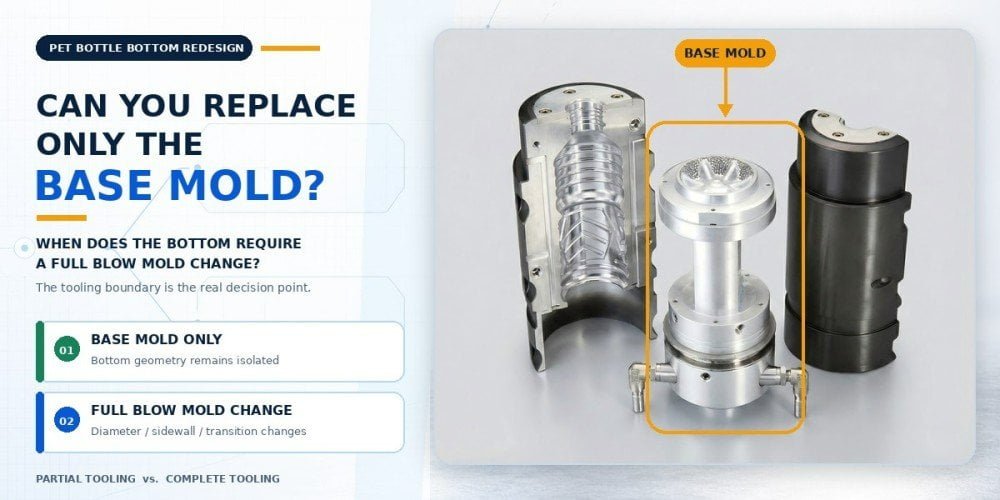
A customer from Indonesia recently asked us a question that sounds very simple:
“We want to keep the bottle body unchanged and only change the bottle bottom. Can we manufacture only a new base mold?”
The customer already had a 14-cavity Krones rotary blow mold, so replacing only the base molds would obviously be more economical than manufacturing new mold halves or a complete set of tooling.
I did not answer yes immediately.
Instead, I asked the customer to send us the original bottle drawing and a reference image of the new bottom he wanted. After comparing the existing bottle geometry with the proposed design, we found that the change was much larger than the customer initially thought.
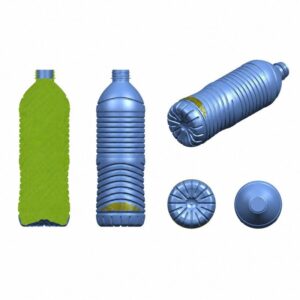
The original bottle used a round base. The new design was a petaloid base.
The petaloid geometry did not stop inside the area controlled by the existing base mold. Its outer feet and transition surfaces extended into the lower bottle body, where the cavity was already formed by the existing mold halves.
So our final answer was no: for this specific bottle, replacing only the base mold would not create the complete new geometry. The new bottle-bottom design had already crossed the boundary between the base mold and the mold halves.
That example explains the main engineering question behind every PET base mold replacement project:
The real question is not whether the base mold can be removed. It is whether the new bottle-bottom geometry stays within the existing base-mold boundary.
Can the Base Mold of a PET Blow Mold Be Replaced Separately?
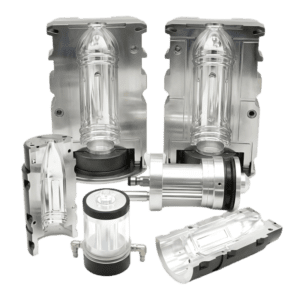
In many rotary PET blow mold systems, the base mold is physically a separate component from the two mold halves. However, being removable does not mean that every bottle-bottom redesign can be achieved by replacing the base mold alone. Geometry determines whether partial tooling replacement is feasible.
The first point is easy to confirm from the machine side.
Krones describes a complete blow mold package in its MouldXpress automatic changeover system as consisting of both mold halves and the base mold. KHS has likewise described rotary PET systems where mold pairs and bases are changed as separate tooling components.
So when a customer asks whether we can manufacture only a replacement base mold, the request itself is technically reasonable.
The base mold is not necessarily machined as one inseparable block together with the left and right mold halves.
This is why base-only replacement projects do exist.
But the mistake is to make the next assumption:
“Because the base mold is removable, anything below the bottle body can be redesigned by changing this part.”
That is not how the cavity works.
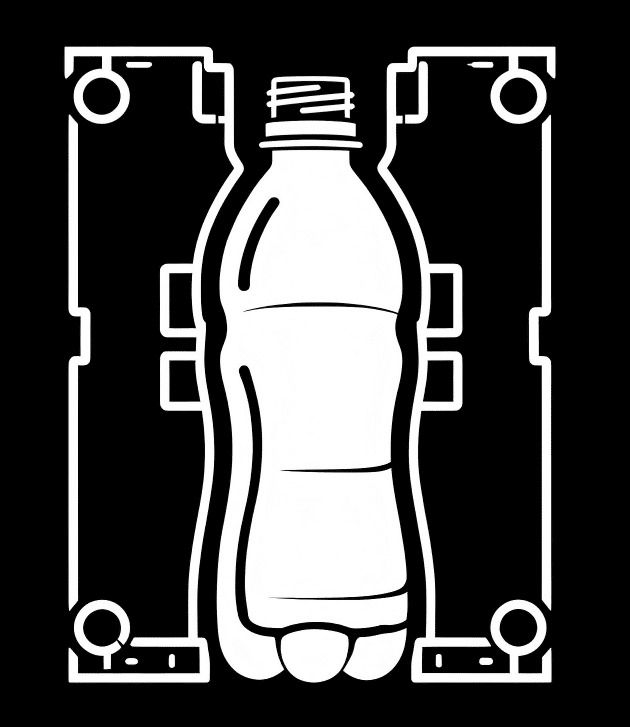
When the blow mold closes, the left mold half, right mold half, and base mold become one continuous three-dimensional bottle cavity. The PET does not know which surface belongs to which purchased mold component. It only sees the complete closed cavity.
If a new bottom design changes only surfaces already controlled by the base mold, a replacement base may be feasible.
If the design change continues outward and upward into surfaces controlled by the mold halves, a new base mold cannot reproduce those areas.
This is why, when we receive this type of inquiry, we do not begin with the question:
“How much does one base mold cost?”
We begin with:
“Where does the new geometry stop?”
That is the more important purchasing question.
Where Does the Base Mold End and the Side Mold Begin?
The practical boundary is the interface where the base mold meets the left and right mold halves. A bottle-bottom modification is suitable for base-only replacement only when the new geometry can transition back into the existing bottle cavity before crossing this interface.
From the outside of a finished PET bottle, customers normally see one complete bottom.
They do not naturally divide it into “this part came from the base mold” and “this part came from the mold halves.”
That is understandable.
But for mold engineering, this division is fundamental.
The central bottom region is usually formed by the base mold. Depending on the tooling architecture, this can include the center, standing area, push-up, and part of the surrounding bottom profile.
Further outward, the geometry reaches the interface between the base mold and the two side mold halves.
Above that interface, the bottle heel and lower sidewall are formed by the existing left and right cavities.
This means that the customer’s visual definition of “the bottle bottom” may be much larger than the actual base-mold-controlled area.
A customer can look at the lower 30 or 40 mm of the finished bottle and say:
“We only changed the bottom.”
But from a tooling perspective, part of that visual bottom may already belong to the side cavities.
This is where the distinction becomes important:
Bottle-bottom change does not automatically mean base-mold change.
The correct tooling scope is determined by the geometry boundary, not by what the customer calls that area of the bottle.
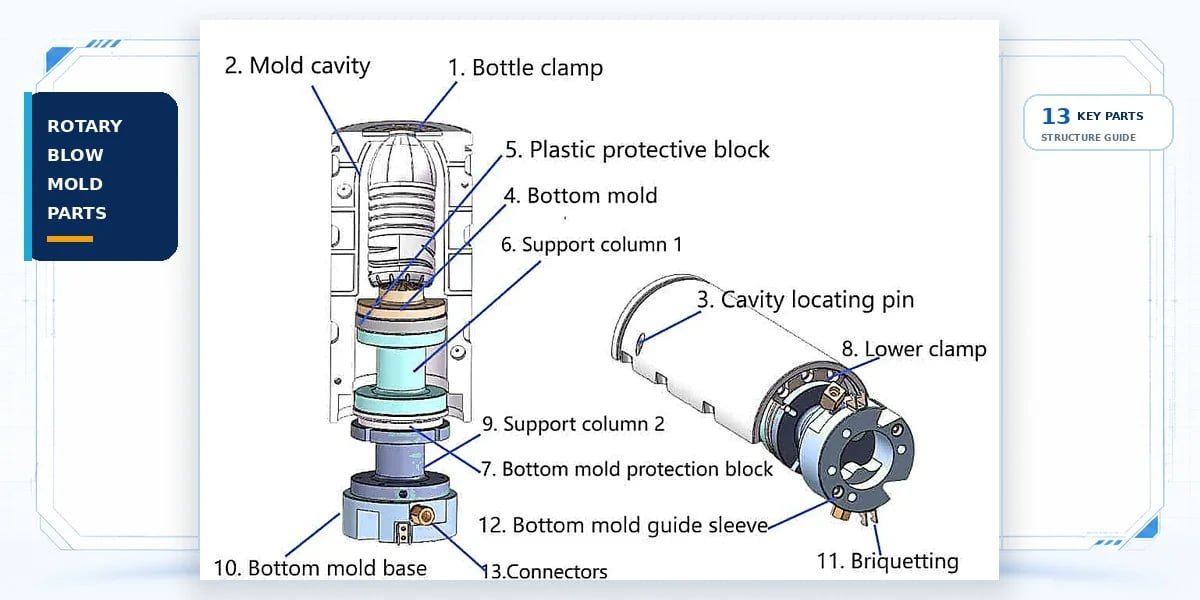
For this article, this diagram would be particularly useful. I would show the bottle inside a closed three-piece rotary mold and clearly mark the base split line.
Then we could show two bottle redesigns.
In the first, the changed geometry remains below the split line.
In the second, the new geometry continues above it into the heel.
That single image would explain most of the engineering decision better than a long list of mold components.
What Bottle-Bottom Changes Are Most Likely to Work With a New Base Mold Only?
Base-only replacement is more likely to be practical when the bottle body, heel, main diameter, and geometry at the base-mold interface remain unchanged, while the redesign is confined to surfaces already controlled by the existing base mold. Final feasibility still requires an old-versus-new CAD comparison.
There are legitimate reasons why a customer may want to change only the base.
Perhaps the bottle body is already accepted by the market and the customer wants to retain the same label area, shelf appearance, and filling-line format.
The issue may be concentrated near the central bottom.
For example, the customer may want to adjust the center geometry, change a standing feature, modify the push-up, or optimise part of a water-bottle base while leaving the outer heel completely unchanged.
Those projects are much more suitable for a replacement base mold evaluation.
The important point is that the new geometry must return smoothly to the existing bottle shape while it is still inside the area formed by the base mold.
Imagine overlaying the old bottle CAD and the new bottle CAD on the same centerline.
Near the center, the profiles are different.
Moving radially outward, the profiles gradually approach one another.
If they become identical before reaching the existing base split line, there is at least a geometric reason to investigate base-only replacement.
That still does not automatically mean we should start machining.
The base mold must also match the existing tooling mechanically, and the new bottom has to remain suitable for the existing preform and blowing process.
But at least the bottle geometry itself has not already ruled the idea out.
This is an important distinction for buyers because partial tooling replacement can make good commercial sense when the modification is genuinely local.
We do not believe in telling every customer:
“Any bottle change requires a complete new mold.”
That is not a useful engineering approach.
If the existing mold halves can be retained safely and accurately, it is reasonable to evaluate that option.
But it should be demonstrated from geometry, not assumed from the sentence:
“The body stays the same.”
Indonesia Case: Why We Rejected a Base-Mold-Only Change on a 14-Cavity Krones Mold
Our Indonesian customer’s project looked like a base-only change commercially, but the CAD comparison showed otherwise. Changing from the existing round base to the requested petaloid base changed the transition into the lower bottle body, so the modification extended beyond the existing base-mold cavity.
This project is a good example of why I normally do not give an immediate answer from a bottle photo.
The customer had a 14-cavity Krones rotary blow mold.
His requirement sounded very clear:
“Keep the bottle body. Change only the bottom.”
From a purchasing point of view, his idea made sense.
Fourteen new base molds are a much smaller tooling project than replacing the left and right cavity halves across fourteen blowing stations.
If we had answered only from the customer’s description, it would have been easy to say:
“Yes, if the body is unchanged, we can make a new base.”
But that would have been premature.
I asked him for the drawing of the existing bottle first.
Then I asked him to send the bottom style he wanted to change to.
The existing bottle had a round bottom geometry. The target design was a petaloid bottom.
Once we compared the geometry, the problem became clear.
The petaloid feet and their surrounding transitions did not exist only in the central base area. To form the new bottom properly, the geometry had to rise outward into the region where the bottom connected to the lower bottle body.
That region was already inside the cavity of the existing mold halves.
So even if we manufactured a completely new base mold, the mold halves above it would still close with the old round-bottom transition.
The complete cavity would not represent the new bottle.
That was why I finally told the customer:
No, for this design we cannot achieve the conversion by replacing only the base mold.
The important point is not simply that a petaloid base is “larger” than a round base.
The important point is that the new geometry did not become identical to the old geometry before it crossed the existing base-mold boundary.
That is the test.
This case also shows why we prefer engineering drawings over visual descriptions.
The customer was correct from a product perspective when he said the bottle body was staying the same.
The upper bottle body was staying the same.
But the lower-body transition required by the new petaloid base was not.
In mold engineering, that difference determines whether a partial tooling replacement is possible.
When Does a New Bottle Bottom Require New Mold Halves Too?
When the redesigned base changes the heel, lower sidewall, bottom diameter, or transition surface above the existing base split line, the current mold halves may no longer contain the correct cavity. In that situation, new side tooling—or potentially a complete new blow mold—should be evaluated.
The easiest way to understand this is to stop thinking about individual tooling pieces and look at the final bottle surface.
Where does the bottle start to change?
And more importantly:
Where does it become the old bottle again?
Suppose the customer changes only the central push-up.
The old and new profiles may differ at the center but become identical well before the mold interface.
That is a strong candidate for base-only evaluation.
Now consider a new bottom with a wider standing diameter.
The new curved surface may continue farther outward before returning to the existing bottle shape.
If that return point crosses the base split line, the side cavities become involved.
The same applies if the heel profile changes.
The heel is particularly important because it is the transition between the functional bottle base and the main body. A redesign that changes this transition cannot always be isolated inside the base component.
This is exactly what happened with our Indonesian customer’s petaloid conversion.
The visible request was:
round base → petaloid base
but the tooling consequence was:
base geometry → heel transition → existing mold-half cavity
Once the new surface enters the existing side cavity, forcing the project into a base-only solution usually creates the wrong engineering objective.
At that point, we should not ask:
“How can we make the base mold do more?”
We should ask:
“Which existing cavity surfaces are no longer correct?”
The practical method is to align the old and new bottle CAD on the same neck and machine centerline, then compare the surfaces directly.
This is much more reliable than looking at two bottle renderings side by side.
The engineering question becomes visible:
Where does the new geometry become identical to the old bottle again?
If that point lies below the existing base split line, partial replacement may be feasible.
If it lies above the split line, the mold halves also need to be evaluated.
Why Must the New Base Mold Still Match the Existing Mold Halves Precisely?
A replacement base mold does not operate as an independent insert. When the mold closes, it becomes part of the existing three-dimensional cavity, so its interface, location, surface transition, and alignment must match the old mold halves accurately enough to reproduce a continuous bottle geometry.
Interestingly, a base-only replacement can demand more careful compatibility work than manufacturing an entirely new matched mold set.
Why?
Because with a complete new blow mold, we design the left mold half, right mold half, and base mold together.
Their common interfaces can be established from one CAD assembly and manufactured as one coordinated tooling package.
With a replacement base mold, we are manufacturing one new component that has to fit tooling already in service.
The new base therefore has two different jobs.
It has to produce the new bottle-bottom geometry we want.
At the same time, it has to meet the old mold halves exactly where they already exist.
This is why the interface cannot be treated as an approximate connection.
If the surfaces do not transition correctly, the final bottle may show an unwanted line, step, contour change, or local deformation around the base-to-sidewall region.
The issue is not simply cosmetic.
The PET is expanding against a continuous cavity during high-pressure blowing. An unintended discontinuity changes the local surface the material is expected to reproduce.
For multi-cavity tooling, consistency becomes even more important.
In our Indonesian customer’s case, there were 14 cavities. A replacement-base project would therefore not be one isolated component. The new design would have to reproduce the required relationship consistently across all positions while continuing to fit the customer’s existing rotary tooling.
This is why we normally want original mold drawings when they are available.
If they are not available, we may need the existing tooling itself, detailed dimensional information, and clear photographs before confirming feasibility.
A replacement base mold is not an independent insert. It becomes part of an existing three-dimensional bottle cavity when the mold closes.
That is the mindset we use when quoting this type of tooling.
Why CAD Overlay Is More Useful Than Asking “Did the Bottle Body Change?”
The fastest engineering check is usually to overlay the old and new bottle geometries on the same reference system. This shows exactly where the two surfaces differ and where they become identical again, making it much easier to determine whether the redesign remains inside the base-mold boundary.
When customers ask about a replacement PET base mold, they often answer the first question confidently:
“The body is unchanged.”
I still prefer to see both drawings.
This is not because we distrust the customer.
It is because bottle-design language and mold-design language are different.
A packaging designer may consider the complete region below the label panel to be “the bottom.”
A mold engineer needs to know the exact 3D surface controlled by each tooling component.
By overlaying the old and new CAD, we can immediately see whether the difference is truly local.
There may be a large change in the central region but no change at the base interface. That can be favourable.
Or the visible difference may appear small, but the transition may continue several millimetres higher into the heel than the existing base mold can control.
That can change the tooling decision completely.
The overlay also prevents another problem: moving the comparison reference.
The bottles should be aligned correctly to the same functional references, not simply scaled or visually positioned until the bodies appear similar.
For an existing rotary blow mold project, we are interested in the real relationship between the neck, bottle centerline, body, bottom, and tooling interface.
This approach is similar to the general principle discussed in 2 Bottle Designs in 1 PET Blow Mold? The Hidden Risks: what looks like a small bottle-design difference can become a much larger tooling issue once the complete cavity and production relationship are considered.
For partial tooling replacement, CAD comparison should happen before price optimisation.
Otherwise, the project may begin with:
“We only want to buy the cheaper component.”
and end with:
“The cheaper component cannot actually form the bottle.”
Can You Change from a Round or Water Base to a Petaloid CSD Base by Replacing Only the Base Mold?
Not automatically. Changing to a petaloid base can alter more than the central bottom pattern. The feet, valleys, standing diameter, heel transition, pressure requirement, and PET material distribution may all need to be reconsidered, so a base-only conversion must be evaluated as a complete bottle-engineering question.
This question deserves its own section because our Indonesian project is not unusual in concept.
A customer sees a normal bottle bottom and then sees a carbonated beverage bottle with a petaloid base.
The logical question is:
“Can I simply machine a petaloid base mold and install it under my existing bottle?”
Sometimes the geometry itself already answers no.
Petaloid feet extend radially. Their outer surfaces need to connect smoothly to the heel and then to the lower sidewall.
Depending on the bottle and existing base split line, this transition may extend beyond the region formed by the original base mold.
That was exactly the situation in our Indonesian customer’s project.
But there is another issue.
If the reason for changing to petaloid is to convert a still-water bottle into a carbonated application, the project is larger than the mold component itself.
The bottle is now expected to operate under internal pressure.
That means the new bottom must be evaluated together with the bottle body, preform, material distribution, target bottle weight, carbonation condition, and blowing process.
A petaloid pattern is not a pressure-resistance sticker that can simply be attached to the bottom of an existing bottle.
A pressure-resistant bottle must be engineered as a complete bottle system, not created by changing the bottom pattern alone.
The existing PETMOLDER article Customizing CSD Bottle Molds: 5 Costly Design Oversights Buyers Must Avoid provides broader guidance on CSD tooling decisions.
If the issue is an existing bottle that already suffers from rollout or rocker bottom, that is a different search intent again. Our PET Bottle Base Rollout Analysis focuses on troubleshooting an unstable base rather than deciding whether partial tooling replacement is commercially and geometrically feasible.
That distinction is important.
This article is about what tooling should be purchased.
Those articles are about why a bottle or CSD design is failing.
Does the Blow Molding Machine Limit a Base-Mold-Only Conversion?
Yes. Even when the bottle geometry can theoretically be achieved with a new base mold, the replacement component still has to fit and operate within the existing blow station. Base-mold compatibility therefore has two sides: bottle-cavity compatibility and machine-interface compatibility.
This becomes especially important on high-speed rotary equipment.
The base mold may be a removable tooling component, but it does not float independently beneath the cavity.
It has a defined relationship with the machine’s base mechanism, the mold halves, the bottle centerline, and the closed blowing position.
Krones’ own automatic mold-change system treats the two mold halves and base mold as one complete blow mold package during format changeover.
KHS has likewise described systems in which mold pairs and bases are switched as coordinated format parts on rotary PET blowing equipment.
This is a useful reminder:
The components may be physically separate, but in operation they are a matched system.
Suppose a new bottle bottom requires a very different base height.
The new geometry may appear to fit inside the bottle cavity, but if achieving that shape requires changing the overall base-mold position or mechanical relationship, then we also have to review the machine.
The same applies when producing replacement tooling for an existing Krones, Sidel, KHS, or another high-speed rotary blower.
The brand name by itself is not enough.
We need the actual mold structure and machine configuration.
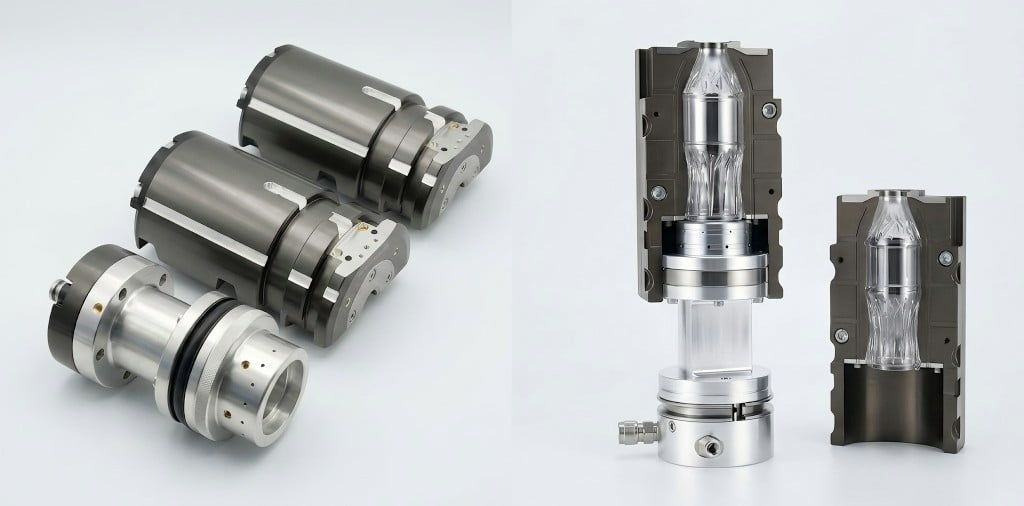
This is why PETMOLDER’s High-Speed Rotary Blow Molds for Krones & Sidel: A Guide to Premium Compatible Tooling focuses on the real equipment interface rather than treating a rotary replacement mold as generic tooling.
For a base-only project, the same principle applies:
A new base mold must fit both the bottle geometry and the existing machine.
Passing one check does not automatically mean it passes the other.
Does a Base-Only Change Mean the Existing Preform and Blowing Process Can Stay Unchanged?
Not necessarily. A mechanically compatible replacement base mold can still create a new material-distribution requirement. If the redesigned bottom changes stretch depth, standing geometry, push-up, or heel transition, the existing preform and blowing process should be reviewed before assuming the new bottom will form correctly.
This is where the tooling decision connects back to PET behaviour.
Imagine a project where the CAD comparison shows that the new bottom remains entirely inside the base-mold boundary.
From the mold perspective, this is promising.
But the new bottom may still be deeper or structurally different.
The PET now has to reproduce a different three-dimensional surface.
If the new design requires more material to reach a deeper standing region, or changes the relationship between the center and outer base, the material-distribution pattern may also change.
This does not mean the customer automatically needs a new preform.
It means we should not promise:
“The base fits mechanically, therefore everything else stays exactly the same.”
In actual two-stage PET production, bottle geometry, preform design, heating, axial stretching, pre-blow, high-pressure blowing, and mold cooling work together.
A partial tooling modification is only successful if the bottle can be produced repeatably after the new component is installed.
This is one reason we ask for preform information when the bottom change is significant.
Even when the buyer wants to purchase only one type of mold component, we still need to evaluate the bottle as a complete stretch-blow product.
If the modification is being considered because of stress-related bottom performance, PETMOLDER’s PET Blow Mold Design Guide: Preventing Bottle Stress Cracking via Base Geometry? covers that failure mechanism separately.
Here, the commercial point is simpler:
Tooling compatibility does not automatically prove process compatibility.
Both should be checked before a partial replacement is approved.
When Is a Full New Blow Mold the More Rational Purchasing Decision?
A complete new blow mold becomes the more rational option when the redesigned bottle affects both the base and side cavities, when too many existing interfaces need rework, or when modifying old tooling creates more uncertainty than manufacturing a matched new set. The decision should be based on engineering scope, not on component price alone.
Customers usually investigate base-only replacement for one obvious reason:
cost.
That is reasonable.
If the desired bottle can be produced by replacing a smaller tooling component while retaining the major cavity halves, there is little reason to manufacture more tooling than necessary.
But partial replacement should only be called cheaper when it actually solves the project.
Suppose the new bottom extends above the split line.
Now the customer needs new base molds and side-cavity modifications.
If the lower parts of the existing mold halves have to be significantly reworked, we also need to consider available machining allowance, cooling passages, existing surface condition, cavity consistency, and the risk of trying to convert used tooling into a substantially different geometry.
At some point, the commercial question changes.
It is no longer:
“Is one base mold cheaper than one complete blow mold?”
Of course it is.
The real comparison becomes:
“Is a heavily modified old mold a better investment than a new matched tooling set for the required bottle?”
That answer depends on the specific project.
We should not automatically recommend new tooling because we manufacture molds.
But we should also not force a partial modification only because its initial quotation looks lower.
For procurement, the correct objective is to buy the minimum tooling scope that completely and reliably produces the required bottle.
Sometimes that is a base mold.
Sometimes it is the base plus new cavity halves.
Sometimes the bottle architecture has changed enough that a complete replacement mold is the cleaner solution.
PETMOLDER’s article Custom Blow Molds: 4 Reasons Your New Mold Won’t Fit Your Blowing Machine discusses the larger compatibility question when new tooling is being introduced into an existing blow molding machine.
What Should Be Checked Before Ordering Only a Replacement Base Mold?
Before ordering a replacement PET base mold, first determine whether the proposed design is truly a component-level change. Compare the old and new bottle CAD, confirm the base split line and machine interface, then review whether the existing preform and blowing process remain suitable. Only then should the tooling scope be frozen.
When a customer sends us this kind of inquiry, the most useful first step is not sending a base-mold price list.
We prefer to see the existing bottle and the target bottle.
If both CAD files are available, we can place them on the same centerline and compare the geometry directly.
The first question is where they differ.
The second question is where they become identical again.
Then we compare this point with the existing base-mold interface.
If the geometry is already identical before reaching that interface, we can continue investigating a base-only solution.
If the new surface continues into the existing heel or lower-sidewall cavity, we know that the mold halves have become part of the project.
After that, we examine the actual tooling.
Original mold drawings are very helpful because they show the base split, interface dimensions, installation arrangement, cooling, and other features that may not be obvious from a bottle drawing.
For older replacement projects where original drawings are unavailable, detailed photographs and accurate measurements of the existing base and complete mold can help us perform a feasibility review.
Machine information also matters, particularly for rotary Krones, Sidel, KHS, and other high-speed molds where the base is part of a specific blow-station architecture.
Finally, if the bottom geometry changes significantly, we ask for preform information.
This is not because every replacement base requires a new preform.
It is because we need to know whether the existing PET material and blowing process can realistically form the new bottom.
Our Indonesian project followed this logic.
The customer first asked a simple commercial question:
“Can I change only the base?”
We did not answer from the component name.
We asked for the existing drawing and target design.
After comparing them, we could give him a technically defensible answer.
That is how we recommend buyers approach partial tooling replacement.
Before ordering a new base mold, first determine whether you are changing a mold component—or changing the bottle architecture.
If it is truly a component-level change, partial tooling replacement may be the correct investment.
If the new geometry has already changed the bottle architecture beyond the base-mold boundary, the complete tooling scope should be reconsidered before machining starts.
FAQ
Can I replace only the base mold of a PET blow mold?
Yes, it can be possible. In many rotary PET blow mold systems, the base mold is physically separate from the two mold halves; Krones and KHS both describe tooling arrangements where the base is treated as a distinct component. However, the new bottle geometry must still match the existing side cavities and machine interface. A removable base does not mean every bottom redesign can be achieved with base-only replacement.
How do I know whether a new bottle bottom needs a full blow mold?
Compare the old and new bottle CAD on the same centerline and determine where the changed geometry returns to the existing bottle surface. If that point remains inside the current base-mold boundary, base-only replacement may be feasible. If the heel or lower sidewall also changes above the base split line, the mold halves should be evaluated as part of the redesign.
Can I change the PET bottle base without changing the bottle body?
Sometimes. The upper bottle body can remain visually unchanged while the new bottom still modifies the heel or lower-body transition formed by the mold halves. This is exactly why we prefer an engineering drawing comparison rather than relying only on the statement “the bottle body is unchanged.”
Can I convert a round or water-bottle base to a CSD petaloid base by changing only the base mold?
Do not assume so. A petaloid base may extend into the heel and lower sidewall, and a CSD application also introduces internal-pressure and material-distribution requirements. Our Indonesian customer’s round-to-petaloid conversion could not be completed with a base-only replacement because the new transition extended into the existing mold-half cavity.
What information is needed to quote a replacement PET base mold?
The most useful information is the existing bottle drawing, the proposed new bottle or bottom CAD, existing mold information, exact blow molding machine configuration, and preform drawing. If the original mold drawing is unavailable, detailed photographs and critical dimensions of the existing base mold and complete tooling can be used for an initial feasibility review.
Conclusion
A PET base mold is often a removable tooling component.
But that fact alone does not tell us whether a bottle-bottom redesign can be completed by replacing it.
Our Indonesian customer with a 14-cavity Krones rotary mold is a good example.
He wanted to keep the bottle body and change only the bottom, so from a purchasing perspective, ordering only new base molds seemed logical.
I did not give him an immediate yes.
I first asked for his existing bottle drawing and the new bottom reference.
When we compared the two designs, we found that the requested change from a round base to a petaloid base did not remain inside the existing base-mold geometry. The petaloid transition extended outward and upward into the lower bottle body, where the existing left and right mold halves were still forming the old profile.
So in that project, replacing only the base mold was not a workable solution.
This is the distinction buyers should remember:
The real question is not whether the base mold can be removed. It is whether the new bottle-bottom geometry stays within the existing base-mold boundary.
If the new design remains within that boundary, a partial tooling replacement may save unnecessary mold investment.
If the new design crosses the boundary into the heel or lower sidewall, trying to save the existing mold halves can create an incomplete cavity and a more complicated project.
For this reason, before we quote a base-only conversion, we prefer to compare the old and new bottle geometry and review the existing tooling first.
If you are considering a PET base mold replacement for an existing Krones, Sidel, KHS, linear, or other blow molding machine, you can send PETMOLDER the existing bottle drawing, target bottle design, current mold information, machine model, preform drawing, cavity number, and available tooling photographs.
We can first determine where the geometry change actually stops and then recommend whether the project should use a replacement base mold, modified/new mold halves, or a complete replacement blow mold.
The purchasing principle is simple:
Do not decide the tooling scope from the name of the bottle part being changed. Decide it from the geometry that actually changes.
Related PETMOLDER Articles
- 2 Bottle Designs in 1 PET Blow Mold? The Hidden Risks
- Custom Blow Molds: 4 Reasons Your New Mold Won’t Fit Your Blowing Machine
- High-Speed Rotary Blow Molds for Krones & Sidel: A Guide to Premium Compatible Tooling
- PET Bottle Base Rollout Analysis: A 6-Step Guide to Fixing Center Gate Bulging and Rocker Bottoms
- PET Blow Mold Design Guide: Preventing Bottle Stress Cracking via Base Geometry?