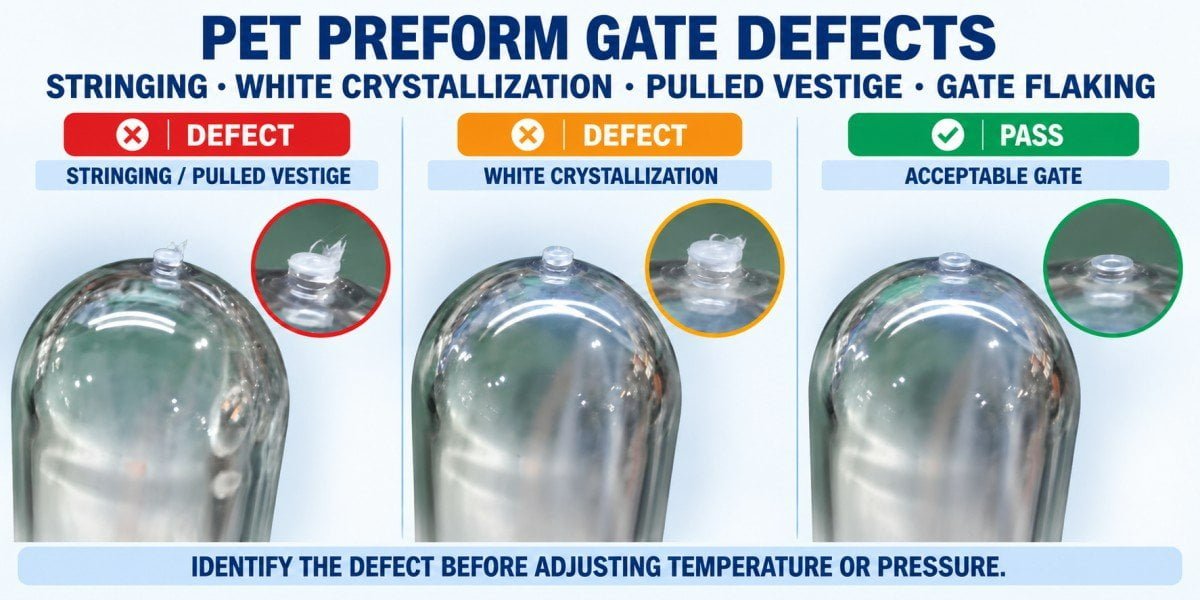
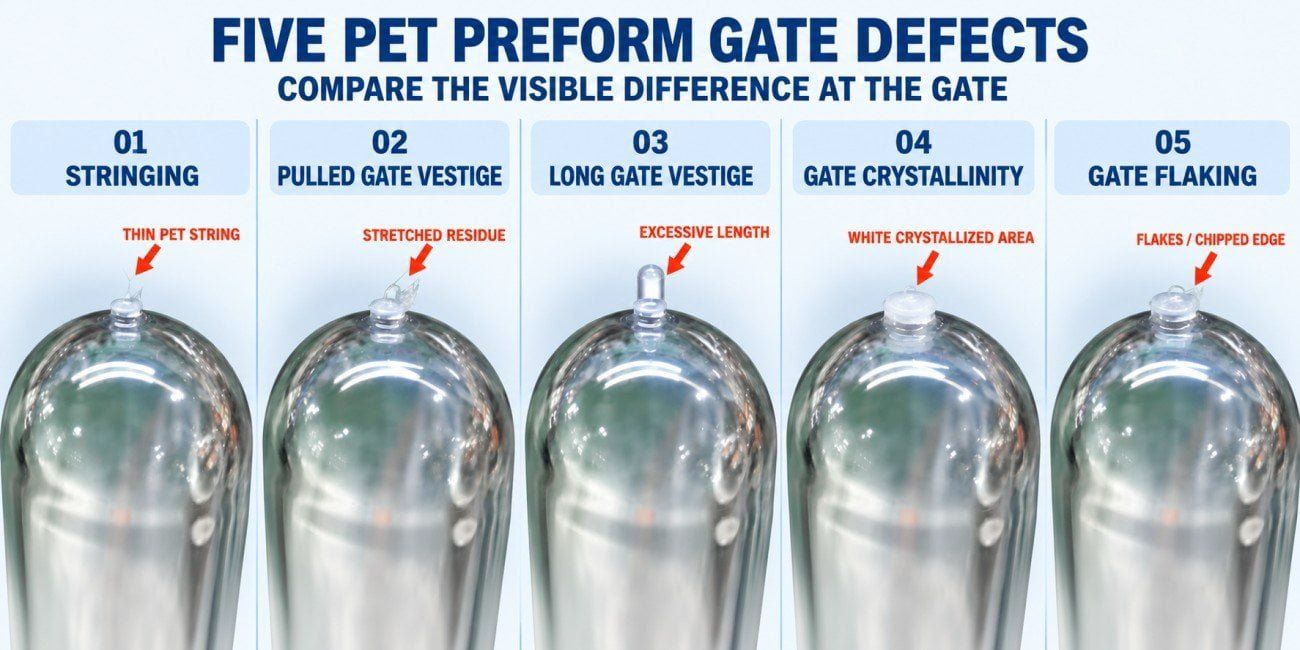
PET preform gate defects should be identified before process parameters or mold components are changed. Stringing, white gate crystallinity, pulled gate vestige, long gate vestige, and gate flaking can look similar around the preform base, but they do not always have the same cause. The correct troubleshooting path depends on cavity pattern, gate cooling, hot runner thermal condition, valve-pin action, and the injection process.
When a customer sends us a photograph of a defective PET preform gate, one of the easiest mistakes is to identify the defect too quickly.
A thin strand at the bottom may be true stringing.
A thicker projection may be a long gate vestige.
A stretched crystalline projection may be a pulled gate vestige.
A white area around the gate may involve gate crystallinity, while a torn crystalline fragment can indicate gate flaking.
These defects can also appear together.
That is why a photograph showing a white, stretched gate does not justify an immediate conclusion such as:
"The valve pin is damaged."
or:
"The nozzle temperature is too high."
The first engineering question should be:
What type of gate defect are we actually looking at, and does it occur on every cavity or only on specific cavity positions?
A recent case involving one of our Vietnamese customers illustrates why this distinction matters.
Real Vietnam Case: Why a 58 g PET Preform Suddenly Developed Stringing and a White Gate
Our Vietnamese customer was operating a 16-cavity PET preform mold for a 39 mm neck, 58 g edible-oil preform. The mold had previously produced normally, but the customer later reported elongated gate residue, local whitening, and fine stringing. Because the defect appeared after a period of stable production, we did not recommend machining the mold or replacing the valve pin immediately.
The customer's mold had 16 cavities, a 39 mm neck finish, and produced a relatively heavy 58 g PET preform intended for edible-oil bottles.
The mold was not a newly installed tool that had never produced acceptable preforms.
It had already been running.
The customer then sent us photographs showing that the gate area at the bottom of some preforms no longer looked like the previous production.
The visible condition included a thin strand around the gate, but the symptom was not limited to a hair-like string. The remaining gate material also appeared elongated, with a noticeable white or crystalline-looking area.
This distinction was important.
If we had looked only at the thin strand, we might have called the problem "stringing."
If we looked only at the white area, we might have called it "gate crystallinity."
If we looked only at the elongated projection, we might have called it a pulled or long gate vestige.
In practice, the customer was seeing overlapping gate symptoms.
Our first response therefore was not:
"Change the valve pin."
It was:
"Please separate the preforms by cavity number. We need to know whether all 16 cavities have the same gate condition or whether the problem is repeatedly coming from specific cavities."
That one piece of information changes the troubleshooting direction.
If nearly all 16 cavities suddenly develop similar defects, we would first look for a condition shared by the complete mold, such as chilled-water performance, common hot runner settings, process changes, or another system-wide production condition.
If only cavity #5 and cavity #11 show the defect while the other 14 cavities remain stable, the investigation becomes more local. The gate insert cooling, hot runner nozzle, valve pin, gate seal, and other components associated with those positions deserve more attention.
At the time of writing, we have not received sufficiently reliable final evidence from the customer to state that the root cause was definitely a blocked cooling channel, nozzle temperature, valve-pin wear, or one specific injection parameter.
For that reason, this case should remain technically accurate:
The cooling circuit was one of the first areas we asked the customer to verify, but the final root cause should not be claimed until the inspection is completed.
This leads to the main principle of the article:
Do not adjust the mold until you correctly identify the gate defect.
Is It Stringing, Pulled Gate Vestige, Long Gate Vestige, White Crystallization, or Gate Flaking?
Several PET preform gate defects can appear similar to the operator, but their physical forms are different. Correct identification provides the first troubleshooting direction: a hair-like strand is not the same defect as a stretched crystalline vestige, a thick melt projection, or a crystalline flake transferred into the next molding cycle.
The Mold-Masters PET-Series troubleshooting manual separates these gate defects instead of treating every bottom-gate abnormality as "stringing."
That distinction is useful for any PET preform factory, even when the installed hot runner is supplied by another manufacturer.
The exact corrective parameters remain system-specific, but the visual diagnostic logic is broadly useful.
| Gate Defect | Typical Appearance | What Makes It Different | First Diagnostic Direction |
|---|---|---|---|
| Stringing | Fine, hair-like strand extending from the gate nub | The material is drawn into a thin filament during separation | Check gate cooling, cooling time, hold condition, and hot runner thermal settings |
| Pulled Gate Vestige | Gate remains elongated and often has a stretched crystalline appearance | More of the gate residue is physically pulled during mold opening or separation | Check cooling-water condition, cooling time, mold-opening behavior, nozzle thermal condition, and pullback settings |
| Long Gate Vestige | Relatively thick or long melt protrusion remains at the gate | The defect looks more like an elongated mass than a fine string | Investigate valve-pin condition, actuation, gate seal, hold condition, pullback, and nozzle/manifold thermal condition |
| Gate Crystallinity | White or milky crystalline formation around or extending from the gate area | The main symptom is an abnormal crystalline thermal history rather than simply an elongated projection | Evaluate nozzle temperature, cooling, gate-insert water circuit, residence condition, shear, valve operation, and packing |
| Gate Flaking | Torn crystalline vestige or flake may appear around the gate or become molded into the preform dome | Material can remain around the gate interface and be carried into the following cycle | Inspect valve pin, gate insert, gate seal components, thermal condition, hold pressure, decompression, and valve timing |
This table also explains why a customer photograph can be difficult to classify.
A preform may show a pulled gate vestige with local crystallinity.
Another preform may show stringing together with a white gate area.
In the Vietnamese case, the most technically defensible description is:
The reported preforms show symptoms consistent with an elongated or pulled gate vestige accompanied by local whitening and stringing. Cavity mapping and process checks are required before the root cause can be identified.
That wording is more useful than declaring that one component has failed before any inspection has taken place.
PETMOLDER already has a more focused article about PET preform gate stringing, crystallization, beryllium copper, and valve-pin timing. The purpose of this article is broader: to help a factory distinguish several similar-looking gate defects before beginning troubleshooting.
Why Does PET Preform Gate Stringing Happen?
True PET preform gate stringing occurs when the material at the gate does not separate cleanly as the preform leaves the molding position. Instead, a small amount of PET remains sufficiently deformable to stretch into a hair-like strand. The investigation should therefore begin with the thermal condition and separation behavior at the gate, not automatically with mold machining.
A clean gate depends on several conditions happening correctly at approximately the same point in the cycle.
The preform must have enough local solidification to separate properly.
The gate region must be cooled correctly.
The hot runner nozzle must be operating within an appropriate thermal window.
The molding process must not leave the gate in an unstable material condition when separation occurs.
Mold-Masters describes stringing in its PET-Series manual as hair-like strands protruding from the gate nub. Its troubleshooting directions include checking cooling-water flow and temperature, increasing preform cooling time, reviewing hold time, and verifying the hot runner heat settings.
This gives us a practical engineering hierarchy.
| Area to Check | Why It Can Influence Stringing | What the Factory Should Compare |
|---|---|---|
| Cooling-water temperature | A warmer gate region can remain softer when the preform separates | Compare actual chilled-water condition with previous stable production |
| Cooling-water flow | Correct inlet temperature has limited value if insufficient water reaches the gate area | Confirm actual circulation rather than only checking whether hoses are connected |
| Preform cooling time | Shorter cooling reduces the time available for the gate/dome region to solidify | Compare current cycle settings with the previous stable process |
| Hold condition | Packing history can influence the thermal and pressure state around the gate | Review whether hold time or related process settings recently changed |
| Hot runner heat settings | An unsuitable local thermal condition changes how PET behaves at the gate | Confirm setpoint, actual response, and thermal stability rather than changing temperature blindly |
| Gate separation | The final defect appears when material does not break cleanly | Examine whether mold-opening, take-out, pullback, or valve-gate behavior changed |
This is particularly important when a mold has produced normally for months and then begins stringing.
The mold geometry has not automatically changed.
The more useful first question is:
Which production condition has changed since the last stable run?
For the Vietnamese 16-cavity mold, that is why we would first compare current chilled-water performance, actual flow, cycle conditions, hot runner behavior, and cavity pattern before considering a mechanical modification.
A clean gate requires both the correct thermal condition and the correct separation condition.
What Is the Difference Between Stringing and a Pulled Gate Vestige?
Stringing mainly appears as a thin filament, while a pulled gate vestige involves a larger portion of the gate being stretched during separation. A pulled vestige often looks thicker, longer, and more crystalline than ordinary stringing, so the cooling and mold-opening/separation conditions deserve closer examination.
The difference is easy to understand if we focus on the amount of material involved.
With true stringing, the remaining material forms something similar to a fine hair.
With a pulled gate vestige, the gate itself appears extended.
Mold-Masters describes a pulled gate vestige as an elongated gate with a stretched crystalline appearance.
Its troubleshooting guidance includes cooling-water flow and temperature, mold break, mold-opening speed, hold condition, nozzle temperature, cooling time, and pullback behavior.
This is why the customer's photograph should not automatically be classified as ordinary stringing if the projection is relatively thick.
| Observation | More Consistent With Stringing | More Consistent With Pulled Gate Vestige |
|---|---|---|
| Main feature | Very thin filament | Elongated gate residue |
| Amount of material | Small | More substantial portion of the gate |
| Surface appearance | May appear as a simple strand | Can appear stretched and crystalline |
| Separation relationship | Material draws into a fine string | Gate material itself is pulled during separation |
| Initial troubleshooting | Cooling and gate thermal condition | Cooling plus mold opening, separation, nozzle condition, and pullback behavior |
A factory does not need to choose between the two categories only from one photograph.
The important point is to recognize that the troubleshooting scope becomes broader when the entire vestige is being stretched.
What Is a Long Gate Vestige—and Why Is It More Closely Related to Valve-Gate Function?
A long gate vestige appears as an elongated melt protrusion rather than only a hair-like string. In a valve-gated PET preform system, this symptom can justify checking valve-pin damage, actuation, piston sealing, gate-seal condition, packing, pullback, and thermal settings because incomplete or abnormal gate closure can affect the remaining gate shape.
This defect is particularly relevant when operators describe the bottom as:
"There is a thick tail on the preform."
A thick tail is not the same visual defect as a fine strand.
The Mold-Masters PET-Series troubleshooting manual separates Long Gate Vestige from Stringing and Pulled Gate Vestige. Its diagnostic directions include the nozzle, valve pin, piston seals, actuation condition, gate-seal components, hold pressure/time, pullback, manifold temperature, and nozzle temperature.
That range of possible causes explains why replacing the valve pin immediately is not justified.
| Inspection Area | Why It Matters for a Long Gate Vestige |
|---|---|
| Valve pin | Physical damage can prevent the intended gate-closing relationship |
| Valve-pin actuator | Incomplete or unstable motion may prevent repeatable closure |
| Piston / actuator sealing | A drive problem may reduce the available movement or force depending on the system |
| Gate seal / gate insert | Damage or wear can change the geometry around the closing pin |
| Foreign material | Contamination can interfere with movement or gate formation |
| Hold pressure and hold time | Gate pressure condition at closing can influence the remaining melt behavior |
| Pullback / decompression | Changes pressure and material condition around the gate region |
| Manifold and nozzle thermal condition | Melt viscosity and gate behavior depend on the actual thermal state |
The exact pneumatic or hydraulic actuation pressure should come from the hot runner supplier.
A factory should not copy a pressure value from another hot runner brand simply because both systems are valve gated.
The correct instruction is:
Verify that the valve-gate actuator operates according to the original hot runner manufacturer's pressure, stroke, timing, and maintenance requirements.
Why Does the PET Preform Gate Turn White?
A white PET preform gate usually indicates an abnormal crystalline or thermal history around the gate, but it should not be simplified to "temperature too high." Gate crystallinity can be influenced by nozzle temperature in either direction, cooling performance, material residence, injection shear, gate-insert blockage, valve-gate behavior, hold pressure, and decompression.
This is one of the most commonly oversimplified PET preform defects.
An operator sees a white gate and immediately lowers the nozzle temperature.
The white area becomes worse.
The operator lowers it again.
Eventually the process moves farther away from the correct operating window.
Mold-Masters' PET troubleshooting guidance is valuable here because the recommended actions for gate crystallinity include both increasing and decreasing hot runner nozzle temperature, depending on the actual mechanism.
That tells us something important:
A white gate is a thermal-history problem, not simply a "high-temperature problem."
The PET around the gate can experience different undesirable histories.
When the gate region is not cooled effectively
If the gate insert is receiving insufficient cooling water, the local area can remain at an unsuitable temperature for too long.
The PET does not follow the intended cooling history, and crystallinity may become visible as whitening.
This is why the gate-insert cooling circuit should be inspected carefully.
When the local nozzle/gate condition is too cold or poorly balanced
The opposite direction can also create problems.
A material region with an unsuitable low-temperature history, stagnation, or poor thermal balance may not behave normally when it enters the next cycle.
This is one reason a diagnostic guide cannot give the universal instruction:
"White gate = lower temperature."
When injection shear adds additional heat
Injection fill rate also matters because flow through the gate creates shear.
If the local shear history is excessive for the process, the thermal condition at the gate can be affected even when the controller temperature appears normal.
When residence and cycle conditions change
If machine stoppage, dry-cycle behavior, residence time, cooling time, or process sequence changes, the gate-area material may experience a different thermal history from the one used during normal stable production.
The main relationships can be organized as follows.
| Condition | How It Can Contribute to a White Gate | What to Verify |
|---|---|---|
| Insufficient gate-area cooling | Local PET does not cool according to the intended cycle | Chilled-water temperature, flow, pressure, and gate-insert water passage |
| Gate-insert water contamination or blockage | Water may be connected but heat removal is locally reduced | Check internal water circulation rather than only external hoses |
| Unsuitable nozzle temperature | Local melt history becomes too hot or too cold for the actual process | Adjust only after confirming which direction improves the defect |
| Excessive shear heating | Melt receives additional thermal energy through high local shear | Evaluate fill rate together with gate quality |
| Unfavorable material residence | PET remains at processing temperature under an unsuitable time history | Review interruptions, machine cycle, and melt residence |
| Insufficient cooling time | Gate/dome is not solidified enough before separation | Compare with the previously stable cycle |
| Valve-pin action abnormality | Gate opening or closing behavior changes the local thermal and pressure history | Verify operation according to the hot runner design |
| Packing condition | Pressure and material flow around the gate remain different from the intended process | Review hold pressure/time before modifying steel |
This table explains why temperature should be adjusted only after the defect has been classified.
Do not keep lowering nozzle temperature simply because the gate is white.
Why Should You Check the Gate Insert Cooling Circuit Before Changing the Mold?
When a PET preform mold previously produced good gates and a new defect appears after extended production, cooling deserves early attention because water temperature, flow, pressure, contamination, and scale can change over time even though the mold geometry remains unchanged. "Water is connected" does not prove that every gate insert is being cooled correctly.
This is especially relevant to the Vietnamese case.
The mold previously produced acceptable 58 g preforms.
The gate defect developed later.
Whenever a stable mold develops a new problem, we prefer to investigate variables that can actually change during production before machining a component whose geometry has remained the same.
Cooling is one of those variables.
A chiller can operate at a different condition from the previous month.
A filter can become contaminated.
Plant water quality can create deposits.
A small cooling channel can gradually accumulate scale.
A hose or fitting can restrict flow.
A local gate insert passage can become partially blocked.
None of these conditions requires the external cooling hose to be completely dry.
That is why:
"Water is connected" does not mean "the gate is being cooled correctly."
A useful cooling investigation should compare actual thermal performance rather than simply confirming that the valve is open.
| Cooling Check | Weak Verification | Better Verification |
|---|---|---|
| Chiller operation | "The chiller is running." | Compare actual supply condition with the previous stable production state |
| Cooling-water temperature | Read only the chiller setpoint | Confirm the actual water condition reaching the mold |
| Flow | Touch the hose and feel water movement | Verify that the circuit has adequate circulation according to the mold design |
| Return water | Assume supply pressure means circulation | Confirm that water is actually returning through the intended circuit |
| Gate insert | Confirm external hoses are connected | Check whether the internal cooling passage is clean and unobstructed |
| Cavity comparison | Inspect the entire mold as one system | Determine whether defective cavities correspond to specific cooling branches |
Mold-Masters specifically includes cooling-water checks in its troubleshooting guidance for Stringing, Pulled Gate Vestige, and Gate Crystallinity. For Gate Crystallinity, it also calls for confirming that gate-insert water channels are free from contamination and blockage.
This is why cooling would be one of the first areas we would ask the Vietnamese customer to verify.
Not because we already know that cooling is the final root cause.
Because the symptoms and production history make it a logical early diagnostic step.
How Can Cavity Mapping Tell You Whether the Problem Is Global or Local?
Cavity mapping is one of the fastest ways to narrow a PET preform gate defect. If nearly every cavity develops the same symptom at the same time, common cooling, thermal, or process conditions deserve priority. If only fixed cavity numbers remain abnormal, the investigation should move toward the corresponding gate insert, nozzle, valve pin, and local cooling circuit.
For the 16-cavity Vietnamese mold, we would not put all preforms into one box and inspect them randomly.
The first samples should preserve cavity identity.
A simple inspection table is enough to reveal whether the defect follows the entire mold or a particular location.
| Cavity | Stringing | White Gate | Elongated Vestige | Flaking | Normal / Abnormal | Notes |
|---|---|---|---|---|---|---|
| #1 | Record | Record | Record | Record | Record | Add photo if abnormal |
| #2 | Record | Record | Record | Record | Record | Add photo if abnormal |
| #3 | Record | Record | Record | Record | Record | Add photo if abnormal |
| #4 | Record | Record | Record | Record | Record | Add photo if abnormal |
| #5–#16 | Continue the same inspection by cavity |
After several cycles, the pattern becomes much more useful than one isolated photograph.
| Cavity Pattern | More Likely Troubleshooting Direction |
|---|---|
| Nearly all 16 cavities change at the same time | Common chilled-water condition, common hot runner setting, material/process change, cycle change, or other system-wide factor |
| One complete region of the mold changes | Cooling branch, hot runner thermal zone, manifold region, or another shared local system |
| The same one or two cavities repeatedly fail | Gate insert cooling, nozzle, valve pin, gate seal, or local cavity-specific condition |
| Abnormal cavity changes randomly between cycles | Process repeatability, machine control, thermal stability, or changing production condition |
| Defect appears immediately after maintenance | Reinspect the serviced components and the production settings changed during restart |
This is the same reason cavity-level records are useful during mold acceptance. Our PET Preform Mold FAT Checklist for a 48-Cavity Mold discusses the value of checking a multi-cavity preform mold systematically rather than judging it from a few mixed samples.
The cavity number does not tell you the root cause, but it tells you where to start looking.
When Should You Inspect the Valve Pin, Gate Insert, and Hot Runner Nozzle?
If cooling is stable and the defect repeatedly follows specific cavity positions, the next investigation should become more local. In a valve-gated PET preform mold, the valve pin, actuator, gate insert, gate seal, nozzle thermal condition, and related wear should be checked according to the hot runner manufacturer's service requirements.
The order matters.
If all 16 cavities suddenly develop white gates after the chiller condition changes, disassembling one valve pin is unlikely to be the best first action.
If cavity #8 repeatedly produces a long vestige while the other 15 cavities remain normal under the same process, the local gate components become much more relevant.
Valve-pin movement
The pin must complete the required opening and closing movement according to the hot runner design.
The problem may involve physical pin damage, but incomplete movement can also result from the actuator or its control system.
Therefore, the inspection should include the complete action rather than only the appearance of the pin tip.
Gate insert and gate seal
The relationship between the valve pin and gate insert is critical.
Wear, damage, contamination, or an abnormal clearance can change how the gate closes and how the remaining PET separates.
Mold-Masters specifically directs users to inspect the valve pin and gate insert for wear in its Gate Flaking troubleshooting section.
Hot runner nozzle
A local nozzle temperature that differs from the intended process can change the viscosity and thermal condition of PET at that gate.
The operator should therefore distinguish between the programmed temperature and the actual stable behavior of the zone.
Actuation system
The valve-gate drive may be pneumatic or hydraulic depending on the system.
The correct pressure and motion requirements should come from the original manufacturer.
We do not recommend publishing a universal actuator pressure for all PET preform molds.
| Component / System | What Should Be Verified | Why It Can Affect the Gate |
|---|---|---|
| Valve pin | Damage, wear, full movement, timing, and closing condition | Determines whether the gate closes as intended |
| Valve-pin actuator | Repeatable movement according to supplier requirements | Incomplete actuation can leave an abnormal gate |
| Gate insert | Wear, damage, contamination, and cooling condition | Controls the local gate geometry and thermal environment |
| Gate seal components | Condition and fit | Wear or deformation can disturb the designed gate relationship |
| Nozzle heater / thermocouple | Stable and correct thermal control | Local viscosity and gate thermal history depend on it |
| Local cooling passage | Flow and cleanliness | The same cavity can remain too hot even when the general chiller is normal |
A spare valve pin can be valuable, but replacement should follow diagnosis.
For the same reason, a factory should not treat every gate defect as proof that the mold supplier delivered a bad valve pin.
What Is Gate Flaking—and Why Can It Appear in the Next Cycle?
Gate flaking is different from ordinary stringing because a portion of crystalline gate material can remain around the valve-pin/gate-insert interface and then be introduced into a later molding cycle. The resulting defect may appear as a torn crystalline vestige or a flake molded into the preform dome.
This mechanism makes gate flaking particularly confusing for operators.
The visible particle may appear on one preform even though the material originated from a previous gate event.
According to the Mold-Masters PET-Series troubleshooting description, a portion of the gate vestige can remain trapped between the gate insert land and valve pin and then be injected into the next cavity cycle.
This is why a flake should not automatically be diagnosed as random external contamination.
The defect can originate from the gate system itself.
The relevant inspection areas include the valve pin, gate insert, gate seal and insulator condition, nozzle temperature, hold pressure, decompression, and valve-pin closing timing.
| Gate Flaking Observation | Why It Matters |
|---|---|
| Torn crystalline material appears near the dome | The defect may originate from previous gate material rather than external contamination |
| Same cavity repeatedly produces flakes | Local gate insert / valve pin relationship becomes more important |
| Wear is visible around valve pin or gate insert | Mechanical inspection or replacement may become justified |
| Defect changes strongly with gate thermal condition | Temperature is contributing to material behavior around the gate |
| Defect changes with decompression or valve timing | The pressure and closing sequence deserve closer attention |
Again, this is why visual defect classification comes first.
A thin string and a crystalline flake may both be called "something at the bottom" by an operator, but they lead to different mechanical questions.
Which Process Parameters Should Be Adjusted—and in What Order?
Process adjustments should follow a controlled diagnostic sequence rather than changing several values at once. First determine the cavity pattern, then verify gate cooling and hot runner thermal stability, confirm valve-gate action where applicable, and only then optimize process variables such as cooling time, hold condition, fill rate, and decompression.
This is one of the most important practical parts of troubleshooting.
When production is under pressure, it is tempting to change many settings simultaneously.
The nozzle temperature is lowered.
Cooling time is increased.
Hold pressure is reduced.
Pullback is changed.
Injection speed is changed.
The defect disappears.
The machine is running again, but nobody knows what fixed it.
That means the factory has not actually learned the process.
When the defect returns, the same trial-and-error sequence begins again.
A more useful order is:
| Diagnostic Stage | What to Verify | Why It Comes Before the Next Stage |
|---|---|---|
| Cavity Mapping | Determine whether the symptom affects all cavities, one region, or fixed cavity numbers | Defines whether the investigation should be global or local |
| Gate Cooling | Confirm chilled-water condition, actual circulation, and gate-insert passages | Cooling is directly relevant to stringing, pulled vestige, and crystallinity |
| Hot Runner Thermal Condition | Confirm nozzle/manifold zones are stable and operating within the validated process | Prevents random temperature adjustment without knowing the starting condition |
| Valve-Gate Action | Confirm opening, closing, timing, and actuation according to supplier requirements | Mechanical gate behavior must be stable before fine process optimization |
| Process Window | Evaluate cooling time, hold condition, injection fill rate, decompression/pullback, and other relevant parameters | Allows controlled optimization after hardware conditions are verified |
| Revalidation | Sample by cavity again after each meaningful change | Confirms whether the adjustment corrected the actual defect pattern |
This sequence should not be interpreted as an absolute rule for every hot runner.
A known mechanical failure can obviously move the relevant inspection forward.
For example, if a damaged valve pin is physically visible, there is no need to pretend that cooling must be optimized before replacing a broken component.
The table is intended for situations such as the Vietnamese case where the root cause is not yet known.
Do not change five parameters at once. If the defect disappears, you need to know which change actually fixed it.
Why Is There No Universal "Reduce the Nozzle Temperature by 5°C" Solution?
A universal temperature correction is not technically reliable because the same visual symptom can result from different thermal mechanisms, and different hot runner systems have different nozzle designs, heater layouts, gate seals, materials, and validated process windows. The direction and magnitude of any temperature change should be determined from the actual defect response.
A troubleshooting article becomes dangerous when it publishes instructions such as:
"For white gates, decrease nozzle temperature by 5°C."
The first problem is that the existing setting is unknown.
The second problem is that the hot runner design is unknown.
The third problem is that white crystallinity may improve by changing temperature in either direction, depending on the actual thermal history.
Mold-Masters' own Gate Crystallinity troubleshooting page demonstrates this by listing both an increase and a decrease in hot runner nozzle temperature among possible corrective directions.
That does not mean both actions should be performed randomly.
It means temperature direction must be diagnosed.
| Situation | Why a Fixed Temperature Recipe Is Unreliable |
|---|---|
| Nozzle is locally too hot | Further increasing temperature could worsen the thermal condition |
| Material around gate is too cold or stagnant | Further lowering temperature could move the process farther from the stable window |
| Cooling water is restricted | Changing the controller setpoint does not repair the blocked water circuit |
| Valve pin is not operating correctly | Temperature adjustment cannot restore a damaged mechanical action |
| Hold / pullback condition is unstable | Gate pressure history may remain incorrect even after temperature changes |
| One cavity differs from the other 15 | A global nozzle/manifold change may disturb cavities that are already producing correctly |
The same caution applies to hold pressure, injection speed, cooling time, and decompression.
Parameter changes should be based on observed response.
How We Would Troubleshoot the Vietnamese Customer's 16-Cavity 58 g Preform Mold
Because the Vietnamese mold previously produced normally and the new symptom includes both an elongated/stringing gate and local whitening, we would not machine the gate or replace the valve pin first. We would map all 16 cavities, verify gate-area cooling, review local hot runner thermal behavior, confirm valve-pin action on affected positions, and then optimize the process using controlled changes.
The existing information gives us three useful facts.
The mold has 16 cavities.
The preform uses a 39 mm neck and weighs 58 g for an edible-oil application.
Most importantly, the mold previously produced acceptable parts.
This last point changes the diagnostic logic.
If the mold has been running correctly and the geometry has not been mechanically altered, we should first investigate conditions that can change over time.
The following table shows how we would approach the actual case.
| What We Observe | First Question | Next Technical Direction |
|---|---|---|
| All 16 cavities show similar white/stringing gates | What common production condition changed? | Check chilled-water system, hot runner common thermal settings, cycle/process changes, and PET processing condition |
| Only one or two fixed cavities show the problem | What is different at those local positions? | Check gate-insert water passage, local nozzle zone, valve pin, gate insert, gate seal, and actuator behavior |
| Defect appeared after cycle time was shortened | Is the gate/dome receiving enough cooling before separation? | Compare cooling time and gate condition with previous stable production |
| Defect appeared after chiller or water-system changes | Is the actual gate-area heat removal still the same? | Verify supply, return, flow, temperature, pressure, and local passage cleanliness |
| White gate changes when nozzle temperature is adjusted | Which direction moves the process toward a stable gate? | Make controlled thermal adjustments instead of assuming "white = too hot" |
| Thick long vestige remains after cooling is verified | Is valve-gate closure functioning normally? | Inspect valve pin, actuator, seal components, gate insert, and pressure history |
| Flakes repeatedly appear at one cavity | Is crystalline material being trapped around the local gate interface? | Inspect pin/insert wear and gate-flaking mechanism |
For the current Vietnamese case, gate-area cooling is one of the most valuable early checks, because the defect combines stretching/stringing with local whitening and because the mold developed the problem only after operating normally.
However, we should keep the wording disciplined:
Cooling is a high-priority diagnostic direction, not a confirmed root cause.
If the customer later reports that the gate-insert water passage was partially blocked and that cleaning restored normal production, then the article can be updated into a completed case:
Stable production → cooling passage contamination → lower local flow → abnormal gate thermal condition → stringing/whitening → circuit cleaned → flow restored → cavity revalidated.
If instead the final inspection identifies a damaged valve pin, incorrect nozzle thermal zone, or process setting, the case should record that actual result.
The customer case is most valuable when the final root cause is real.
How Should the Customer Confirm That the Gate Problem Is Actually Solved?
A gate defect should be considered corrected only after the relevant cavity positions remain stable over repeated production cycles. One visually good preform immediately after an adjustment is not enough; the factory should confirm cavity repeatability, gate appearance, weight, and stable hot runner/cooling conditions before returning to normal production.
This is especially important after multiple adjustments.
Suppose cavity #7 showed a white elongated gate.
The technician changes the nozzle temperature.
The next preform from cavity #7 looks good.
That result is encouraging.
It is not yet proof that the process is stable.
The factory should observe repeated cycles under stable production conditions.
| Revalidation Check | What It Confirms |
|---|---|
| Same affected cavity remains normal over repeated cycles | The correction is not only a one-shot improvement |
| Other cavities remain acceptable | The correction did not solve one cavity by disturbing the rest of the mold |
| Gate whitening does not gradually return | Thermal condition remains stable after the system reaches equilibrium |
| Stringing or elongated vestige does not reappear | Separation remains repeatable |
| Gate flakes are no longer found in later cycles | Residual gate material is not continuing to transfer |
| Preform weight and general quality remain within project requirements | Gate correction has not created another molding problem |
For cavity-specific defect diagnosis, the quality approach should be similar to other multi-cavity preform problems: preserve the cavity number.
A random box of preforms cannot tell the maintenance team whether the originally defective drop has recovered.
When Should the Mold Be Opened for Mechanical Inspection?
Mechanical inspection becomes more justified when the defect repeatedly follows the same cavity after cooling, thermal settings, and process conditions have been verified, or when there is direct evidence of valve-pin damage, gate-insert wear, actuator abnormality, or another local component problem. Process adjustment should not be used indefinitely to hide a mechanical defect.
The process-first approach should not be misunderstood.
We are not saying:
"Never inspect the mold."
We are saying:
Do not open a precision hot runner simply because one photograph shows a white gate.
Hot runner service introduces its own risks.
Precision components can be damaged during unnecessary disassembly.
Contamination can enter sealing or moving areas.
Incorrect reassembly can create a new problem that did not previously exist.
Mechanical inspection becomes more appropriate when evidence points locally.
| Evidence | Is Mechanical Inspection More Justified? |
|---|---|
| All cavities change together after chiller failure | Not as the first action |
| Problem disappears after restoring cooling flow | No local gate repair is indicated by that evidence |
| One cavity remains abnormal after process stabilization | Yes, local inspection becomes more useful |
| Valve pin does not complete normal movement | Yes |
| Gate insert shows visible wear or damage | Yes |
| Gate flaking repeatedly follows one position | Yes, pin/insert/seal condition deserves inspection |
| Long gate vestige persists despite stable cooling and thermal conditions | Valve-gate system should be checked |
| Defect appeared immediately after gate-component maintenance | Reinspect the serviced local components |
This logic also protects the mold from unnecessary modification.
Our article Why Do Hidden PET Preform Mold Defects Kill Your Factory Profits? discusses why precision preform mold conditions can create production losses that are not obvious from the initial mold appearance.
Why Should Gate Defects Be Checked Before the Preforms Reach the Blow Molding Line?
Gate defects are formed during preform injection, but their consequences do not necessarily end at the injection machine. Excessive vestige, crystalline material, flakes, or abnormal gate geometry can complicate preform handling and may influence the behavior of the preform base during downstream reheating and stretch blow molding.
A PET preform is an intermediate package component.
The bottom dome and gate region later become part of the stretched bottle base.
That means a gate defect should not be judged only by whether the preform can be packed into a carton.
The importance depends on the defect severity and final bottle application.
For an edible-oil bottle, bottle-base quality, stability, appearance, and mechanical behavior still matter after blowing.
A small visual preform defect can sometimes become less noticeable after blowing, while another gate abnormality may contribute to a more visible or structural base issue.
The correct approach is not to predict the bottle result from appearance alone.
If a new gate condition has appeared, the factory should first correct the preform process and then validate the preform on the intended blow-molding process where necessary.
For buyers evaluating overall preform quality rather than only gate appearance, How to Procure PET Preforms: A Guide to Avoiding 8 Critical Defects provides a broader quality-control perspective.
A Practical PET Preform Gate Defect Troubleshooting Matrix
The fastest troubleshooting method is to combine defect appearance with cavity pattern and production history. The same white or stretched gate can point toward cooling, hot runner temperature, valve-gate mechanics, or the injection process, so the visible defect should be used to select the next inspection—not to declare the root cause.
| Observed Gate Condition | Cavity Pattern | High-Priority Checks | Avoid Doing First |
|---|---|---|---|
| Hair-like string | All cavities | Cooling-water condition, cooling time, hot runner thermal settings, hold condition | Replacing all valve pins |
| Hair-like string | One fixed cavity | Local gate cooling, nozzle thermal zone, local gate condition | Changing the complete mold temperature without comparison |
| White crystalline gate | All cavities | Cooling system, nozzle thermal window, residence condition, fill shear, process changes | Automatically lowering every nozzle zone |
| White crystalline gate | Fixed cavities | Gate-insert water passage, local nozzle, valve operation | Machining the gate before confirming thermal condition |
| Pulled crystalline vestige | Several cavities | Cooling, mold opening/separation, nozzle temperature, pullback | Calling it ordinary stringing without checking vestige shape |
| Thick long gate vestige | Fixed cavity | Valve pin, actuator, gate seal, pressure history, local thermal condition | Increasing cooling indefinitely without checking valve closure |
| Crystalline flakes | Fixed cavity | Valve pin/gate insert wear, gate seal, decompression, valve timing | Treating every flake as random contamination |
| Several defects appear after recent process change | Many cavities | Compare new settings with previous stable process | Opening the hot runner before returning to known conditions |
| Several defects appear after cooling maintenance | One mold region | Verify the modified cooling branch and local flow | Assuming connected hoses equal correct cooling |
The table should be used as a diagnostic map rather than a universal parameter recipe.
Different PET preform hot runners have different nozzle constructions, gate inserts, actuators, thermal designs, and validated process windows.
FAQ
Why does my PET preform have a string coming from the bottom gate?
A hair-like strand protruding from the gate is consistent with PET preform gate stringing.
The first checks should include gate-area cooling, cooling-water condition, preform cooling time, hold condition, and hot runner thermal settings. If the problem repeatedly follows one cavity, the local gate insert, nozzle, and valve-gate condition should also be evaluated.
Why does the PET preform gate turn white?
A white gate commonly indicates gate crystallinity or an abnormal local thermal history, but it does not simply mean the nozzle temperature is too high.
Cooling-water condition, gate-insert blockage, nozzle temperature, material residence, injection shear, cooling time, valve-gate operation, packing, and decompression can all be relevant. Temperature should therefore be adjusted according to the defect response rather than automatically reduced.
What is the difference between stringing and pulled gate vestige?
Stringing mainly appears as a thin, hair-like filament extending from the gate.
A pulled gate vestige involves a larger portion of the gate material being stretched during separation and can have a more elongated, crystalline appearance.
Because the mechanisms overlap but are not identical, pulled vestige troubleshooting gives more attention to cooling, mold opening/separation, nozzle condition, and pullback behavior.
Can a blocked cooling channel cause PET preform gate defects?
Yes, restricted gate-insert cooling can contribute to gate defects because the PET around the gate may not follow the intended cooling history.
Official PET hot runner troubleshooting guidance includes checking cooling-water flow and temperature for stringing and pulled gate vestige, and specifically recommends confirming that gate-insert water channels are free from contamination and blockage when investigating gate crystallinity.
However, a blocked channel should be confirmed rather than assumed from appearance alone.
Should I replace the valve pin when PET preform gate stringing appears?
Not immediately.
First identify whether the defect is true stringing, a pulled gate vestige, a long gate vestige, crystallinity, or flaking, and determine whether it affects all cavities or fixed positions.
Cooling and thermal conditions should be checked before replacement. Valve-pin repair or replacement becomes more justified when inspection shows damage, wear, incomplete action, abnormal closing behavior, or a repeated local gate defect that remains after process conditions are stabilized.
Conclusion
PET preform gate defects should be diagnosed by defect type, cavity pattern, production history, cooling condition, hot runner behavior, and valve-gate action before the mold is modified. A white or stretched gate is a symptom—not a complete diagnosis.
Our Vietnamese customer's 16-cavity, 39 mm neck, 58 g edible-oil preform mold is a useful example.
The mold had previously produced normally.
The customer later reported gate stringing, an elongated gate residue, and local whitening.
That combination did not justify immediately concluding that the valve pin was damaged.
It also did not justify telling the customer simply to lower the nozzle temperature.
The correct first step was to determine whether the symptom followed all 16 cavities or only specific cavity numbers.
From there, the investigation could move in a controlled sequence.
| Diagnostic Question | Why It Matters |
|---|---|
| Are all 16 cavities affected? | A common cooling, thermal, material, or process condition becomes more likely |
| Are only fixed cavities affected? | Local gate cooling, nozzle, valve pin, gate insert, or actuator deserves closer inspection |
| Did the mold previously produce good gates? | Conditions that change over time should be investigated before unchanged mold geometry |
| Is actual gate-insert cooling still effective? | Connected water lines do not guarantee adequate local heat removal |
| Is the white area true gate crystallinity? | Temperature direction cannot be selected correctly until the defect is classified |
| Is the projection a thin string or a thick/elongated vestige? | The distinction changes the priority given to separation and valve-gate mechanics |
| Does the defect respond to one controlled process change? | Cause-and-effect information can be preserved |
| Does the problem remain after process stabilization? | Mechanical inspection becomes more justified |
For the current Vietnamese project, gate-area cooling is one of the first conditions we would verify because the mold previously operated normally and because both stretching/stringing and whitening are sensitive to gate thermal conditions.
However, the final customer result has not yet been confirmed.
We therefore will not invent a completed root-cause story.
If the customer eventually confirms a blocked gate-insert water circuit, that will become the case conclusion.
If the customer finds valve-pin wear, nozzle temperature imbalance, or another process issue, the article should record that actual result instead.
From our manufacturing experience, this discipline is more important than providing a fast but unsupported answer.
A white, stretched PET gate is a symptom—not a diagnosis. The fastest solution comes from identifying whether the problem follows the cavity, the cooling condition, the hot runner, or the process.
If you are troubleshooting PET preform gate defects, provide the preform weight, neck finish, mold cavity number, photographs from each affected cavity, cavity map, chilled-water condition, cooling time, hot runner temperature records, valve-gate system information, recent maintenance history, and current molding parameters.
With this information, the mold supplier can evaluate whether the next step should focus on gate cooling, nozzle thermal balance, valve-pin action, gate-insert condition, or the injection process instead of changing mold components without evidence.
Related PETMOLDER Articles
- Eliminating PET Preform Gate Stringing and Crystallization: The Role of Beryllium Copper and Valve Pin Timing
- How to Procure PET Preforms: A Guide to Avoiding 8 Critical Defects
- PET Preform Mold FAT Checklist: How to Inspect a 48-Cavity Mold Before Delivery
- PET Preform Concentricity: Why Mold Precision Matters
- Why Do Hidden PET Preform Mold Defects Kill Your Factory Profits?
-300x300.jpg)