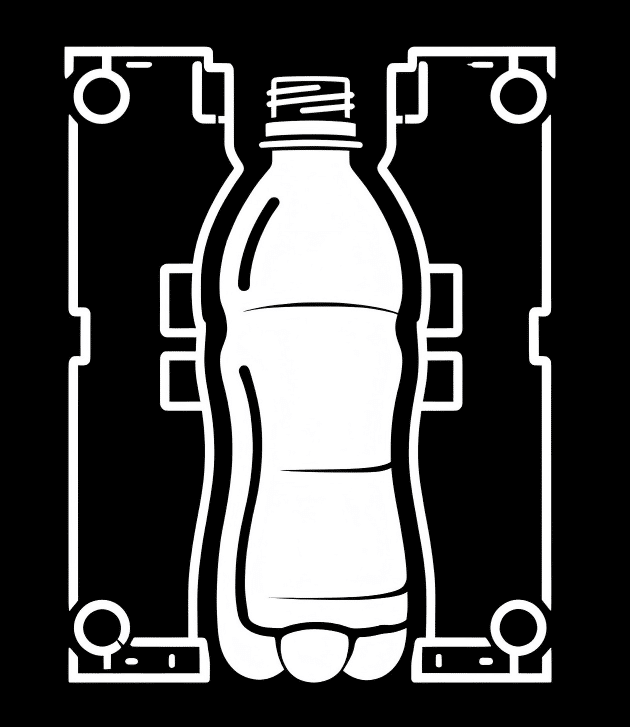
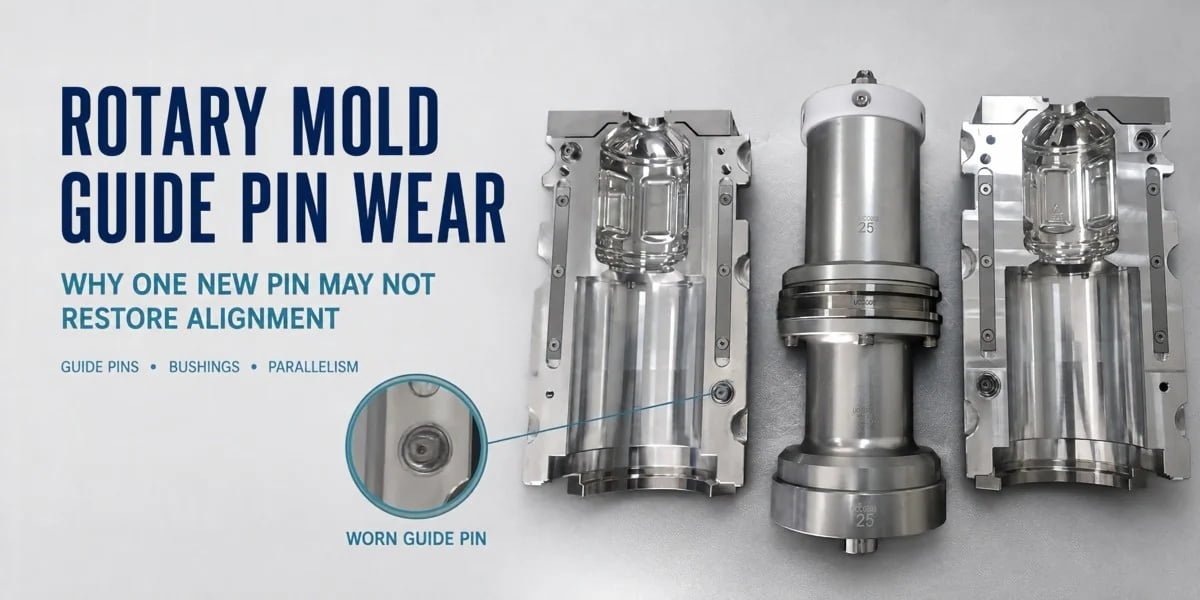
A rotary PET blow mold can continue opening and closing even after wear has started to develop in its guide system. However, a mold that can still close mechanically is not necessarily returning its two cavity halves to exactly the same relative position on every production cycle.
When guide pins and guide bushings wear, the repeatability of mold alignment may gradually decrease. On an older rotary mold where wear has developed across more than one guide position, replacing only the most visibly damaged guide pin may not restore the original alignment of the complete guide system.
In the rotary mold structure discussed in this article, the guiding arrangement consists of two guide pins working with two corresponding guide bushings. Each pin and bushing operate as a pair during mold closing, so their condition should be evaluated together rather than treating the visible pin as an isolated wear part.
This distinction became particularly important in one of our Saudi Arabia projects. The rotary tooling had already been running for approximately three years when the customer noticed that the bottle parting line had become considerably heavier than before. Inspection later confirmed wear in the guide system.
For that specific long-service mold, we did not recommend replacing only the guide pin that looked worst. We recommended restoring the two guide positions by replacing both guide pins and both corresponding guide bushings in the affected mold.
That recommendation should not be converted into a universal maintenance rule. If one guide pin suffers isolated accidental damage while the other guide pin, both bushings, mounting locations, and overall mold alignment remain within the intended condition, replacing one component may still be reasonable.
The correct maintenance decision depends on the wear pattern, operating history, measured fit, and condition of the complete mold-guiding system.
What Do Guide Pins and Guide Bushings Actually Do in a Rotary PET Blow Mold?
Guide pins and guide bushings help the two cavity halves return to a repeatable relative position during every opening and closing cycle. The critical requirement is not simply that the mold can close, but that the cavity halves continue to close in the same geometric relationship after long-term rotary production.
A rotary PET blow molding machine repeatedly opens and closes every mold station during production. After a finished bottle is released, the tooling receives the next heated preform, closes again, and begins another stretch blow molding cycle.
Because this movement repeats continuously, the cavity halves must return to essentially the same position every time.
During closing, each guide pin enters its corresponding guide bushing and helps control the relative location of the mold halves. The pin and bushing therefore form a working pair, and the condition of one component cannot be evaluated properly without considering the condition of the other.
| Guide-System Function | Why It Matters in Rotary Blow Molding |
|---|---|
| Controls relative movement during mold closing | Helps the two cavity halves approach the intended position rather than moving freely relative to each other |
| Supports repeatable mold-half positioning | Helps maintain a consistent cavity relationship at the parting position |
| Operates during every mold cycle | Long-term production exposes the guide system to repeated contact and wear |
| Functions as a pin-and-bushing pair | Wear in either component can alter the effective guide clearance |
| Supports bottle geometry consistency | Loss of repeatability can become visible on the final PET bottle |
| Contributes to station-to-station consistency | Important on rotary equipment where many stations produce the same bottle design |
The guide system should not be treated as the only mechanism controlling rotary mold alignment. Depending on the machine platform and mold construction, mounting interfaces, locating surfaces, closing mechanisms, and the mechanical condition of the blow station also influence the final position of the cavity halves.
Guide pins and guide bushings nevertheless deserve particular attention because they participate directly in repeated mold closing.
Why the Guide Pin and Guide Bushing Must Be Evaluated Together
A guide pin does not operate independently. Every closing cycle brings the guide pin into contact with its guide bushing under the actual alignment, loading, and movement conditions of the blow station.
If a guide pin has accumulated wear after several years of production, the corresponding guide bushing has also completed the same operating cycles. Their wear rates may not be identical, but their operating histories are directly connected.
This leads to an important maintenance principle:
A new guide pin installed into a worn guide bushing may not restore the original guiding condition.
For this reason, when we inspect a long-running rotary blow mold, we evaluate the effective relationship between the pin and bushing rather than focusing only on scratches or polishing marks visible on the pin surface.
For buyers working with high-speed rotary tooling, our High-Speed Rotary Blow Molds for Krones & Sidel: A Guide to Premium Compatible Tooling explains why the mold should always be evaluated together with the machine platform and station structure.
What Are the Typical Signs of Guide Pin or Guide Bushing Wear?
Guide-system wear often appears first as a gradual production change rather than an obviously broken component. A parting line that becomes heavier over time, increasing differences between stations, one-sided guide-pin wear, bushing damage, or measurable clearance changes can all justify further inspection, but none of these signs alone proves that guide wear is the root cause.
When a customer reports that the bottle parting line has become more visible, changing guide components immediately is not the correct first response.
Parting-line appearance can also be influenced by mold installation, locating surfaces, machine-side station positioning, actual mold-half mismatch, contamination, or another mechanical condition. The operating history helps determine which causes deserve priority.
A new mold that produces a strong parting line immediately after commissioning should be investigated differently from tooling that ran successfully for several years before gradually changing.
| Production Observation | Recommended Investigation Direction |
|---|---|
| One rotary station suddenly develops a heavier parting line | Inspect that station, its mold installation, guide system, and closing condition |
| Several older molds gradually show similar changes | Long-term component wear becomes a stronger possibility |
| One guide pin shows clear unilateral polishing or scoring | Check the corresponding guide bushing and determine whether the pair is wearing unevenly |
| A new mold shows the problem immediately after installation | Check installation, seating, mechanical compatibility, and station condition before assuming wear |
| Parting-line appearance changes from cycle to cycle | Investigate repeat positioning and dynamic machine behavior |
| A new guide pin is installed but alignment remains poor | Inspect the bushing, mounting features, and other locating components |
| Both guide positions show wear after long production | Evaluate the complete guide system rather than one visible component |
Guide pins can develop one-sided polished areas, grooves, scoring, scratches, or measurable diameter loss. Guide bushings may show internal scoring, local wear, enlarged effective clearance, or damage around the entry region.
These conditions are more useful when considered as part of the complete wear pattern than when treated as isolated visual defects.
Visual inspection is a good starting point, but dimensional inspection provides stronger evidence when the maintenance decision affects mold alignment. Where original drawings or manufacturing specifications are available, used guide components should be compared with the intended design rather than judged only from appearance.
A changing bottle parting line can be a warning sign of guide-system wear, but it is not proof by itself.
Why Can Worn Guide Pins and Bushings Make the PET Bottle Parting Line More Visible?
Wear between the guide pins and guide bushings can increase effective clearance and reduce the repeatability of the closed mold position. Even a relatively small geometric change between the cavity halves can make the bottle parting line more visible, particularly on transparent smooth PET bottles where reflected light can amplify minor surface differences.
A PET bottle cavity is created by two mold halves. When the tooling closes correctly, the contour from one half should continue into the contour of the opposite half with good geometric continuity.
If the guide system develops additional clearance, the exact closed position can become less repeatable. The bottle may then reproduce a small step or local parting-line mismatch that did not exist, or was less visible, when the guide system was in better condition.
The key mechanical question is therefore not whether one guide pin looks scratched. The more useful question is whether the entire guide system can still return the two cavity halves to the intended relative position consistently.
| Guide-System Condition | Possible Effect During Production |
|---|---|
| Pin and bushing fit remains within the intended condition | Mold-half positioning can remain more repeatable |
| One guide position develops abnormal wear | Local guiding control may become less consistent |
| Both guide positions accumulate long-term wear | Overall mold alignment repeatability may decrease |
| Guide-bushing clearance increases | Installing a new pin alone may still leave excessive movement |
| Pin and bushing wear unevenly | The guide load may become less balanced |
| Closed mold position varies between cycles | Bottle parting-line appearance may also vary |
| The bottle is clear and highly polished | A small physical difference may look stronger under directional lighting |
Transparent PET can make this symptom appear more serious than the actual geometric displacement.
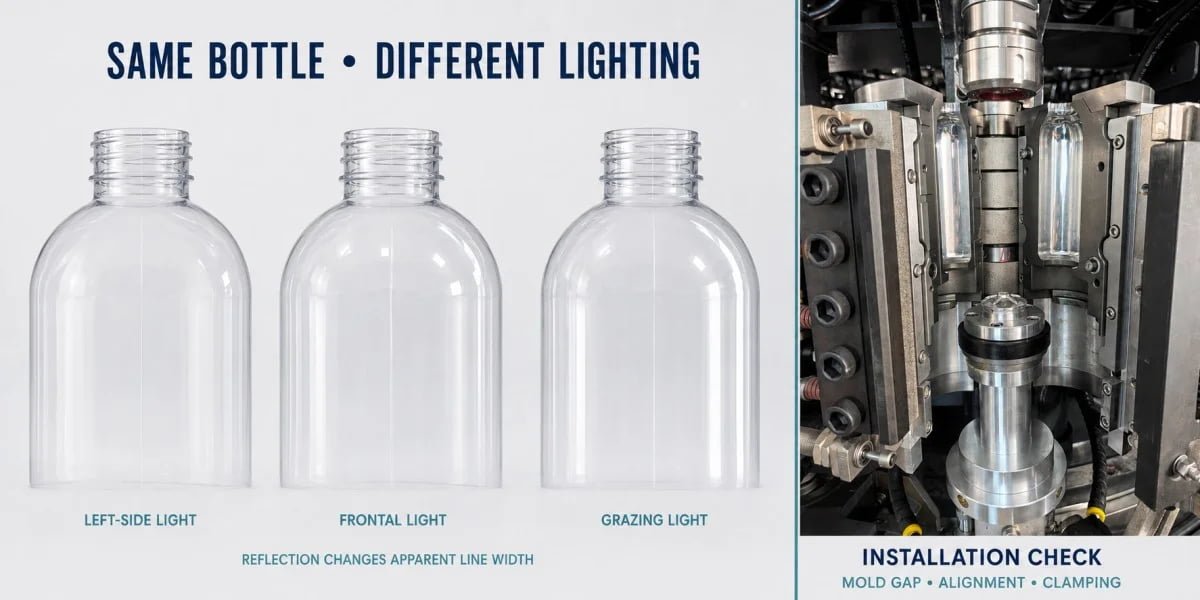
A very small step at the parting location can interrupt the bright reflected highlight on a smooth round bottle, producing a stronger visible line. For that reason, we recommend checking whether the line can actually be felt or measured rather than estimating mold misalignment from a photograph alone.
Guide wear may be one contributing factor, but bottle appearance should not be treated as a direct measurement of guide clearance.
How Should You Inspect the Guide Pins and Guide Bushings?
The guide system should be inspected as two pin-and-bushing pairs. If one guide position shows significant wear, the corresponding bushing should be inspected at the same time, while the second guide pair should also be checked to determine whether the problem is isolated or part of broader long-term wear.
Simple component replacement begins with the damaged-looking part.
Proper mold maintenance begins with the working relationship between components.
If one guide pin has obvious scoring, the investigation should continue into its corresponding guide bushing. The opposite guide pair should then be compared so the maintenance team can determine whether only one position has been affected or whether the complete system is aging.
| Inspection Area | What Should Be Checked | Why It Matters |
|---|---|---|
| Guide Pin No. 1 | Surface condition, one-sided wear, scoring, grooves, and dimensional change | Establishes the condition of the first guide position |
| Guide Bushing No. 1 | Internal wear, scoring, effective clearance, and entry condition | Determines whether a new pin can still work with the existing bushing |
| Guide Pin No. 2 | Wear pattern compared with the first pin | Helps distinguish isolated damage from broader guide-system wear |
| Guide Bushing No. 2 | Internal condition compared with the first bushing | Completes the evaluation of both guide positions |
| Pin mounting area | Burrs, looseness, damage, or incorrect seating | A precision pin cannot guide accurately if its mounting position is compromised |
| Bushing mounting area | Seating, movement, damage, or deformation | Bushing position directly influences final mold alignment |
| Mold parting and locating surfaces | Dirt, damage, abnormal contact, or seating problems | Prevents another positioning issue from being misdiagnosed as guide wear |
| Machine-side blow station | Closing repeatability and mechanical condition | Confirms whether the machine is contributing to the wear or alignment change |
Why One-Sided Wear Should Trigger a Broader Inspection
If one side of a guide pin is noticeably more polished or worn than the opposite side, the contact load may not have been distributed evenly.
Replacing the pin without investigating the cause can result in the new component developing a similar pattern later.
The uneven contact could be associated with the guide bushing, mold seating, blow-station alignment, contamination, or another mechanical condition. The exact cause has to be established from the actual tooling and machine.
The maintenance question is therefore not simply whether the worn pin should be replaced. It is also why that guide position experienced the observed wear pattern.
Dimensional Inspection Is More Reliable Than Appearance Alone
A component can look heavily polished while still retaining an acceptable dimensional relationship. Another component may appear visually clean but already have measurable wear.
For important rotary tooling, measurements should therefore be compared with the original mold specification whenever reliable design data is available.
We do not recommend applying a universal guide-pin-to-bushing clearance taken from another mold because the intended fit depends on the specific rotary tooling design.
Should You Replace Only One Worn Guide Pin—or Replace Both Guide Pairs?
There is no fixed replacement rule that applies to every rotary PET blow mold. An isolated damaged guide pin may be replaced individually when the remaining guide pin, both bushings, mounting areas, and alignment remain in acceptable condition. When wear has developed across an older guide system, restoring both pin-and-bushing pairs can provide a more consistent maintenance result.
This decision should be based on the failure mechanism rather than on a general statement such as “always replace one” or “always replace everything.”
A relatively new mold may suffer accidental damage to a single guide pin during maintenance. If inspection confirms that the opposite guide position and both bushings remain within the original fit condition, replacing only the failed component can be technically reasonable.
A long-running rotary mold presents a different situation.
If the mold has operated for several years and both guide positions have accumulated measurable or visible wear, the system is no longer dealing with one isolated failed part. The complete guiding relationship has aged.
| Maintenance Condition | More Appropriate Engineering Direction |
|---|---|
| One guide pin has isolated accidental damage | Individual replacement may be reasonable after the remaining system is verified |
| The second guide pin and both bushings remain within specification | Good components do not need automatic replacement |
| The mold has operated for years and wear is present at both guide positions | Evaluate the two pin-and-bushing pairs as one aged guide system |
| One bushing already has enlarged clearance | Replacing the corresponding pin alone may not restore the intended fit |
| Both bushings show wear | Replacing both guide pairs becomes more reasonable |
| Alignment remains poor after guide components are replaced | Inspect mounting, locating surfaces, and the machine-side blow station |
| Machine misalignment is confirmed as the primary cause | Correct the machine condition before relying on new guide parts to solve the problem |
For an older mold with distributed wear, replacing only the worst guide pin can create a mixed guide system in which one component has a new fit while the other pin and bushings retain several years of production wear.
This does not automatically mean the mold will fail. The issue is that the guide system may not return to the most consistent possible condition.
Our engineering view is therefore:
In an aged rotary mold with wear across multiple guide positions, we prefer to restore both guide-pin and guide-bushing pairs as a matched system rather than replace only the most visibly damaged pin.
This is intentionally different from saying that every rotary mold must always receive four new guide components.
The correct repair strategy still depends on the actual mold condition.
How Should Worn Guide Pins and Bushings Be Replaced and the Mold Rechecked?
Guide-component replacement should follow a confirmed wear diagnosis and the original mold design. After the new pins and bushings are installed, the maintenance work is not complete until mold closing, parting-surface contact, station movement, and bottle production have been rechecked under controlled conditions.
This article is not intended to provide a machine-disassembly procedure. Maintenance should follow the safety requirements of the blow molding machine manufacturer and the service instructions for the actual mold platform.
The engineering sequence should nevertheless remain systematic.
Before removing the old guide components, the maintenance team should record the affected mold or station, bottle parting-line condition, visible guide wear, bushing condition, and whether the symptom appears continuously or intermittently. This creates a useful reference for comparing the condition after repair.
The mounting areas should then be inspected before new components are installed. Burrs, contamination, looseness, local damage, or deformation can prevent a new guide pin or bushing from working correctly even if the replacement component itself is manufactured accurately.
A new guide system should enter and close smoothly under an approved controlled movement. Abnormal binding or impact should be investigated rather than allowing the tooling to “wear itself in” during high-speed production.
| Verification Stage | What Should Be Confirmed |
|---|---|
| Guide-component installation | Pins and bushings are correctly seated and match the original tooling design |
| Controlled mold closing | Guide pins enter the bushings without abnormal resistance or impact |
| Parting-surface condition | The mold closes without an abnormal gap or visible seating problem |
| Machine movement | The guide system remains stable throughout the station movement |
| Initial controlled bottle trial | Parting-line appearance is compared with the pre-maintenance condition |
| Station-to-station comparison | The repaired mold is compared with known normal stations |
| Continued production | The improvement remains stable after repeated operating cycles |
If a heavier parting line was the original complaint, before-and-after bottles should be photographed under similar lighting and from similar angles. This provides more useful evidence than comparing memory or photographs taken under completely different conditions.
Replacement is not complete until the mold alignment and bottle result have been verified after installation.
For older tooling, guide-system repair should also be considered as part of the overall condition of the mold. Our PET Blow Mold Maintenance: When to Refurbish vs. When to Replace for Maximum ROI discusses how component-level maintenance fits into the broader decision for aging molds.
What Spare Guide Components Should Overseas Rotary Blow Mold Users Keep?
For overseas rotary molds, guide pins and guide bushings are worth including in the spare-parts discussion because the cost of the components can be relatively small compared with the production downtime created by identification, manufacturing, international freight, customs, and waiting for replacement parts after a failure occurs.
We do not recommend one fixed spare quantity for every factory.
A customer running the same beverage mold continuously throughout the year has a different maintenance risk from a factory using a particular bottle format only during seasonal campaigns.
The more useful approach is to evaluate the production environment before shipment.
| Spare-Parts Planning Question | Why It Matters |
|---|---|
| Are the two guide-pin specifications identical? | Determines whether one spare specification can serve both guide positions |
| Are the two guide bushings standardized? | Simplifies inventory and future replacement |
| How many rotary mold stations are running? | Affects total exposure to long-term guide wear |
| How intensive is production? | Continuous high-cycle production can justify a stronger spare strategy |
| Can the components be manufactured or sourced locally? | Long international lead times can make advance stock more valuable |
| Does the customer have suitable maintenance capability? | Spare components only help when they can be installed and checked correctly |
| Are original guide drawings and mold records available? | Makes correct part identification easier several years after shipment |
| Are station and mold numbers tracked? | Helps connect future wear to a specific tooling position |
Guide-pin and guide-bushing information should also be stored together.
A useful maintenance record links the mold project number, machine platform, guide-pin drawing, guide-bushing drawing, installation position, quantity per mold, and previous replacement history.
This approach avoids a common overseas service problem where a customer sends a photograph years later and asks for “this guide pin” without enough information to identify the exact component.
For overseas tooling, our preference is to discuss critical wear parts before shipment rather than wait until production has already stopped.
Preventive inspection can further reduce this risk. Our PET Blow Mold Preventive Maintenance: A Complete Guide for Aluminum and Stainless Steel Tooling explains why guide components, mold surfaces, cooling, locating areas, and other wear-related features should be monitored as part of regular tooling maintenance.
Saudi Arabia Case: Why We Recommended Replacing Two Guide Pins and Two Guide Bushings
One of our Saudi customers had been operating a series of rotary PET blow molds for approximately three years when the bottle parting line became noticeably heavier than before. Inspection showed wear in the guide system, so for this long-running mold we recommended replacing both guide pins and both corresponding guide bushings rather than changing only the most visibly worn pin.
This case is useful because the operating history strongly influenced the troubleshooting logic.
The mold had already been producing normally for approximately three years. It was not a new-tool commissioning problem.
When the customer contacted us, he reported that the latest bottles showed a considerably heavier parting line than bottles previously produced by the same tooling. He also sent bottle photographs so we could review the change.
Why Long-Term Wear Became a More Relevant Possibility
If a strong parting line appears immediately after a new mold is installed, our investigation normally begins with installation, mold seating, mechanical compatibility, parting alignment, and the condition of the blow station.
The Saudi case was different because the mold had already demonstrated stable operation over a long period.
A symptom that develops after several years creates stronger justification for checking components that experience repeated mechanical contact.
We therefore asked the customer to inspect the guide system, and visible wear was found on the guide components.
The customer then asked a practical maintenance question:
“Can we replace only the worn guide pin?”
For this mold, our recommendation was to evaluate the complete two-pair guide system.
The Mold Uses Two Guide Pins and Two Corresponding Guide Bushings
The actual guide arrangement is important to describe correctly.
This mold does not contain four independent guide pins. It uses two guide pins and two corresponding guide bushings, forming two guide pairs that work together when the cavity closes.
The maintenance decision therefore needed to consider all four guide components as parts of one positioning system.
| Saudi Project Condition | Engineering Interpretation |
|---|---|
| Mold operating history | Approximately three years of production |
| Bottle symptom | Parting line became more visible than during previous production |
| Initial tooling status | Long-running rotary mold rather than a newly commissioned mold |
| Inspection result | Wear was identified in the guide system |
| Customer’s initial proposal | Replace only the most visibly worn guide pin |
| PETMOLDER recommendation for this mold | Replace both guide pins and both corresponding guide bushings |
| Maintenance objective | Restore a more consistent guide relationship and repeatable mold alignment |
Why We Did Not Recommend Replacing Only One Pin
After approximately three years of production, the other guide components could no longer be treated as new.
Even if one pin showed more obvious surface damage, the second pin and both guide bushings had completed essentially the same long production history.
Installing only one new guide pin would therefore create a mixed guide condition.
| Guide Component | Condition If Only the Worst Pin Were Replaced |
|---|---|
| First guide pin | New component |
| First guide bushing | Existing component with approximately three years of operating history |
| Second guide pin | Existing component with approximately three years of operating history |
| Second guide bushing | Existing component with approximately three years of operating history |
This condition does not prove that the mold could not continue running.
The maintenance objective, however, was not simply to make the tooling close again. The objective was to restore as much consistency as practical to the guiding relationship responsible for repeatable mold positioning.
For this specific aged mold, replacing both pin-and-bushing pairs provided a more controlled restoration strategy.
Why the Guide Bushings Were Included
The guide bushings had completed the same closing cycles as the guide pins.
If an older bushing had already developed additional internal clearance, inserting a new guide pin into that bushing would not necessarily reproduce the original fit.
This is why our maintenance recommendation included both guide pins and both guide bushings.
The logic was not “the bottle line is heavy, therefore replace four parts.” The actual engineering sequence was that a long-running mold developed a new parting-line symptom, guide-system wear was confirmed, and the overall age and condition of the guiding relationship justified restoring both guide pairs.
Why This Case Should Not Become a Universal Rule
Another rotary mold can present a completely different failure mechanism.
For example, a relatively new mold may suffer accidental damage to one guide pin during maintenance. If inspection confirms that the second guide pin, both bushings, mounting locations, and overall mold alignment remain within the intended condition, replacing only the damaged guide pin may be reasonable.
| Isolated Guide-Pin Damage | Saudi Long-Term Wear Case |
|---|---|
| One component is damaged by a specific event | The guide system has accumulated several years of production wear |
| Other guide parts may still be close to their original condition | Other guide components have also completed the same long operating period |
| Bushing fit can remain acceptable | Bushing wear also needs to be considered |
| Individual replacement may be technically justified | Restoring both guide pairs was preferred |
| Maintenance focuses on an isolated component failure | Maintenance focuses on restoring overall guiding consistency |
This distinction is important because effective mold maintenance responds to the actual failure mechanism rather than applying the same replacement instruction to every project.
Our Engineering View
When an older rotary mold develops a heavier parting line, we do not want to replace components simply because one part looks worse than another.
We first ask what mechanical condition the tooling needs to recover.
In the Saudi project, the answer was stable and repeatable positioning after years of guide-system wear.
That is why we recommended replacing both guide pins and both guide bushings.
Our goal was not simply to replace the visibly damaged component. It was to restore consistent mold alignment across the complete guide system.
For this type of repair, maintaining a technical record can make future maintenance much easier.
| Maintenance Record | Why It Is Useful |
|---|---|
| Bottle photograph before repair | Documents the original parting-line condition |
| Photos of both guide pins | Records the actual wear pattern at each guide position |
| Inspection results for both guide bushings | Documents the condition of the complete guide system |
| Bottle photograph after repair | Allows the production result to be compared objectively |
| Mold or station identification | Connects the repair to the correct rotary tooling position |
| Replacement date | Provides a reference for future maintenance history |
If the same customer later experiences another alignment-related issue, this record gives both the factory and the mold manufacturer much better information than a general note saying that “the guide pin was replaced.”
Frequently Asked Questions
Can Worn Guide Pins Cause a Thick Parting Line on PET Bottles?
Guide-system wear can contribute to a thicker or more visible bottle parting line. If wear between the guide pins and bushings increases effective clearance, the two cavity halves may not return to the same relative position as consistently as they did when the tooling was new.
However, a heavier parting line does not prove that guide wear is the cause. Mold installation, locating surfaces, cavity alignment, machine-station condition, and other mechanical factors should also be checked.
Should I Replace Only One Worn Guide Pin in a Rotary PET Blow Mold?
It depends on why the component is damaged and on the condition of the remaining guide system.
An isolated guide-pin failure may justify individual replacement if the second pin, both bushings, mounting locations, and final mold alignment remain acceptable.
For an older mold with wear across multiple guide positions, restoring both guide-pin and guide-bushing pairs can provide a more consistent result.
Should the Guide Bushings Be Replaced When the Guide Pins Are Worn?
The bushings should always be inspected when significant guide-pin wear is found.
A guide pin and bushing operate as one pair. If the bushing has already developed excessive clearance or internal wear, installing a new pin alone may not restore the intended guiding condition.
In the Saudi long-service mold described in this article, we recommended replacing both guide pins and both corresponding bushings because the guide system had already accumulated several years of production wear.
How Do I Know When a Rotary Blow Mold Guide System Is Worn?
The best diagnosis combines production behavior with component inspection.
A parting line that becomes gradually heavier, visible differences between rotary stations, one-sided guide-pin wear, bushing scoring, or measurable clearance changes can all justify further investigation.
Where possible, the used components should be compared with the original mold design or supplier specifications rather than relying only on visual appearance.
Should Overseas Buyers Keep Spare Guide Pins and Guide Bushings?
For rotary molds used in continuous production, keeping critical guide components can reduce downtime when maintenance becomes necessary.
The correct quantity depends on the mold structure, number of stations, production intensity, local machining capability, and international lead time.
We also recommend keeping the guide-pin and guide-bushing drawings together with the mold project number so the correct components can be identified quickly several years after shipment.
Conclusion
Guide pins and guide bushings are relatively small components compared with a complete rotary PET blow mold, but they help control one of the most important mechanical conditions in production: the repeatable relative position of the two cavity halves.
For this reason, the correct maintenance question is not simply which guide pin looks the most damaged.
The more useful question is whether the complete guide system can still position the mold accurately and repeatedly.
In the rotary mold discussed in this article, the guide arrangement consists of two guide pins and two corresponding guide bushings, working as two guide pairs.
If one pin suffers isolated accidental damage while the remaining guide components are still in acceptable condition, individual replacement may be justified.
The Saudi project presented a different situation. The tooling had already been operating for approximately three years, the bottle parting line had become noticeably heavier, and wear had developed in the guide system. For that condition, we recommended replacing both guide pins and both corresponding guide bushings rather than replacing only the most visibly worn pin.
That recommendation was based on the age and condition of the complete guide system, not on a universal rule that every guide component must always be replaced together.
A new pin running in a worn guide bushing does not automatically recreate the original alignment. Likewise, new guide parts cannot correct a separate mold-seating or machine-station problem.
The tooling therefore still needs to be checked after maintenance.
The objective is not to replace the maximum number of components. The objective is to restore stable, repeatable mold alignment.
For overseas rotary mold users, maintaining guide-component drawings, mold identification, maintenance dates, inspection records, and before-and-after bottle samples can make future troubleshooting considerably faster.
If your rotary PET blow mold begins producing a heavier parting line after long-term operation, you can send us bottle photos, the affected mold or station number, operating history, guide-pin photographs, guide-bushing condition, machine model, and any available dimensional inspection results.
We can then evaluate whether the next step should focus on the guide system, mold installation, machine station, or another alignment factor before parts are replaced unnecessarily.
Related PETMOLDER Articles
- PET Blow Mold Preventive Maintenance: A Complete Guide for Aluminum and Stainless Steel Tooling
- PET Blow Mold Maintenance: When to Refurbish vs. When to Replace for Maximum ROI
- High-Speed Rotary Blow Molds for Krones & Sidel: A Guide to Premium Compatible Tooling
- 30ml Capacity Variance in Same-Batch PET Blow Molds: A CNC Manufacturing Analysis
- Preventing PET Bottle Scratches: Is Your Mold or Blow Molding Machine to Blame?