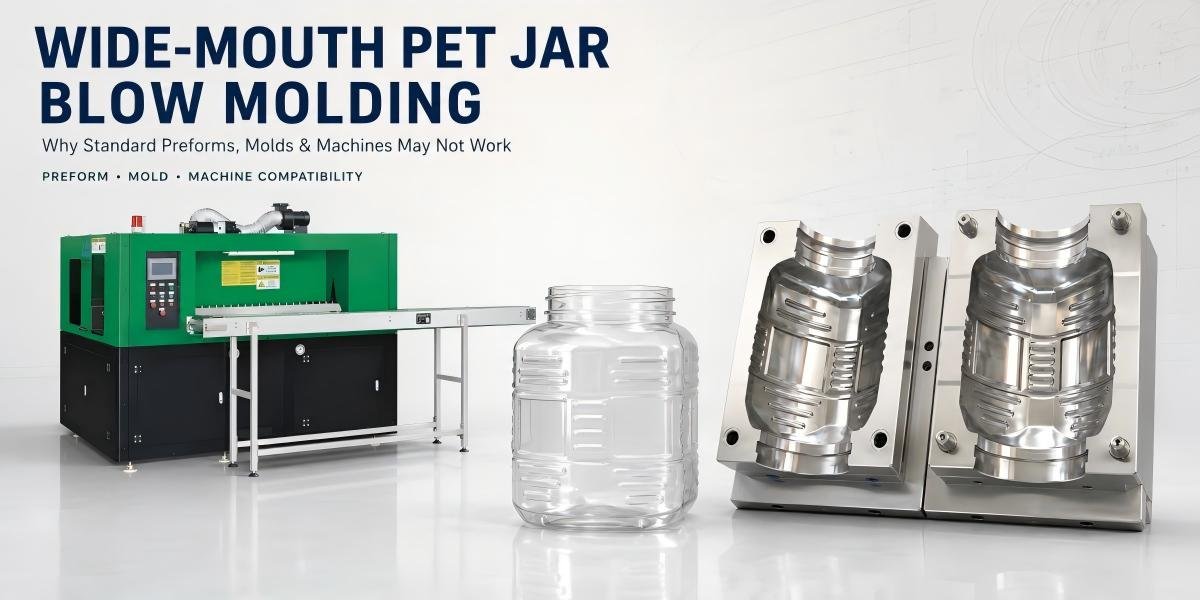
A wide-mouth PET jar cannot normally be developed by simply enlarging the neck of a standard water bottle and installing a different blow mold. Wide-mouth PET jar blow molding requires the preform, neck finish, heating system, mold geometry, and blowing machine to be evaluated together. A machine that produces small water bottles successfully may not have the pitch, heating capacity, transfer clearance, or mold space required for a large-diameter jar.
This becomes especially important when a bottle manufacturer wants to expand into food jars, candy jars, nut containers, protein powder packaging, or other wide-mouth applications using existing PET equipment.
What Makes a Wide-Mouth PET Jar Different From a Standard PET Bottle?
A wide-mouth PET jar is a different stretch blow molding application, not simply a standard bottle with a larger neck. The larger neck and wider body change the preform geometry, heating requirement, material distribution, mold dimensions, and the mechanical space required inside the blow molding machine.
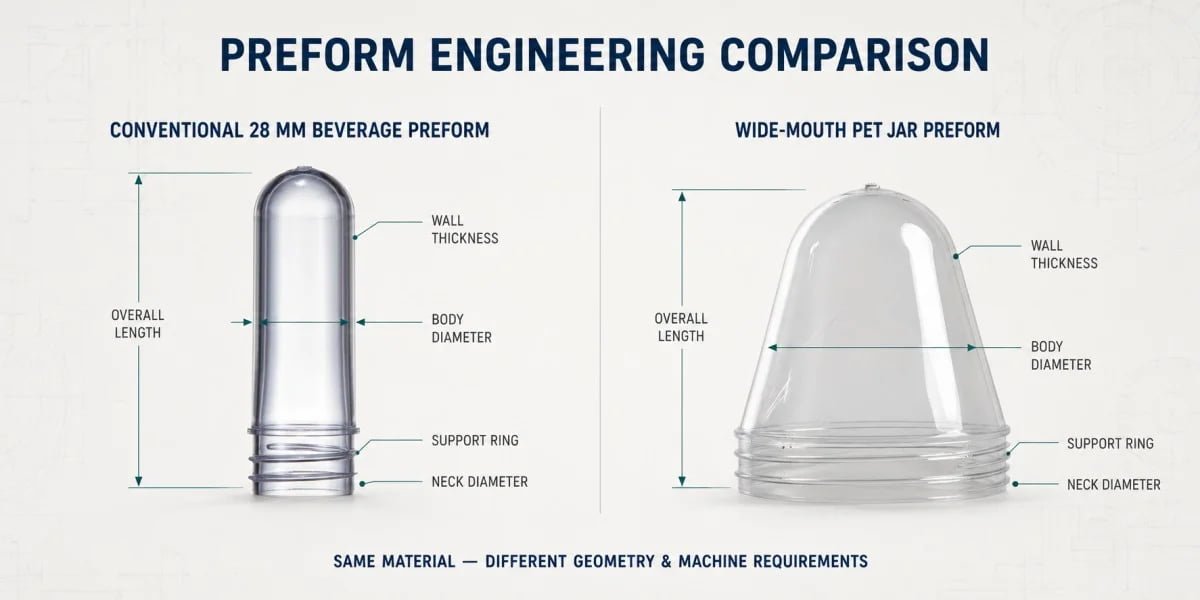
A conventional small beverage bottle usually combines a relatively narrow neck with a body that is substantially larger than the neck finish.
The preform can therefore be relatively slim and elongated. During stretch blow molding, PET material is redistributed axially and radially from that preform into the shoulder, body, and base of the finished bottle.
A wide-mouth jar starts from a different geometry.
The neck opening represents a much larger proportion of the container diameter. The preform neck, support ring, body diameter, and wall structure therefore tend to occupy more space before blowing even begins.
The finished container is also often shorter and wider than a conventional water bottle.
These changes affect the complete manufacturing system.
| Engineering Area | Standard Small PET Bottle | Wide-Mouth PET Jar |
|---|---|---|
| Neck-to-body relationship | Neck is relatively small compared with bottle body | Neck can represent a large proportion of jar diameter |
| Typical preform geometry | Relatively slim and elongated | Often wider and may be shorter for a similar container volume |
| Radial expansion | Usually significant but starts from a small preform diameter | Different because the starting preform is already much wider |
| Axial stretching | Often relatively large on beverage bottles | May be lower on short, wide jar designs |
| Heating-system clearance | Designed around conventional beverage preforms | Must accommodate a larger preform and support-ring geometry |
| Blow-station space | Optimized for the machine’s normal bottle diameter range | Larger jar and mold may require greater center pitch and clearance |
| Wall distribution | Established around conventional bottle stretch ratios | Requires separate evaluation because the stretch relationship changes |
This is why capacity alone is a poor way to judge machine compatibility.
A 1 L water bottle and a 1 L wide-mouth jar may have approximately the same nominal capacity while requiring very different molds and machine space.
The jar may be much larger in diameter and considerably shorter.
From our manufacturing experience, maximum bottle volume should never be used as the only parameter when deciding whether an existing blowing machine can produce a wide-mouth jar.
Bottle diameter, preform diameter, neck/support-ring dimensions, cavity pitch, heating envelope, and mold installation space can become more important than the litre rating printed on the machine specification.
Why Can’t a Standard PET Preform Simply Be Used for a Wide-Mouth Jar?
The preform must be designed or selected for the final jar geometry, not by neck diameter alone. Enlarging a conventional beverage preform neck without reconsidering the preform body, weight, wall distribution, and stretch relationship does not ensure that PET material will distribute correctly into a short, wide jar.
The neck finish of a PET preform is already formed during injection molding.
During stretch blow molding, the machine is mainly reshaping the material below the neck area into the finished container body.
This means the preform entering the blower already contains several critical features that cannot be treated independently:
the neck finish, support ring, preform body diameter, wall thickness, weight, length, and material distribution.
For a wide-mouth jar, the neck diameter increases significantly compared with many water-bottle applications.
The preform body also needs to be evaluated accordingly.
Why Neck Diameter Alone Is Not Enough
Suppose a manufacturer wants to produce a new jar and begins by selecting a wide-mouth neck finish.
That establishes only one part of the package.
The remaining PET still has to form the entire jar.
When we evaluate whether an existing preform can be used, we also look at the relationship between the preform and the finished container.
| Preform Question | Why It Matters |
|---|---|
| Is the neck finish compatible with the selected closure? | The neck is not recreated during blowing |
| Is the preform body diameter suitable for the jar? | It influences radial stretch and machine clearance |
| Is the preform length appropriate? | It affects axial stretching and material placement |
| Is the preform weight suitable? | The finished jar needs enough PET, but weight alone does not determine distribution |
| How is the preform wall distributed? | Thick and thin regions affect heating and stretching |
| Is the support ring compatible with the machine? | The machine must transport and hold the preform correctly |
| Can the preform physically pass through the heating and transfer system? | A mechanically incompatible preform cannot be solved by the blow mold |
This is why we do not recommend selecting a preform only because its neck diameter appears correct.
The preform must be evaluated against the final jar and the actual blowing machine.
A Heavier Preform Is Not Automatically a Better Preform
Another common assumption is that a wall-thickness problem can always be solved by adding preform weight.
Sometimes additional material is necessary.
However, if the basic preform geometry does not match the jar, increasing weight may simply create more PET in the wrong region.
For example, additional material may remain concentrated around the shoulder while another part of the jar is still stretched too aggressively.
The result can be a heavier jar without a proportional improvement in performance.
The better engineering sequence is to evaluate:
the jar geometry, required material distribution, preform geometry, heating behavior, and stretch relationship together.
Why Is Heating a Wide-Mouth PET Preform More Difficult?
A wide-mouth preform generally presents a different heating challenge because its larger diameter and often greater wall section change how infrared energy is absorbed through the PET. The machine must provide suitable heating coverage and control, not merely enough physical space for the preform to enter the oven.
In two-stage PET blow molding, the preform must be reheated before stretching.
This is not simply a matter of making the preform “hot enough.”
The temperature profile through the preform wall and along its length strongly influences how the material stretches.
A conventional beverage preform is usually relatively narrow. Blow molding machines designed for small water bottles are therefore built around a heating geometry suitable for that preform range.
A wide-mouth jar preform can be substantially larger in diameter.
Its thermal behavior changes accordingly.
A Thicker Preform Needs More Than a Longer Heating Time
The outer PET surface is exposed more directly to infrared radiation.
The material deeper inside the wall receives heat differently.
If the outside becomes too hot before the internal wall reaches the required thermal condition, the preform can develop an unsuitable temperature gradient.
The objective is therefore not simply to increase heating time or turn every lamp to a higher setting.
Heating has to produce a usable temperature profile for stretching.
| Heating Issue | What May Happen |
|---|---|
| Heating zone is physically too narrow | Large preform may not pass correctly through the oven |
| Lamp arrangement was designed for much smaller preforms | Heating coverage may not suit the wide preform geometry |
| Preform surface receives excessive heat | Outer PET may become too soft before the wall is heated appropriately |
| Internal wall remains relatively cold | Material may resist stretching or distribute poorly |
| Circumferential heating is inconsistent | One side of the jar may stretch differently from another |
| Neck protection is unsuitable | Heat may affect areas of the neck finish that should retain their molded dimensions |
| Heating capacity is insufficient at target output | Preform may not reach a stable processing condition at production speed |
The exact lamp power and oven configuration depend on the blowing machine.
There is no single lamp wattage that should be specified for every wide-mouth jar.
However, a machine platform designed specifically for wider and thicker preforms may use a different heating-zone width, lamp arrangement, heating capacity, ventilation arrangement, or number of heating positions compared with a machine optimized for small beverage bottles.
This becomes an important purchasing question.
A customer should not ask only:
“Can my machine hold this preform?”
The more important question is:
“Can the machine heat this preform correctly and repeatedly at the required production output?”
Physical fit and process capability are not the same thing.
Can a Standard PET Blow Molding Machine Produce Wide-Mouth Jars?
Sometimes it can, but compatibility must be checked from the actual machine structure. A machine that produces 500 mL water bottles cannot be assumed to produce wide-mouth jars simply by replacing the mold, heating head, or grippers. Preform clearance, cavity pitch, heating system, transfer components, mold space, and target jar diameter all need to be verified first.
This is one of the most important points for buyers who already own PET blowing equipment.
The existing machine represents a large investment, so it is natural to ask whether the same equipment can be used for a new product.
We always prefer to evaluate the existing machine before recommending another machine.
However, there are mechanical limits that a new blow mold cannot change.
Case Study: An Australian Water-Bottle Producer Expanding Into Wide-Mouth Jars
We recently discussed this issue with an Australian customer.
The customer was already producing PET water bottles and wanted to expand into wide-mouth jars.
Initially, he believed his existing fully automatic blow molding machine could be converted by changing the preform heating components and grippers.
After reviewing the machine, we explained why the project required a broader compatibility check.
His current machine was a 2-cavity fully automatic PET blow molder with a 76 mm cavity center pitch.
That platform had been designed primarily for relatively small-diameter water bottles.
The jar he wanted to develop belonged to a much wider container category.
The problem therefore was not limited to how the machine held the preform.
The available space between blow stations was also a fundamental constraint.
| Item | Customer’s Existing Machine | Requirement Direction for the New Jar |
|---|---|---|
| Current application | Small PET water bottles | Wide-mouth PET jars |
| Number of cavities | 2 | To be selected according to jar size and output |
| Existing cavity center pitch | 76 mm | Insufficient for the jar format under evaluation |
| Preform type | Small beverage preform platform | Larger wide-mouth preform |
| Heating arrangement | Designed around smaller preform geometry | Needs evaluation for wider, thicker preform |
| Mold space | Suitable for small-bottle tooling | Must accommodate a larger-diameter jar mold |
| Proposed initial conversion | Change heating head and grippers | Not sufficient by itself |
For the jar size being discussed, we would normally evaluate a machine platform with a substantially larger center pitch, around 120 mm or above in this project direction, subject to the final jar diameter and actual machine design.
That number should not be interpreted as a universal wide-mouth PET industry standard.
Some jars may require a different pitch, and different machine manufacturers use different mechanical layouts.
The engineering principle is more important than the exact number:
the cavity pitch has to provide enough physical space for the jar mold, mold wall thickness, machine movement, and operating clearance.
Why 76 mm Center Pitch Becomes a Physical Constraint
Consider two neighboring blow stations.
Their centerlines are fixed by the machine.
If those centerlines are only 76 mm apart, both molds must fit within the space available around those fixed positions.
A wide jar can require a cavity diameter that approaches or exceeds what this architecture can physically accommodate after mold wall thickness and machine clearance are included.
Changing the gripper does not move the blow-station centerlines.
Changing the oven components does not increase the mold-opening space.
Changing the blow mold cannot create additional pitch inside the machine.
That is why machine compatibility must be evaluated before the wide-mouth blow mold is manufactured.
What Should Be Checked on an Existing Machine?
| Machine Parameter | Why It Matters for a Wide-Mouth Jar |
|---|---|
| Maximum preform outside diameter | Determines whether the preform can pass through the heating and transfer system |
| Neck and support-ring geometry | Determines whether the machine can transport and locate the preform |
| Oven/heating clearance | Determines whether the wider preform can be heated without mechanical interference |
| Heating capability | Determines whether the thicker/larger preform can reach a suitable temperature profile |
| Blow-station center pitch | Limits the physical width available to each mold station |
| Mold opening and installation space | Determines whether the jar mold can open, close, and be installed correctly |
| Maximum practical container diameter | Directly relates to wide jar feasibility |
| Container height range | Confirms that the machine can handle the intended jar length |
| Stretching system | Must be suitable for the jar/preform geometry |
| Required output | Determines whether acceptable heating and blowing can be achieved at the commercial production rate |
This same principle applies when ordering any replacement tooling. A machine nameplate alone does not confirm every dimensional interface, which is why we recommend checking the actual equipment before manufacturing. Our article Custom Blow Molds: 4 Reasons Your New Mold Won’t Fit Your Blowing Machine discusses this compatibility issue in more detail.
For buyers comparing different PET tooling platforms, Semi-Auto vs. Fully Auto PET Blow Molds and Mechanical Compatibility also explains why mold design must follow the machine structure rather than bottle capacity alone.
How Is a Wide-Mouth PET Blow Mold Different From a Standard Bottle Mold?
A wide-mouth blow mold must be designed around the actual jar, preform, and blowing machine together. The difference is not merely a larger cavity. A short, wide jar changes the shoulder transition, cavity proportions, base geometry, cooling arrangement, mold dimensions, and available installation space.
When a customer sends us a final jar sample and asks for a quotation, the sample gives us valuable information about the intended package.
However, the sample alone does not tell us whether the jar can be produced on the customer’s machine.
To design the tooling correctly, we also need to understand the preform and machine.
The Shoulder Region Changes Significantly
On many conventional water bottles, the shoulder transitions from a relatively small neck into a much larger body.
A wide-mouth jar has less radial distance between the neck and the container wall.
Its shoulder may therefore be much shorter.
In some designs, the neck-to-body transition is almost vertical compared with a beverage bottle.
This changes how PET material moves during the blowing process.
The mold must reproduce the desired shoulder geometry while remaining compatible with the preform stretching behavior.
Jar Mold Diameter Affects the Complete Machine Interface
A wide jar creates a larger cavity.
A larger cavity requires an appropriately sized mold body around it.
That affects:
- the external mold dimensions;
- cooling-channel placement;
- fitting position;
- mounting surfaces;
- available clearance to neighboring stations;
- opening and closing movement.
This is why a machine with insufficient center pitch cannot be made compatible simply by machining the mold walls thinner.
The mold still needs enough material for mechanical strength, cooling channels, mounting features, and stable production.
The Base Mold Still Requires Separate Engineering
Wide-mouth jars may use different bottom structures depending on the product, container diameter, stacking requirement, and appearance.
The base needs to provide stable standing performance while working with the expected material distribution from the selected preform.
A very wide jar base can also create a different thermal load from a narrow bottle base.
Cooling must therefore be designed around the actual mold geometry.
When we design a blow mold, we are not designing an isolated aluminum cavity.
We are designing an interface between:
the final container, the PET preform, and the blowing machine.
That is especially important for unusual formats such as wide-mouth jars.
Why Is Wall-Thickness Distribution Harder to Control in Wide-Mouth PET Jars?
Wide-mouth jars can be more sensitive to wall-thickness distribution because their preforms and finished containers often have a different axial-to-radial stretch relationship from conventional beverage bottles. If the preform geometry, heating profile, and jar design do not work together, adding more preform weight may increase material consumption without correcting the distribution problem.
Wall-thickness distribution is not determined by preform weight alone.
The PET material has to move from its original location in the preform to the correct location in the final jar.
This depends on stretching.
A conventional water-bottle preform may undergo substantial axial stretching before the material reaches the bottom of the bottle.
The bottle body also expands radially.
Together, those movements create a particular biaxial stretch history.
A short, wide jar changes this relationship.
The axial distance may be relatively short while the radial expansion remains important.
The material therefore does not necessarily redistribute in the same way as it does in a tall beverage bottle.
Why the Shoulder Can Retain Too Much Material
The region close to the neck starts relatively near the final jar wall.
If the preform and heating profile are not properly matched, material near the upper body may not stretch as much as material farther down the jar.
The shoulder can remain relatively thick.
At the same time, another section may receive too much stretching and become thinner.
This is a distribution problem rather than simply a total-weight problem.
| Observed Condition | Possible Engineering Direction |
|---|---|
| Shoulder remains excessively thick | Evaluate upper preform geometry and heating profile |
| Mid-body becomes relatively thin | Review radial stretch and temperature distribution |
| Base receives insufficient material | Evaluate preform length, bottom material location, stretching, and heating |
| One side is thinner than the other | Check circumferential heating and mechanical centering |
| Complete jar is heavier but weak area remains | Do not assume more preform weight has corrected distribution |
| Jar does not reproduce cavity details consistently | Evaluate heating, blowing, stretching, and mold cooling together |
Stretch Ratio Should Be Evaluated Before the Preform Is Frozen
Stretch ratio is useful because it describes how far the PET must move from preform geometry to final container geometry.
For a wide-mouth project, both axial and radial relationships matter.
The objective is not to chase one theoretical number.
The purpose is to determine whether the selected preform gives the material a realistic path into the required jar.
When we evaluate a bottle drawing, this is one reason we want both the preform information and final container dimensions.
Without the preform, we only know the destination.
We do not know where the material is starting.
Why Increasing Preform Weight May Waste Resin
Suppose a jar has a thin body region.
The immediate reaction might be to add several grams to the preform.
If those additional grams remain concentrated around the shoulder or another already-thick area, the original weak region may improve very little.
The manufacturer then pays for more PET on every jar while the fundamental process window remains narrow.
A better solution may involve changing:
- preform body geometry;
- wall distribution;
- heating profile;
- stretching condition;
- or, in some cases, the jar geometry itself.
The correct answer depends on the application.
This is one advantage of evaluating the preform mold and blow mold as related tooling rather than treating them as two unrelated purchases.
Why Should the Cap and Neck Finish Be Confirmed Before Designing the Preform Mold?
The closure should be confirmed early because its thread and sealing requirements define the neck finish, and the neck finish then affects the preform neck ring, support geometry, blowing-machine handling, and blow mold interface. Designing the preform before confirming the closure can create compatibility problems that are expensive to correct later.
This is particularly important for food jars and other wide-mouth packaging.
A customer may begin the project with a visual idea for the jar:
a clear cylindrical container for nuts, a square candy jar, or a large protein powder jar.
But the container also needs to close and seal correctly.
The closure system is therefore an engineering input, not a cosmetic accessory selected at the end.
Closure and Neck Finish Are Connected
The cap must mate with a specific neck geometry.
That includes more than the nominal opening diameter.
The thread form, thread position, sealing surface, neck height, and other closure-interface dimensions all matter.
Once the neck finish is defined, those dimensions influence the preform mold.
The neck finish is formed during preform injection molding and normally remains largely unchanged through the stretch blow molding process.
If the neck finish is wrong, changing the blow mold cavity will not correct the closure compatibility.
For a more detailed explanation of why nominal neck diameter alone does not define a PET neck system, see our Ultimate Guide to Preform Neck Finishes.
A Better Development Sequence
For many new wide-mouth projects, a practical development sequence is:
| Development Stage | Main Question |
|---|---|
| Product requirement | What will the jar contain and how will it be filled and used? |
| Closure | What cap and sealing method are required? |
| Neck finish | What exact geometry must mate with that closure? |
| Preform | What preform can produce the jar while remaining compatible with the machine? |
| Jar design | What body and base geometry meets the commercial and technical requirement? |
| Machine verification | Can the existing blower transport, heat, and blow this preform and jar? |
| Blow mold design | What tooling fits both the approved jar and actual machine? |
| Trial and optimization | Does the full system produce stable bottles under production conditions? |
Real projects do not always move through these stages in a perfectly straight line.
For example, an existing machine may impose limits that force a preform or jar revision.
The key point is that the decisions are connected.
A customer should avoid completing a new preform mold and only then discovering that the selected preform cannot travel through the existing blow molding machine.
Similarly, the customer should avoid manufacturing the wide-mouth blow mold before confirming that the final closure and neck finish are approved.
Our From Concept to Production guide to custom PET bottle molds discusses this development logic from a broader tooling perspective.
What Should Be Checked Before Ordering a Wide-Mouth PET Jar Blow Mold?
Before ordering a wide-mouth PET jar blow mold, confirm the product application, closure, neck finish, preform, final jar geometry, and actual blowing machine. If the existing machine cannot transport or heat the selected preform or cannot physically accommodate the jar mold, manufacturing the blow mold first will not solve the incompatibility.
A request such as:
“I need a 1 L wide-mouth jar mold.”
is enough to begin a discussion, but it is not enough to release the mold for manufacturing.
The project should first be defined as a complete packaging and production system.
Start With the Product
A jar for nuts does not necessarily have the same closure and handling requirements as a sauce container or a protein powder jar.
The product helps define:
- closure type;
- sealing requirement;
- jar opening;
- handling requirement;
- possible stacking requirement;
- body geometry.
We do not need every final detail before the first discussion, but the application should be clear enough to guide the design.
Confirm Existing Equipment Before Freezing the Jar
If the customer already has a blowing machine, this is where the Australian project provides an important lesson.
The customer had a working fully automatic PET machine.
That did not mean the machine was suitable for every PET container.
His 76 mm center-pitch platform was designed for smaller bottle formats. The wide-mouth jar he wanted required a substantially different mechanical envelope.
If we had designed and manufactured the jar mold first and checked the machine later, the customer could have received a mold that could not physically operate in his machine.
That is exactly the type of error we want to prevent in overseas projects.
Information We Recommend Providing
| Project Information | What We Need to Evaluate |
|---|---|
| Product application | Food, nuts, candy, powder, sauce, dry goods, or another use |
| Target capacity | Basic container-volume requirement |
| Closure sample or drawing | Confirms the cap and sealing concept |
| Neck-finish drawing | Defines the exact preform neck interface |
| Existing preform drawing or samples | Allows us to evaluate whether the preform can be retained |
| Preform weight | Helps establish the current material starting point |
| Proposed jar 2D/3D drawing or sample | Defines the final container geometry |
| Maximum jar diameter | Critical for machine pitch and mold-space evaluation |
| Jar height | Confirms machine and stretch range |
| Blow molding machine brand and model | Establishes the machine platform |
| Machine nameplate photo | Helps verify the exact equipment version |
| Existing mold dimensions | Provides direct compatibility evidence |
| Cavity center pitch | Critical for large-diameter jar tooling |
| Preform transfer and support-ring information | Determines handling compatibility |
| Oven/heating-space information | Helps evaluate wide-preform feasibility |
| Required production output | Determines whether the process is commercially practical |
For new container development, our step-by-step PET bottle development guide explains why design, preform, tooling, trial, and production validation should be treated as connected stages rather than isolated purchases.
Do You Need a New Preform Mold as Well?
Not every wide-mouth jar project requires a new preform mold.
If the customer already has a suitable preform with the correct neck finish, geometry, weight, and machine compatibility, that existing preform should be evaluated first.
If no suitable preform exists, a custom preform may need to be developed.
In that situation, the preform mold should not be designed independently of the jar and blowing equipment.
We need to know what container the preform must become and what machine must process it.
Do You Need a Dedicated Wide-Mouth Blowing Machine?
Sometimes the answer is yes.
This does not mean every wide-mouth jar requires one specific machine category.
It means there are applications where the existing small-bottle blower is mechanically or thermally unsuitable, and modifying a few format parts will not change those fundamental limits.
For relatively large-diameter jars, dedicated wide-mouth machines are available because their mechanical and heating systems are designed around this application.
Compared with a small water-bottle platform, the differences may include a larger blow-station pitch, more space for wider molds, greater preform clearance, a wider heating envelope, and heating hardware configured for the thermal load of larger preforms.
The exact design varies by machine manufacturer.
This is why we recommend evaluating the jar project from the machine backward before machining the mold.
For a wide-mouth PET jar project, confirm the preform and machine compatibility before the blow mold design is frozen.
That single step can prevent a technically correct mold from becoming an unusable mold at the customer’s factory.
Frequently Asked Questions
Can I Use a Standard PET Preform to Make a Wide-Mouth Jar?
Usually, this cannot be decided from bottle capacity alone.
The preform needs to match the required neck finish, jar diameter, jar height, material distribution, and blowing-machine handling system.
An existing preform may be usable if its geometry and machine compatibility are suitable, but a conventional small water-bottle preform should not be assumed to work for a wide-mouth jar.
Can a Normal PET Bottle Blowing Machine Make Wide-Mouth Jars?
Possibly, but the actual machine must be checked.
The most important limitations can include preform outside diameter, support-ring handling, oven clearance, heating capability, blow-station center pitch, mold installation space, and maximum practical container diameter.
A machine’s maximum bottle-volume rating alone is not enough to confirm compatibility.
Why Are Wide-Mouth PET Jars Harder to Blow Evenly?
Wide-mouth jars often use a larger preform and a shorter, wider final container geometry.
This changes the axial and radial stretching relationship.
If the preform geometry and heating profile do not suit the jar, PET may remain too thick in one area and become too thin in another.
Increasing preform weight alone does not necessarily correct that distribution.
Should I Choose the Cap Before Designing a Wide-Mouth PET Preform?
It is generally advisable to confirm the closure system early.
The closure defines important neck-finish requirements, and the neck finish affects the preform mold, support ring, and machine handling.
Changing the neck system after the preform mold is completed can require substantial tooling changes.
What Information Is Needed to Quote a Wide-Mouth PET Jar Blow Mold?
The most useful information includes the jar drawing or sample, target capacity, closure, neck-finish drawing, existing or proposed preform information, and the exact blow molding machine model.
For an existing machine, photos of the current mold, cavity pitch, preform handling system, and heating area can also help us determine whether the wide-mouth project is technically compatible before the mold is manufactured.
Related PETMOLDER Articles
- Custom Blow Molds: 4 Reasons Your New Mold Won’t Fit Your Blowing Machine
- Semi-Auto vs. Fully Auto PET Blow Molds and Mechanical Compatibility
- The Ultimate Guide to Preform Neck Finishes: How to Choose the Right Standard for Your Bottle
- From Concept to Production: What Are the 8 Steps to Custom PET Bottle Molds?
- How to Develop a 500ml PET Bottle: The Step-by-Step Timeline Guide