Why would a beverage company that has already spent years reducing PET bottle weight continue looking for another 1.55 grams?
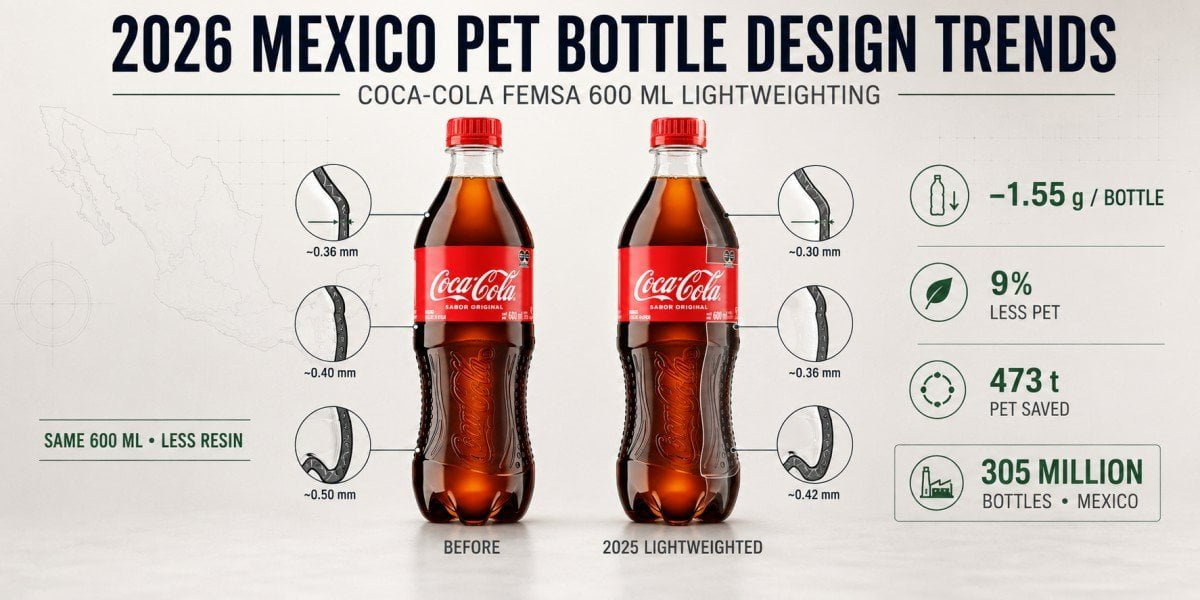
Coca-Cola FEMSA provides a useful recent example from Mexico. In its 2025 Integrated Report, published in March 2026, the company reported that it further optimized its 600 ml PET bottle by reducing 1.55 grams per bottle, equivalent to a 9% reduction in PET consumption for that initiative. Across approximately 305 million bottles produced and distributed in Mexico, the change reduced PET use by about 473,000 kg. The same bottle now uses 42% less plastic than it did in 2014.
Those numbers should not be interpreted as proof that every Mexican beverage producer is following exactly the same packaging strategy.
They do show something important.
PET lightweighting is continuing even after many of the easier grams have already been removed. That means the next stage of bottle development depends increasingly on bottle geometry, material distribution, preform design, blowing stability, and blow mold precision.
From our manufacturing perspective, a lighter bottle is not necessarily a simpler bottle.
In many projects, the opposite is true.
Less PET requires more engineering, not less engineering.
What Does Coca-Cola FEMSA’s 600ml Bottle Lightweighting Tell Us About Mexico’s PET Packaging Direction?
Coca-Cola FEMSA’s 600 ml project is a strong example of continued packaging optimization in Mexico, but it should be treated as a market signal rather than a universal rule. The important engineering message is that mature PET bottle designs are still being challenged to use less material without giving up the functions required in high-volume beverage production.
The scale of this project makes the engineering significance easier to understand.
| Coca-Cola FEMSA 600 ml Bottle Indicator | 2025 Reported Result |
|---|---|
| Additional PET reduction per bottle | 1.55 g |
| PET consumption reduction from the 2025 optimization | 9% |
| Bottles produced and distributed in Mexico | Approximately 305 million |
| Annual PET reduction | Approximately 473,000 kg |
| Plastic reduction compared with the 2014 version | 42% |
Source: Coca-Cola FEMSA 2025 Integrated Report.
A 1.55 g reduction may sound small when looking at one bottle on a laboratory table.
At 305 million bottles, it becomes hundreds of tonnes of resin.
That scale helps explain why large beverage producers continue to investigate relatively small weight reductions.
Resin cost, transport weight, packaging efficiency, recycled-content strategy, and environmental targets can all create incentives to remove material where the package can safely operate with less.
However, the more interesting question for a bottle and mold manufacturer is not:
“How much plastic did they save?”
It is:
How can a bottle that has already been reduced repeatedly continue to lose material and still function on a high-speed production and distribution system?
That question moves the discussion away from sustainability marketing and into bottle engineering.
Our Mexico Projects Are Showing a Similar Direction
We are seeing the same type of pressure in our own customer discussions, although the projects and specifications are independent of Coca-Cola FEMSA.
One of our customers in Mexico has been reducing the weight of a 300 ml PET water bottle over several years.
The bottle originally used a 12 g preform.
The project later moved to 10 g.
This year, the customer asked us to evaluate a further reduction to 8.5 g.
| Development Stage | 300 ml Customer Project |
|---|---|
| Earlier bottle weight | 12 g |
| Current lighter version | 10 g |
| New development target | 8.5 g |
| Customer’s design preference | Retain the recognizable existing bottle appearance |
| Additional request | Evaluate additional rib structures to support the lighter bottle |
The 8.5 g bottle is a development target, not a claimed production result.
That distinction is important.
At this stage, our technical team cannot simply tell the customer that reducing another 1.5 g will work because ribs are being added.
The geometry has to be evaluated.
The preform and blowing conditions have to be evaluated.
The bottle still has to perform its required functions.
This is exactly why we believe the next stage of lightweighting is more engineering-intensive than simply ordering a lighter preform.
Our existing PET Bottle Lightweighting: A 7-Step Engineering Guide to Reducing Weight Safely explains the general lightweighting process. This article focuses more narrowly on what current Mexico projects can tell buyers about the relationship between lighter bottles and the next generation of bottle and blow mold design.
Why Is PET Lightweighting Becoming a Structural Design Challenge, Not Just a Preform Weight Reduction?
Once a PET bottle has already undergone several rounds of lightweighting, the project increasingly becomes a structural optimization exercise. Simply changing from a heavier preform to a lighter one without reconsidering bottle geometry can reduce the material available in areas that previously depended on wall thickness for stiffness, handling stability, and dimensional control.
The earliest stage of a lightweighting program may sometimes offer relatively straightforward opportunities.
A bottle may have more material than the actual application requires.
A slightly lighter preform can then be tested while keeping much of the existing bottle design.
The situation changes after several optimization cycles.
Imagine a bottle that has already moved through:
12 g → 10 g → 8.5 g target.
The existing geometry was originally developed around a different amount of PET.
Every rib, panel, shoulder transition, base radius, and body diameter was being formed with more material available.
When another portion of that material is removed, the bottle does not simply become a thinner version of the previous bottle.
Its structural behavior can change.
Material Thickness and Geometry Perform Different Jobs
A relatively thick cylindrical wall naturally provides some resistance to deformation.
When the wall becomes thinner, geometry increasingly has to contribute to stiffness.
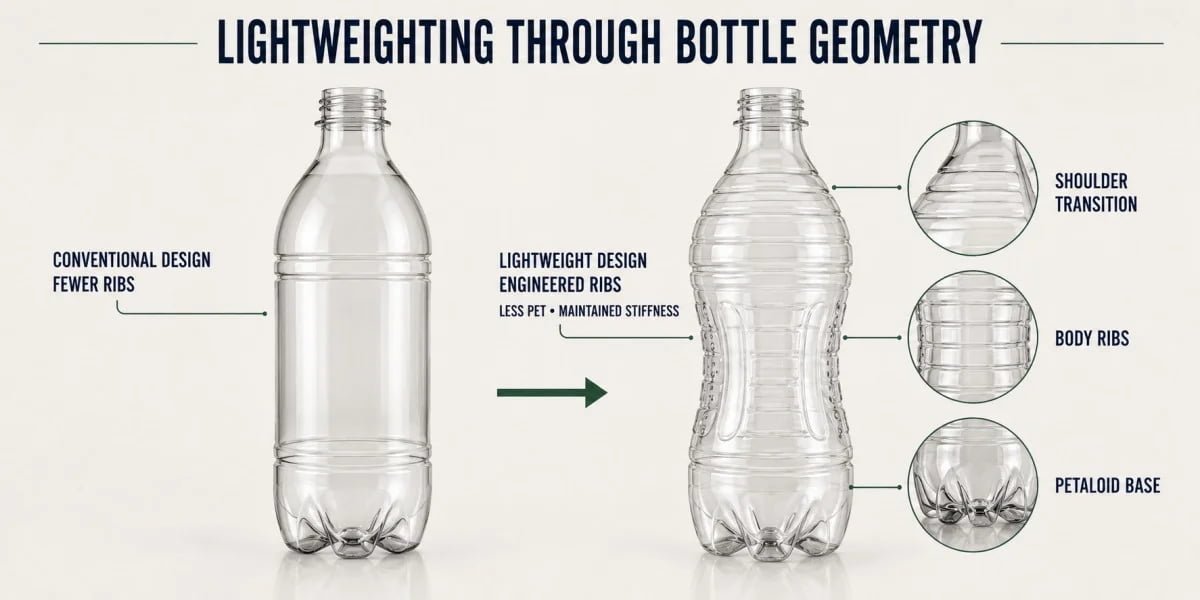
This is one reason lightweight bottles often use carefully engineered ribs, beads, panels, grooves, shoulder transitions, and base structures.
However, adding more ribs is not automatically an improvement.
The geometry must be positioned where it supports the actual load case.
A decorative groove that looks strong in CAD may add very little functional stiffness.
A deep rib may also become difficult to reproduce when there is limited PET available in that region.
For our Mexican customer’s new 8.5 g target, the request to preserve the original bottle appearance while adding additional rib structures therefore requires a balance between branding and structural optimization.
We need to ask several questions.
| Design Question | Why It Matters as Weight Falls |
|---|---|
| Which areas of the existing bottle are already relatively thin? | They may have little remaining material margin |
| Where does the consumer apply gripping force? | Lightweight walls may deform more easily during handling |
| Which geometry currently provides body stiffness? | These features may become more important after weight reduction |
| Can additional ribs be formed clearly with less PET? | A CAD feature is useful only if the material can reproduce it |
| Does the bottle need a stable label panel? | Extra ribs can interfere with labeling or visual appearance |
| Is the base still receiving enough material? | Removing preform weight can change bottom performance |
| Is the shoulder already retaining excess material? | Material may need redistribution rather than simply adding weight |
This is why a lightweighting project should not begin with the assumption:
“We removed 1.5 g, so we need to add three more ribs.”
The better question is:
Where does the remaining PET need to work harder?
That is a bottle-design question.
Keeping the Same Exterior Design Has Limits
Customers understandably want to protect brand recognition.
A successful bottle may already have familiar proportions, rib patterns, label dimensions, and shelf appearance.
We therefore try to preserve important visual features where practical.
But deep lightweighting may eventually require selective geometry changes.
If the original bottle relied heavily on wall thickness for stiffness, keeping every original radius, panel depth, and body transition while substantially reducing weight can create a very narrow processing window.
The design process should therefore distinguish between:
brand features that should remain recognizable
and
structural features that can be optimized without changing the product identity.
That approach is usually more realistic than demanding either a completely new appearance or an absolutely unchanged geometry.
For buyers interested in the broader economics behind this type of project, our article on systematically reducing PET bottle production costs explains why resin reduction should be evaluated together with stable production rather than treated as a standalone saving.
Which Parts of a PET Beverage Bottle Become More Critical as Bottle Weight Decreases?
As bottle weight falls, the engineering importance of individual bottle regions increases because there is less material available to compensate for weak geometry or uneven distribution. The shoulder, grip area, label panel, transition zones, and bottle base must increasingly obtain performance from shape and controlled material placement rather than from additional wall thickness.
Lightweight bottle design is fundamentally a material redistribution problem.
The goal is not to achieve the same wall thickness everywhere.
Different areas of the bottle perform different functions and experience different loads.
What matters is placing enough material where the package needs it while avoiding unnecessary material where geometry can provide the required performance.
The Shoulder
The shoulder transfers geometry from the relatively rigid neck region into the flexible bottle body.
Depending on the bottle design and preform, this area can retain more material than other regions.
That does not automatically mean the shoulder should simply be made thinner.
The shoulder may contribute to top-load behavior and overall bottle shape.
The engineering task is to determine whether material concentrated there can be redistributed more effectively without destabilizing the bottle.
The Main Body and Grip Area
The body is where consumers, conveyors, guides, packers, and other equipment interact with the bottle.
As the wall becomes thinner, smooth unsupported panels can become easier to deflect.
Ribs and panel geometry can help, but their depth, spacing, direction, and transition radii matter.
| Bottle Region | Main Design Concern During Deeper Lightweighting | Possible Engineering Response |
|---|---|---|
| Shoulder | Excess material or insufficient structural transition | Rebalance geometry and heating rather than removing material blindly |
| Grip/body area | Hand squeeze and sidewall deformation | Use suitable rib or panel geometry |
| Label area | Panel stability and label application | Maintain enough controlled surface geometry |
| Transition between ribs and smooth walls | Local stress and forming difficulty | Use appropriate radii and gradual transitions |
| Lower body | Material draw toward the base | Coordinate body design with preform and base requirements |
| Bottle base | Standing stability and deformation resistance | Review base geometry and material allocation |
The Bottle Base
The base is particularly sensitive because it has to satisfy several requirements at once.
It must form correctly.
It must stand stably.
It must receive a suitable amount of PET.
It must work with the filling and distribution conditions of the bottle.
Reducing bottle weight without checking base material can create problems even when the sidewall still looks acceptable.
For this reason, a lightweighting program should not evaluate only average wall thickness.
The bottom material distribution and base geometry need their own inspection.
Our article on PET bottle base geometry and stress-cracking considerations explains why the lower bottle region has to be treated as an engineered structure rather than simply the end of the cavity.
Why More Ribs Are Not Automatically Better
The Mexican customer’s request to add more ribs is technically worth evaluating.
Ribs can improve stiffness in suitable locations.
But several factors must be checked:
- Are the ribs deep enough to contribute structurally?
- Can the lighter preform provide enough material to reproduce them?
- Do the ribs create unwanted thick/thin transitions?
- Will they affect labeling?
- Do they change how the bottle feels in the hand?
- Are they compatible with downstream guides and packaging equipment?
A rib should have a purpose.
On a very lightweight bottle, using limited PET to reproduce unnecessary decorative complexity can work against the original lightweighting objective.
The available PET should be used where it contributes the most value.
How Is rPET Influencing the Next Generation of PET Beverage Bottles in Mexico?
Lightweighting and recycled-content development should increasingly be validated together rather than as unrelated projects. Coca-Cola FEMSA publicly lists lighter packaging and recycled materials as parallel packaging priorities, while reporting that 27% rPET was incorporated into its primary packaging in 2025 across its operations.
An important wording distinction is needed here.
The 27% rPET figure is a Coca-Cola FEMSA company-level primary-packaging disclosure, not a statement that every Mexican PET beverage bottle contains 27% recycled resin.
However, its strategy is still relevant to Mexico because the company is simultaneously investing in Mexican bottle-to-bottle recycling capacity.
For bottle engineers, the important trend is the interaction between:
lower bottle weight
and
changing material composition.
It is tempting to discuss these as two separate sustainability projects.
In practice, both influence the processing window of the package.
Why the Planned Material Should Be Used During Validation
It would be technically weak to develop a lightweight bottle under one material condition and assume that exactly the same heating and blowing window will apply after the resin system changes.
Material behavior can depend on the actual recycled-resin source, blend, resin specifications, preform manufacturing conditions, and quality-control system.
The correct approach is therefore not to make a blanket statement that rPET is always “harder to blow.”
Instead:
the actual material system intended for commercial production should be validated.
| Development Variable | Why It Should Be Verified With the Planned Material System |
|---|---|
| Preform quality | Production consistency begins before the bottle enters the blower |
| Reheat response | Heating settings need to suit the actual preform |
| Stretching behavior | Material needs to redistribute into the lightweight geometry |
| Wall distribution | Limited PET makes uneven material placement more significant |
| Bottle dimensions | Finished geometry must remain within the project requirement |
| Base definition | Material and thermal conditions affect bottom forming |
| Production window | Stable commercial output matters more than one successful sample |
This becomes increasingly important when two changes are made at the same time.
For example:
- lower preform weight;
- increased recycled content;
- redesigned bottle ribs;
- changed base geometry.
If all variables are changed together without controlled validation, troubleshooting becomes much harder.
When possible, a lightweighting program should establish a clear test sequence so engineers can understand which change produced which result.
Preform Consistency Becomes More Important, Not Less
A lighter bottle begins with a lighter preform.
If preform dimensions or concentricity are inconsistent, a bottle with limited material margin may show that variation more clearly.
The same principle applies to preform wall distribution.
The blow mold cannot redistribute PET consistently if the starting condition varies significantly from one preform to another.
Our article on PET preform concentricity and mold precision explains why preform consistency is relevant to downstream bottle forming.
For the next generation of lightweight bottles, the connection between preform engineering and blow mold engineering becomes increasingly important.
Why Does Mexico’s Bottle-to-Bottle Recycling Capacity Matter for PET Bottle Design?
Mexico’s expanding food-grade PET recycling infrastructure matters because it supports a packaging system in which bottle design, resin efficiency, recyclability, and future recycled-content use are increasingly connected. The bottle is no longer evaluated only as a container to manufacture; it also becomes part of a material loop that returns post-consumer PET to packaging applications.
Coca-Cola FEMSA and ALPLA began operations at the PLANETA food-grade PET recycling facility in Tabasco, Mexico, in 2024.
Coca-Cola FEMSA states that the facility has capacity to process approximately 50,000 tonnes of post-consumer PET bottles annually, which it describes as close to 6% of Mexico’s total PET recycling capacity.
Its 2025 reporting also shows the company’s continuing emphasis on PET collection and recycled resin use.
This article does not need to become a recycling-plant report.
The engineering significance is more useful.
Bottle Design Is Becoming Part of a Larger Material System
Historically, a packaging-development discussion might concentrate primarily on questions such as:
Can the bottle be produced?
Does it look correct?
Can the customer fill it?
What does the mold cost?
What is the PET consumption per bottle?
Those questions remain important.
But bottle-to-bottle recycling adds another layer.
A modern PET package is increasingly evaluated as part of a cycle:
| Stage | Engineering Relevance |
|---|---|
| Resin/preform production | Determines starting material and preform quality |
| Bottle blowing | Determines material distribution and manufacturing stability |
| Filling and distribution | Determines mechanical requirements |
| Consumer use | Determines handling and package functionality |
| Collection and recycling | Returns PET into a recycling stream |
| rPET production | Provides recycled material for future packaging |
| New preform/bottle development | Requires validation with the intended recycled-content system |
This helps explain why lightweighting and circularity should not be treated as opposing concepts.
Using less PET per bottle reduces the amount of resin required for each package.
Improving bottle-to-bottle recycling can increase the availability of recycled material for future packaging.
The bottle-development challenge is to do both without creating a package that becomes unstable in production or inadequate in use.
Lightweighting Still Has to Respect Manufacturability
A very low bottle weight has little commercial value if the plant cannot produce it consistently.
At high output, a narrow process window can create:
- more rejects;
- more adjustment time;
- greater sensitivity to preform variation;
- more production interruptions;
- reduced usable machine efficiency.
This is why material reduction should always be evaluated alongside manufacturing stability.
The lowest gram value achieved during one controlled trial is not necessarily the best commercial bottle weight.
The useful target is the lowest material consumption that still provides an acceptable production and performance window for the customer’s actual operation.
Why Does Deep Lightweighting Make Blow Mold Precision More Important?
As PET weight decreases, the amount of excess material available to absorb geometric and process variation also decreases. Cavity-to-cavity consistency, base geometry, mold alignment, cooling, and repeatable replication of structural ribs become increasingly important because a lightweight bottle has less margin to hide uneven material distribution or local dimensional differences.
This becomes especially important for high-volume beverage production.
Coca-Cola FEMSA’s reported 2025 project involved approximately 305 million 600 ml bottles in Mexico.
A 1.55 g change per bottle became approximately 473 tonnes of PET saved.
The scale works in both directions.
A small material saving is amplified across hundreds of millions of bottles. A small production instability can also be amplified across hundreds of millions of bottles.
Why Cavity Consistency Matters
Imagine a multi-cavity mold in which one cavity produces a slightly different rib depth, base geometry, or body dimension.
On a heavier bottle, there may be enough material margin for all cavities to remain acceptable.
As bottle weight falls, that margin can become smaller.
The same variation may then create different material behavior between cavities.
This is one reason high-volume lightweight projects need strong control over both mold design and manufacturing consistency.
| Blow Mold Area | Why It Becomes More Important on a Lightweight Bottle |
|---|---|
| Cavity geometry | Structural features must be reproduced consistently |
| Cavity-to-cavity dimensions | Different geometry can create different bottle behavior |
| Mold alignment | Mismatch can influence bottle symmetry and local forming |
| Base mold position | Affects the lower bottle geometry and forming condition |
| Rib and groove machining | Structural features need consistent depth and radii |
| Cooling channels | Stable thermal conditions support repeatable production |
| Surface transitions | Poor transitions can create difficult-to-form local geometry |
We previously analyzed a more extreme example of cavity inconsistency in 30ml Capacity Variance in Same-Batch PET Blow Molds: A CNC Manufacturing Analysis.
A lightweighting project is not the same defect scenario, but the manufacturing principle is related:
multi-cavity tooling must reproduce the intended geometry consistently if the customer expects consistent bottles.
A Rib in CAD Is Not Enough
This is one of the biggest differences between visual bottle design and production bottle engineering.
A CAD designer can add a rib in seconds.
The mold can machine that rib accurately.
But neither guarantees that the lightweight PET bottle will reproduce it correctly.
The PET still has to reach that section of the cavity.
If material is already highly stretched before it reaches a deep structural feature, the final rib may become weak or poorly defined.
That is why mold engineering and bottle engineering cannot be separated.
A useful structural feature has to satisfy two requirements:
- it should contribute to the mechanical behavior of the bottle;
- it should be realistically formable with the selected preform and blowing process.
This is particularly relevant to our Mexican customer’s plan to add more ribs while moving toward 8.5 g.
We should not simply machine more grooves into the cavity.
We first need to determine where the bottle needs stiffness and whether the available PET can reproduce the proposed features consistently.
How Should Blow Mold Design Evolve for the Next Generation of Lightweight PET Bottles?
A lightweight blow mold should do more than reproduce an existing bottle shape at a lower preform weight. The mold design should support a bottle geometry that makes efficient use of the remaining PET, provides repeatable structural features, controls the base and transition regions, and remains compatible with the actual blowing machine and production conditions.
When a customer gives us an approved bottle drawing, dimensional accuracy remains fundamental.
But for a deep lightweighting project, we also want to understand how that geometry is expected to function.
Some features are visual.
Some are structural.
Some do both.
Our engineering discussion should distinguish between them.
Structural Geometry Should Have a Reason
A rib may improve local panel stiffness.
A bead may help control deformation.
A shoulder shape may improve structural transition.
A base feature may support standing stability.
But adding geometry without understanding its purpose can waste the limited material available.
For this reason, the mold designer should not view the bottle as a decorative 3D surface.
The better question is:
What work does each important feature need to perform?
Mold Cooling Also Matters
Every heated preform transfers energy into the blow mold.
During continuous production, cooling water removes this heat and helps maintain a repeatable mold temperature.
For a lightweight bottle, stable cooling can become particularly important because the thin container may be more sensitive to thermal and dimensional variation after demolding.
A mold that runs at unstable temperature can make process optimization more difficult even if its cavity geometry is correct.
Base Geometry Should Be Re-Evaluated
When bottle weight changes significantly, we should not assume that the existing base is automatically optimal.
The lighter preform changes the amount of PET available to the complete container.
If the existing bottom design requires substantial material to form correctly, the new project may need adjustments to:
- base depth;
- radii;
- standing surface;
- transition geometry;
- local structural features.
The correct changes depend on the actual bottle.
There is no universal “lightweight base.”
Machine Compatibility Has to Remain Part of the Review
Lightweighting sometimes changes bottle geometry.
A customer may increase body ribs, alter diameter, change shoulder proportions, or modify the base.
Those changes still have to work inside the existing blow molding machine.
Before final mold manufacturing, we should confirm relevant machine limits such as mold dimensions, cavity pitch, stretching arrangement, cooling connections, and the customer’s required output.
This becomes particularly important for overseas tooling, where correcting a compatibility problem after delivery is much more expensive than checking it during design.
What Should the Blow Mold Manufacturer Focus On?
| Engineering Priority | Why It Matters |
|---|---|
| Bottle geometry review | Determines whether the remaining PET is being used efficiently |
| Structural feature definition | Ensures ribs and panels have a clear function |
| Formability of deep features | Prevents CAD geometry that cannot be reproduced consistently |
| Base mold engineering | Supports stable lower-bottle forming |
| Cavity consistency | Reduces station-to-station bottle variation |
| Cooling design | Supports repeatable thermal conditions |
| Machine compatibility | Ensures the mold can operate on the customer’s actual blower |
| Trial feedback | Allows geometry and process to be evaluated together |
The manufacturing philosophy can be summarized simply:
The best lightweight blow mold does not simply reproduce a lighter bottle. It helps the available PET work harder.
What Should Mexican Beverage Producers Verify Before Launching a New Lightweight PET Bottle?
Before launching another lightweighting step, beverage producers should establish the performance of the current bottle, define what functions must be retained, confirm the target material and preform, review bottle geometry, check machine compatibility, and then validate the complete package under realistic production conditions. The first question should not simply be, “How many grams can we remove?”
Our Mexican customer’s 300 ml project is a good example of how this discussion should begin.
The customer already has a bottle.
He already knows the market appearance he wants to retain.
He has already reduced weight from 12 g to 10 g.
Now he wants us to evaluate 8.5 g and additional body ribs.
That gives us a clear project direction.
It does not yet give us permission to simply cut another 1.5 g from the preform and manufacture a new mold.
Start With the Existing Bottle
Before changing anything, understand the current baseline.
What bottle weight is actually running?
How stable is the current production?
Where is the material currently distributed?
Which parts of the bottle are already flexible?
What performance matters to the customer?
A lightweighting project should have a baseline because otherwise there is no meaningful way to judge whether the next design is better or simply lighter.
Define the Functions That Must Remain
For a typical beverage bottle, this may include several requirements depending on the application:
- acceptable handling feel;
- dimensional stability;
- filling-line compatibility;
- conveyor performance;
- labeling;
- packing;
- palletized transport;
- base stability;
- appearance.
Not every project needs the same tests.
The bottle should be validated according to its real supply chain.
Use the Planned Preform and Material
If the commercial project will use a particular preform weight and a specific virgin/rPET material system, that should be incorporated into validation as early as practical.
Otherwise, the development team may optimize the bottle around conditions that will not exist in production.
Freeze the Blow Mold Only After the System Is Reviewed
For overseas mold projects, we prefer to confirm important technical information before the cavity design is finalized.
| Project Input | What Should Be Confirmed |
|---|---|
| Existing bottle sample/drawing | Establish current geometry |
| Current bottle/preform weight | Establish baseline material use |
| New target weight | Define the lightweighting objective |
| Planned material system | Ensure trials represent production conditions |
| Preform drawing | Evaluate stretch and material starting geometry |
| Structural performance requirement | Identify what the bottle must retain |
| Label and packing requirements | Prevent geometry changes from affecting downstream operations |
| Blow molding machine model | Confirm tooling and processing compatibility |
| Required output | Evaluate commercial production stability |
| Proposed bottle drawing | Review ribs, panels, shoulder and base before mold manufacture |
This type of development process takes more engineering work than simply ordering a lighter preform.
That is exactly the point.
Coca-Cola FEMSA’s reported 600 ml project shows that even a bottle that already uses 42% less plastic than its 2014 version can still be optimized further.
Our own Mexican customer’s progression from 12 g to 10 g and now an 8.5 g development target shows a similar commercial question at a different scale.
Manufacturers continue to ask:
Can we use less PET?
Our role as a bottle and mold manufacturer is to add the next question:
Can we use less PET while keeping a stable bottle and a stable production process?
That is where the next generation of lightweighting will be decided.
The next gram should be removed by engineering—not by guesswork.
Frequently Asked Questions
How Much Lighter Did Coca-Cola FEMSA Make Its 600ml PET Bottle in Mexico?
According to Coca-Cola FEMSA’s 2025 Integrated Report, the company reduced another 1.55 g of PET per 600 ml bottle in 2025, representing a 9% reduction in PET consumption for that optimization.
Across approximately 305 million bottles produced and distributed in Mexico, it reported approximately 473,000 kg of PET savings. The bottle uses 42% less plastic than its 2014 version.
Does PET Bottle Lightweighting Simply Mean Using a Lighter Preform?
No.
A lighter preform is only the starting point.
As weight decreases, the bottle geometry, material distribution, heating, stretching, base forming, mold cooling, and production window should also be reviewed.
Simply reducing preform weight without re-evaluating the container can reduce the engineering margin available in critical regions.
Is rPET Becoming More Important in Mexico’s Beverage Packaging?
Public activity from Coca-Cola FEMSA indicates that recycled PET is an important part of its packaging strategy.
The company reported 27% rPET in its primary packaging in 2025 across its operations, while its PLANETA joint venture with ALPLA in Tabasco provides food-grade PET recycling capacity in Mexico. These figures should not be interpreted as the rPET level of the entire Mexican beverage market.
Why Does Lightweighting Make PET Blow Mold Design More Difficult?
As the bottle becomes lighter, there is less excess PET available to compensate for weak geometry or uneven distribution.
Structural ribs, base details, transition radii, cavity consistency, cooling, and process repeatability therefore become more important.
A feature that is easy to draw in CAD still has to be reproducible with the available material.
Should a New Lightweight Bottle Be Tested Before the Final Blow Mold Is Manufactured?
The bottle, preform, material system, and machine compatibility should be evaluated before the final tooling design is frozen, especially when the project changes several variables at once.
The appropriate validation method depends on the development route, but the objective is to reduce the risk of discovering a geometry or production problem only after the final mold has been completed.
Related PETMOLDER Articles
- PET Bottle Lightweighting: A 7-Step Engineering Guide to Reducing Weight Safely
- Cost Reduction: How to Systematically Reduce PET Bottle Production Costs?
- PET Preform Concentricity: Why Mold Precision Matters
- PET Blow Mold Design Guide: Preventing Bottle Stress Cracking via Base Geometry?
- 30ml Capacity Variance in Same-Batch PET Blow Molds: A CNC Manufacturing Analysis