A South African customer contacted me recently with a question that many new bottle producers eventually face.
His factory currently produces mainly 300ml to 600ml PET bottles, but he is preparing to expand into 5L and 10L one-way PET water containers.
The bottle sizes were already clear.
The problem was the preform.
He had limited experience with large-container preforms and wanted us to explain what preform weight he should consider, which neck size would be suitable, how threaded and snap-on necks differ, and whether he should use clear or blue PET.
We discussed these points in detail. For larger water containers, we often encounter wider neck formats such as 45mm and 55mm in the projects and enquiries we handle, but these are not universal rules. Other commercial neck sizes also exist, so the final neck has to be selected around the closure, bottle application, filling equipment and available preform supply.
We also discussed preform weight. I gave him an approximate range for the bottle concepts we were discussing, but I would not recommend publishing a simple rule such as:
“5L bottles use this many grams, and 10L bottles use that many grams.”
That is not how we select preforms in actual bottle development.
The correct PET preform should be selected from the complete bottle requirement: neck finish first, then material weight, preform geometry, bottle stretch relationship, product application, color and machine compatibility. Bottle volume is only the starting point.
Today, our technical team and I want to answer the complete question from the opposite direction to most preform guides:
If you already have a bottle drawing, a 3D concept or a clear idea of the bottle you want to produce, how do you determine which PET preform should be used?
That is the purpose of this guide.
Why Can’t You Choose a PET Preform by Bottle Volume Alone?
Bottle volume is useful when beginning PET preform selection, but it cannot determine the preform by itself. Two bottles with the same capacity can require different neck finishes, bottle weights, preform geometries and material distributions because their shapes, applications and performance requirements are different.
This is one of the first things we explained to our South African customer.
He was moving from approximately 300–600ml bottles to 5L and 10L water containers, so naturally the first question was:
“What gram preform should I buy for 5L and 10L?”
Capacity certainly matters.
A larger container normally needs more PET material than a small single-serve bottle when other conditions are comparable. RETAL also states in its commercial preform catalogue that preform weight depends on the desired end-container volume.
But the same catalogue demonstrates exactly why capacity alone cannot provide the answer.
Consider these current RETAL commercial examples:
| Preform family | Neck | Published weight range | Published container range |
|---|---|---|---|
| PCO 1881 | 28mm | 13–50g | 0.3–2.5L |
| 30/25 | 30mm | 14–34g | 0.25–2L |
| 38mm 2/3-start | 38mm | 16.5–76g | 0.2–6L |
| 48mm | 48mm | 74–100g | 4–8L |
| Special large-container preforms | Custom | 260–485g | 10–25L |
These are commercial catalogue ranges, not universal preform recommendations. They illustrate that different neck families, applications and weights can overlap substantially within the same bottle-capacity range.
A 500ml still-water bottle, for example, does not automatically use the same preform as a 500ml carbonated beverage bottle.
A tall 500ml bottle does not necessarily behave like a short, wide 500ml bottle.
A 5L rectangular edible-oil bottle can distribute PET very differently from a round 5L water container.
Even when the final bottle weight is similar, the preform may still need a different length or body diameter to create the required stretching relationship.
Husky describes a PET preform as containing the material required for the final bottle together with the precise neck finish and controlled material distribution. That is a useful way to understand the component: the preform is already part of the final package engineering, not simply a plastic tube selected from a volume chart.
So when a customer asks us:
“Which preform is suitable for my 1L bottle?”
we normally need to see the bottle before giving a technically useful answer.
Start With the Neck Finish: What Must Match Before Blow Molding?
The neck finish should normally be confirmed before selecting the rest of the preform because the finished PET neck is already formed during preform injection molding. It must match the intended closure and should also be compatible with the blow molding and filling equipment that will handle the preform and finished bottle.
This is the first selection decision we make.
Not preform weight.
Not color.
Not even preform length.
First, we ask:
What closure will this bottle use?
The neck finish contains the thread or retention geometry, sealing surface, support-ring structure and other dimensions required by the closure system.
During two-stage PET production, this neck is already injection molded before the preform enters the stretch blow molding machine. The blowing process forms the shoulder, body and base, but it does not create a completely new closure thread.
That means choosing a preform with the wrong neck cannot normally be corrected later by changing the blow mold.
This is why our selection order is usually:
Closure requirement → neck finish → preform → blowing-machine compatibility
not:
Bottle volume → preform weight → check the closure later
Sidel provides a good industrial example. Its X-LITE Still conversion involves moving between preform/neck formats such as 29/25 and 26/22, and Sidel notes that the line retrofit includes adaptation parts for changes in preform, neck diameter and neck height.
So neck finish affects more than the cap.
It can also influence how an existing production line handles the preform.
For a detailed explanation of different bottle-neck standards, we already have a separate Ultimate Guide to Preform Neck Finishes. In this article, the important point is simply that neck selection should happen before the rest of the preform specification is frozen.
45mm, 55mm, Threaded or Snap-On: What About Large Water Bottles?
Large PET water containers often use wider necks than ordinary single-serve bottles, but there is no single neck diameter that automatically belongs to every 5L or 10L container. The closure method, filling line, carrying and pouring requirements, local preform supply and machine configuration should all be considered.
This was particularly relevant to our South African customer’s project.
His existing 300–600ml production experience did not directly answer what he should use when moving to 5L and 10L disposable water containers.
In the large-water-container projects and enquiries we see, 45mm and 55mm necks are common references, so I introduced both to him.
But I also explained that he should not think:
“5L means 45mm and 10L means 55mm.”
That would simply replace one oversimplified rule with another.
Commercial preform portfolios demonstrate the variety. RETAL, for example, publicly offers a 48mm preform family for 4–8L containers and states that specialised or custom preform necks can cover a wider 17–63mm range.
The correct neck therefore starts with the actual package.
For large water containers, the customer also has to decide whether the closure system will use a threaded/screw finish or a push-on/snap-on type finish.
These are mechanically different solutions.
A screw closure engages with a defined thread system on the neck. A push-on closure uses a neck geometry designed for press-on or snap engagement rather than relying on the same threaded relationship. BERICAP’s commercial portfolio, for example, separately identifies screw closures and closures designed for push-on neck finishes.
The distinction is not only about how the consumer opens the bottle.
The preform neck must match the cap, and the filling/capping equipment must be able to handle that same closure system.
This is why, when our South African customer asked which mouth size he should use, we did not begin by selecting one from a preform catalogue.
We first discussed what kind of finished container he wanted to sell and how it would be capped.
How Much Preform Weight Does the Bottle Really Need?
Preform weight determines how much PET is available to form the finished bottle, but more PET does not automatically mean a better bottle. The correct weight should provide enough material for the required bottle geometry and performance without adding material that the application does not need.
This is usually the question buyers care about most.
PET resin is not only a technical material. It is also one of the recurring costs in every bottle produced.
If you select a preform that is unnecessarily heavy and manufacture millions of bottles, the extra grams become a continuous material cost.
But the opposite approach is equally risky.
We should not decide on an aggressive lightweight preform and only later try to force the bottle design to work with it.
Sidel’s packaging development work shows why lightweighting is normally approached through coordinated preform and package redesign. Its current packaging/preform design service specifically describes reducing preform weight while maintaining bottle performance rather than treating weight reduction as an isolated subtraction exercise.
Husky makes a similar point from the injection side: the preform contains the material required for the final bottle, and material distribution is controlled in the preform itself.
So when a customer asks:
“What gram preform normally blows a 500ml bottle?”
my preferred answer is:
Show me the 500ml bottle first.
If it is an ordinary still-water bottle, the material requirement may be one thing.
If it has deep ribs, a complex base, a very high shoulder or significant structural requirements, the selection may be different.
For large bottles the same principle becomes even more important because material has to travel much farther from the original preform to the finished bottle wall.
Why I Did Not Give Our South African Customer One “Standard” 5L/10L Weight
During our discussion, I gave the customer practical approximate weight guidance for the type of large water bottle he was planning.
But I also explained why he should not treat that range as a permanent rule for every future 5L or 10L design.
The final weight depends on the bottle itself.
For example, RETAL publicly lists its 48mm preforms for 4–8L containers at 74–100g, while its specialised large-container products for 10–25L occupy a much broader 260–485g range.
Those figures immediately show why a statement such as:
“A 10L bottle requires X grams.”
would be misleading.
The 10–25L range may include very different containers and applications. A lightweight one-way container and a heavy-duty large container are not the same packaging project.
The correct question is:
How much PET does this particular bottle require to achieve its intended function?
That answer should come from bottle engineering, not from copying one competitor’s preform weight.
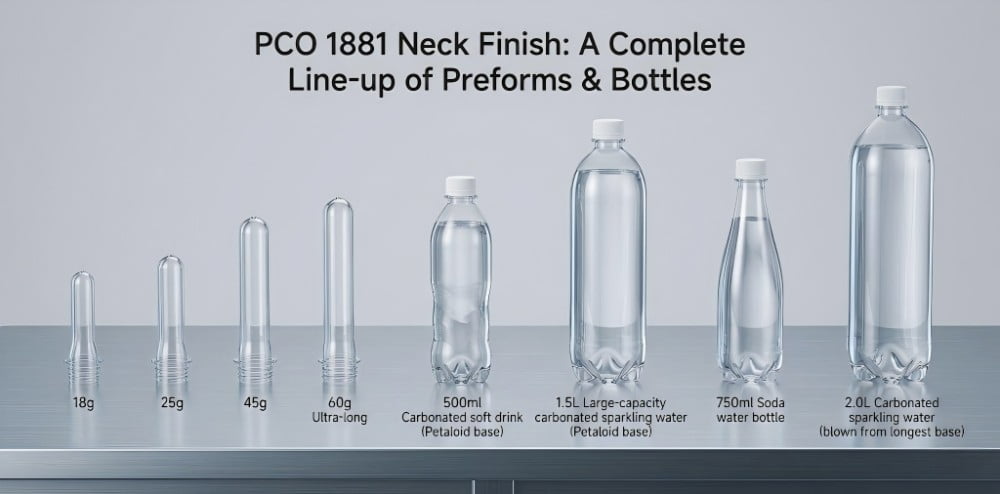
Why Do Preform Length and Body Diameter Matter for Stretching?
Preform size means more than neck diameter and gram weight. Two preforms can have the same neck finish and the same total weight but different body lengths and diameters, which changes how far the PET must stretch axially and radially to form the final bottle.
This is the point where customers often begin to understand why we keep asking for the preform drawing.
Imagine two preforms.
Both are 28mm.
Both are 25g.
From a purchasing spreadsheet, they may appear almost identical.
But one has a longer, narrower body.
The other is shorter and wider.
Once heated and stretch blown into the same bottle cavity, those two preforms do not begin from the same geometry.
The longer preform already places material farther down the bottle axis. The wider preform begins closer to the final bottle wall in the radial direction.
The total material is the same, but the stretching relationship is different.
That is why:
Same neck finish + same weight does not automatically mean the same blowing behaviour.
This is not only a bottle-design issue. It can also become a machine issue.
Krones’ Contiform BigBottle, for example, publicly specifies that its heating system can process preforms up to 160mm in length and up to 53mm support-ledge diameter. Those are platform-specific figures, not general limits for all machines, but they demonstrate that preform geometry must physically fit the equipment as well as the bottle design.
So if you already own the blowing machine, we need to ask two questions:
Can this preform produce the bottle we want?
And can this machine process this preform correctly?
Both matter.
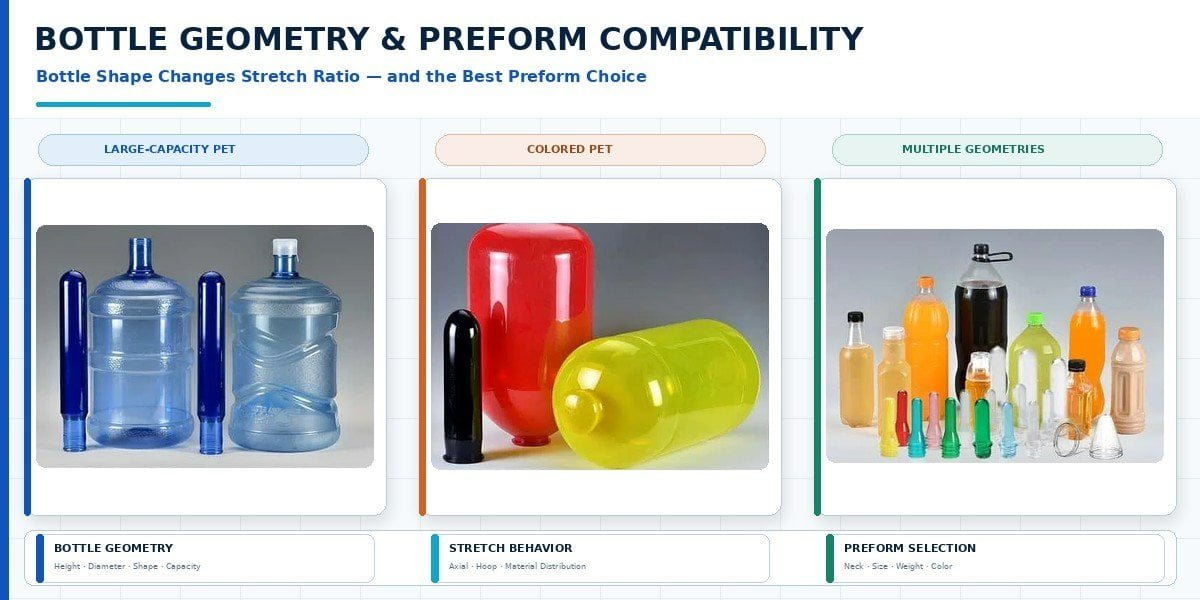
How Do Bottle Geometry and Stretch Ratio Determine Preform Compatibility?
The preform must provide a suitable axial and radial stretching relationship for the final bottle geometry. A preform that works well for one 500ml bottle may not be the best choice for another 500ml design if the height, diameter, shoulder, base or cross-section changes substantially.
This is where preform selection becomes closely connected to blow mold design.
Take three bottles with the same 500ml nominal volume.
The first is a conventional round water bottle.
The second is short and relatively wide.
The third is tall and slim.
Capacity is identical.
But the PET does not move through the same distance during blowing.
The tall bottle asks the material to travel farther axially.
The wide bottle creates a different radial expansion.
Now change the bottle from round to oval.
The material on the long side of the oval cavity has to travel farther than material toward the short side.
Krones has publicly described this exact material-distribution challenge for oval PET bottles, noting that conventional heating would tend to create different wall thicknesses between the long and short sides unless the process is adapted.
This is why we do not treat stretch ratio as a theoretical number that only machine technicians need to understand.
It directly connects the bottle drawing to the preform.
Krones also states that an optimised stretch ratio affects bottle characteristics including top load, thermal stability, burst pressure and CO₂ impermeability.
That is a strong reminder that preform geometry influences much more than whether the bottle looks fully blown.
It influences the PET orientation and material distribution that create the finished container’s performance.
For a buyer, the practical conclusion is simple:
Preform selection is not only a material-weight decision; it is also a material-distribution decision.
If you already have a bottle drawing and an existing preform, send us both.
A description such as:
“28mm, 25g”
is useful.
A complete preform engineering drawing is much more useful.
Why Can the Same Preform Sometimes Produce More Than One Bottle Size?
One PET preform can sometimes cover more than one bottle format, provided the resulting stretch relationship, material distribution, machine compatibility and bottle performance remain acceptable. However, this usable window has engineering limits and should not be defined from neck finish and weight alone.
Factories naturally want to reduce SKU complexity.
If one preform can produce 500ml, 600ml and perhaps another nearby bottle format, purchasing, storage and production planning become simpler.
This can be a practical strategy.
Commercial catalogues also demonstrate that one preform family may be offered across a capacity range rather than only one exact bottle volume. RETAL’s preform families often cover several container sizes within the same neck system.
But this does not mean one exact preform is optimal for every bottle in that published range.
The further the bottle geometry moves away from the preform’s intended stretch window, the more carefully the process needs to be evaluated.
For example, if the bottle becomes much taller while the same preform is retained, axial stretching changes.
If it becomes significantly wider, radial stretching changes.
If a deep base or handle geometry is added, material has to be sent to new areas.
At some point, using one preform for too many bottles stops being genuine standardisation and becomes process compromise.
This is why we prefer to define a preform family around the actual bottle portfolio.
The question is not:
“How many bottle sizes can I force this preform to produce?”
It is:
“Which bottle formats can this preform produce reliably without creating an unreasonable process window?”
How Does the Product Application Change the Preform You Should Choose?
The bottle must be designed for the product it will contain, so the preform should also be selected with the final application in mind. Still water, carbonated beverages, hot-filled juice, edible oil and personal-care products do not impose identical requirements on the finished PET container.
This is why our South African customer’s product information mattered.
He was not simply asking for a 5L plastic bottle.
He was developing a one-way PET water container.
That immediately tells us more than the capacity alone.
For a still-water application, we do not need to engineer the package around the same internal-pressure condition as a highly carbonated CSD bottle.
A hot-fill juice bottle introduces another set of thermal requirements.
Sidel’s hot-fill technology, for example, explicitly uses optimised preforms with specific bi-orientation ratios and thickness together with controlled heating and stretching conditions.
RETAL’s own product portfolio also separates preform applications across still and carbonated beverages, juice and dairy, oils, cosmetics and other products rather than presenting all preforms as universal blanks.
This leads to one of the most useful selection rules in the article:
Choose the preform for the product the bottle must contain—not only for the empty bottle you want to produce.
This is particularly important when customers send us a competitor bottle and say:
“I want exactly this shape.”
We still need to know what they intend to fill into it.
The same shape used for another application does not automatically prove that the same preform, weight or processing window is appropriate.
South Africa Case: Moving from 300–600ml Bottles to 5L and 10L Water Containers
Our South African customer’s project shows why moving into large PET bottles should start with bottle, closure and preform evaluation rather than simply scaling up the preform used for small bottles. His existing 300–600ml production experience did not directly determine the correct preform for the planned 5L and 10L formats.
When the customer contacted me, he already knew the direction of his business.
His factory was producing mainly 300–600ml bottles, but he wanted to expand into 5L and 10L disposable bottled-water formats.
What he did not yet have was a clear large-preform specification.
So our discussion began with three practical questions.
What type of bottle does he want to produce?
What closure does he want to use?
And what blowing equipment will produce the new container?
From there, I introduced the large-neck formats we frequently see in this part of the market. 45mm and 55mm are common references in many of the large-water-container enquiries we handle, and I explained the difference between threaded necks and push-on/snap-type closure concepts.
But I also made clear that neither number should be selected just because the bottle is 5L or 10L.
The bottle neck has to be compatible with the cap and the filling/capping arrangement.
We then discussed preform weight.
Because the customer was entering a much larger format, the weight range is naturally very different from the small preforms he normally uses.
But instead of giving him one fixed industry number, we considered the bottle application and the type of one-way water container he wanted to make.
That is important because published commercial ranges can be extremely broad. RETAL, for example, lists 74–100g 48mm preforms for 4–8L products, while its specialised 10–25L container preforms are listed at 260–485g. These examples are useful references for understanding scale, but they should not be copied directly into a customer’s project without evaluating the actual bottle.
We also discussed color.
From the projects and market enquiries we handle, clear and blue are the two colors we see most often for large PET water packaging.
Clear PET gives the customer a direct view of the water and emphasizes transparency.
Blue-tinted PET is also widely requested in water packaging for visual positioning.
But I told the customer that color comes after the technical preform specification.
First make sure the neck, weight and geometry work.
Then confirm the color.
The final part of our discussion was cost.
Because this customer is only beginning the 5L and 10L project, my recommendation was not to immediately invest in his own large-preform injection production.
At the beginning, his demand for these formats is still developing.
Purchasing finished preforms allows him to validate the bottle, market demand and production volume without immediately adding another major manufacturing process.
If the 5L and 10L business later becomes stable and volume grows substantially, then he can evaluate producing the preforms himself.
That decision is not based on one universal “pieces per month” number.
It depends on annual demand, SKU stability, resin purchasing, injection-machine utilisation, preform-mold investment, utilities, manpower, maintenance and quality-control capability.
Husky’s current equipment portfolio itself reflects this economic reality: it offers different PET injection platforms for different production scales, including systems specifically positioned for mid-volume preform manufacturing rather than assuming every bottle producer needs the same injection investment.
For our South African customer, the commercial sequence is therefore:
validate the large-bottle business with purchased preforms first; evaluate in-house preform production when the volume justifies a dedicated manufacturing investment.
That is a much safer decision than buying an injection system simply because the factory has decided to add two new bottle sizes.
Clear, Blue, Green or Amber: How Should PET Preform Color Be Selected?
PET preform color should be selected according to the desired finished-bottle appearance and any verified functional requirements. The thick preform does not show color exactly as the final stretched bottle will, and visual tint should not be confused with barrier performance.
Color sounds simple until the customer starts approving samples.
A blue preform can look relatively dark because the PET wall is thick.
After the same material is stretched across the much larger surface of the finished bottle, the appearance becomes lighter.
This is why we prefer customers to approve color from a blown-bottle sample whenever appearance is commercially important, rather than judging only from the preform.
RETAL publicly describes its PET preforms as available in colorless, tinted and specialised versions, with dyes and additives depending on the application.
That supports a wide range of packaging choices.
For ordinary water applications, our experience is that clear and blue are especially common requests.
For other markets, customers may ask for green, amber or brand-specific colors.
But there is an important distinction.
Suppose a customer tells us:
“We need a darker bottle because we need better shelf life.”
Now we need more information.
Color and barrier are not automatically the same engineering function.
RETAL separately describes tinted PET preforms and multilayer/barrier preforms, with barrier structures used when additional shelf-life protection is required.
So we should not promise UV, oxygen or shelf-life performance simply because a bottle looks darker.
Color is a packaging specification; barrier performance is an engineering specification. Do not treat them as the same thing.

Should You Buy PET Preforms or Produce Them Yourself?
For a new bottle format with uncertain or relatively low demand, purchasing preforms is often the more practical way to begin. When annual demand becomes large and stable enough to support injection equipment, preform molds, utilities, maintenance and quality control, in-house production can then be evaluated economically.
This was another important part of my conversation with the South African customer.
He was not only asking which preform to select.
He also wanted to understand the long-term supply strategy.
My recommendation was straightforward.
At the beginning, if the 5L and 10L products are still new and production volume is relatively limited, buy the preforms first.
Why?
Because producing a PET preform yourself does not mean buying only a preform mold.
You are introducing an injection-molding process into the factory.
The company needs an appropriate PET injection system, mold, resin drying and handling, cooling, process knowledge, maintenance capability and quality control.
If only a modest number of large bottles are being produced, those investments may remain underutilised.
Purchasing preforms transfers that production responsibility to a specialist supplier while the bottler concentrates on blowing, filling and developing the market.
When demand becomes large and predictable, the calculation changes.
Now every purchased preform represents a recurring external supply cost, while an injection system may operate at a much higher utilisation rate.
At that point, developing an in-house preform mold and production system can make strategic sense.
But I would not publish a universal break-even quantity because every factory’s resin cost, electricity, labour, financing, mold cavitation, machine utilisation and supplier pricing are different.
Even equipment manufacturers divide PET preform systems according to production scale. Husky positions NexPET and HyPET NX6 for mid-volume applications, while its HyPET 6e platform offers configurations up to 200 cavities for larger-scale manufacturing.
The decision should therefore be:
Does our stable demand justify becoming a preform manufacturer as well as a bottle manufacturer?
not:
“We make PET bottles, so we should automatically make the preforms too.”
What Happens If You Already Have a Preform but Want to Design a New Bottle?
If you already own or regularly purchase a preform, the first engineering step is to compare that exact preform drawing with the new bottle drawing. Existing stock is an advantage only when the neck, machine compatibility, stretch relationship and available PET material remain appropriate for the new design.
This is another situation we handle frequently.
The customer says:
“We already have thousands of these preforms. Please design the new bottle around them.”
That can be a sensible starting point.
Using an existing preform may simplify procurement and reduce SKU complexity.
But we still need to verify it.
The first thing we check is the neck finish.
If the new bottle uses the same closure, that requirement may already be satisfied.
Then we compare preform and bottle geometry.
Is the preform length reasonable for the new bottle height?
Is its body diameter suitable for the required radial expansion?
Does the available PET weight match the target bottle weight?
Will the material have to travel into an unusually deep base, wide shoulder or other difficult feature?
Finally, we check the machine.
The preform may theoretically work with the bottle but still be outside the practical handling or heating format of the available blow molding machine.
This is why we want the actual preform drawing, not just:
“30g, 28mm.”
PETMOLDER’s PET Preform Concentricity: Why Mold Precision Matters also explains why preform geometry and dimensional consistency affect the later blowing process. A correct specification is only useful when the actual preform is manufactured consistently.
What Happens If No Existing Preform Is Suitable?
If available commercial preforms cannot provide the required neck, weight, geometry or stretching relationship, the next step is to evaluate a custom preform rather than forcing an unsuitable standard preform into the project. That may eventually require a new PET preform mold.
This is where our work in preform molds and blow molds connects directly.
Many projects can use commercially available preforms.
That is often the most economical route, especially for a new product or modest volume.
But sometimes the bottle requirement is unusual.
The neck may be proprietary.
The bottle may require a particular material distribution.
The preform geometry needed for the desired stretch relationship may not exist in the local supply market.
Or a very large producer may want to optimise PET usage beyond what a generic commercial preform offers.
At that stage, custom preform development becomes reasonable.
Sidel’s packaging services explicitly combine bottle and preform design because the two parts need to work together during industrialisation.
Krones similarly offers preform engineering based on the desired bottle specification, including preform drawing and stretch-ratio considerations.
This is also why a preform mold should not be designed first and the bottle considered later.
A custom preform project needs an intended bottle or bottle family.
Otherwise we may manufacture a technically accurate injection mold that repeatedly produces the wrong preform for the final packaging objective.
How Should You Verify a PET Preform Before Ordering the Blow Mold or Preform Mold?
Before the blow mold design is frozen, confirm the bottle application and closure, select the neck finish, compare the complete preform geometry with the bottle, evaluate material requirement and stretch relationship, and verify machine compatibility. If no suitable commercial preform exists, only then should a custom preform mold be considered.
From our manufacturing perspective, the most efficient project starts with the final product.
First tell us what you want to fill.
Then show us the bottle.
If the bottle is only a concept, a 3D model or a preliminary drawing is enough to start the discussion.
Next, confirm the closure.
Once the neck finish is known, we can narrow the preform choices substantially.
Then we look at weight and geometry together.
We want to know not only how many grams of PET are available, but where that material starts before blowing and how far it needs to stretch to create the shoulder, body and base.
After that, we verify the blow molding machine.
This step is particularly important for customers moving into a substantially different bottle size, as our South African customer is doing with the transition from 300–600ml production to 5L and 10L.
A preform that fits the bottle design still has to fit the machine.
Finally, we decide the sourcing route.
If a suitable commercial preform already exists, purchasing it may be the fastest route into production.
If the project becomes high-volume and stable, the economics of making that preform in-house can be evaluated.
If no existing preform is technically suitable, then we can discuss custom preform mold development.
PETMOLDER’s How to Procure PET Preforms: A Guide to Avoiding 8 Critical Defects covers the next question: once the specification is selected, how do you make sure the actual preforms you purchase meet the required quality?
The most important sequence for a new bottle project is:
Select and verify the preform before freezing the blow mold—not after the mold has already been manufactured.
That one decision can avoid a situation where the bottle cavity has already been machined but the available preform does not provide the neck, material distribution or stretching relationship the new bottle requires.
FAQ
Can the same PET preform be used for different bottle sizes?
Yes, sometimes. One preform can have a usable bottle range, and commercial preform families are often offered for multiple container capacities. However, the final bottle height, diameter, shape, material distribution and performance still need to remain within a reasonable stretch window. Same neck finish and sufficient weight do not automatically make one preform suitable for every bottle size.
How do I know what PET preform weight I need for my bottle?
Start with bottle capacity, but do not stop there. The bottle drawing, target finished weight, product application, base and shoulder geometry, preform dimensions and expected performance all influence the choice. RETAL’s commercial catalogue shows substantial weight overlap even within similar capacity ranges, which is why a universal capacity-to-weight table is not technically reliable.
Can two PET preforms with the same neck finish and weight produce the same bottle?
They may both be able to produce the bottle, but their blowing behaviour does not have to be identical. Different preform lengths and body diameters create different axial and radial stretching relationships even when neck finish and total grams are the same. This is why we recommend comparing complete preform drawings rather than only two specification numbers.
Does PET preform color affect bottle performance?
Color primarily defines the visual packaging specification unless a specific functional additive or barrier technology has also been engineered into the preform. A tinted preform should not automatically be assumed to provide a particular UV, oxygen or shelf-life performance. RETAL, for example, distinguishes tinted preforms from specialised multilayer/barrier structures.
What information should I send to check whether a PET preform is suitable for my bottle?
The most useful starting information is your bottle drawing or 3D model, intended product, neck finish or closure requirement, target bottle weight, available preform drawing and blow molding machine information. If you do not yet have a preform, we can evaluate the bottle first and determine whether an existing commercial specification is suitable or whether a custom preform should be developed.
Conclusion
The question behind PET preform selection sounds simple:
“I know which bottle I want to produce. Which preform should I buy?”
But the answer should never begin with only one number.
Not bottle volume.
Not neck diameter.
Not preform weight.
Our South African customer’s project explains this well.
His factory already produces mainly 300–600ml PET bottles and now wants to introduce 5L and 10L one-way water containers.
His first questions were naturally about grams and neck size.
So we discussed the larger preform-weight range required for these bottle formats, the wider necks commonly encountered in the large-water market, including 45mm and 55mm references, and the difference between threaded and snap-on closure concepts.
We also discussed clear and blue preforms, which are the two color directions we most often encounter in our water-packaging enquiries.
But the most important advice was not one particular weight or diameter.
It was the selection process.
Start with the bottle and product requirement. Confirm the closure and neck finish. Then determine how much PET the bottle needs and whether the preform geometry provides a reasonable stretching relationship. Check that the preform can actually run on the blowing machine. Only then confirm color and purchasing strategy.
For his current project, because the new 5L and 10L business is only beginning, I recommended purchasing the preforms rather than immediately investing in his own preform injection production.
If his volume becomes large and stable later, we can then evaluate a dedicated injection system and PET preform mold.
That is also the approach we recommend for other buyers.
If you already have a bottle drawing but do not know which preform to use, send PETMOLDER the bottle drawing or 3D file, intended product, target bottle weight if known, closure information, existing preform drawing if available, and blow molding machine model.
Our technical team can first evaluate the bottle-to-preform relationship.
If a commercial preform can work, there is no reason to develop unnecessary tooling.
If the available preforms are not suitable, we can then evaluate whether the bottle should be adjusted or whether a custom PET preform and preform mold are justified.
Choose the preform from the bottle you need to produce—not from a generic capacity chart.
Related PETMOLDER Articles
- How to Procure PET Preforms: A Guide to Avoiding 8 Critical Defects
- The Ultimate Guide to Preform Neck Finishes: How to Choose the Right Standard for Your Bottle
- PET Preform Concentricity: Why Mold Precision Matters
- What is PET Two-Stage Molding? The Ultimate Beginner’s Guide to the Factory Process
- Can You Produce 5L, 10L, 15L, and 20L PET Bottles on a Single Blowing Machine?
-4-300x300.jpg)