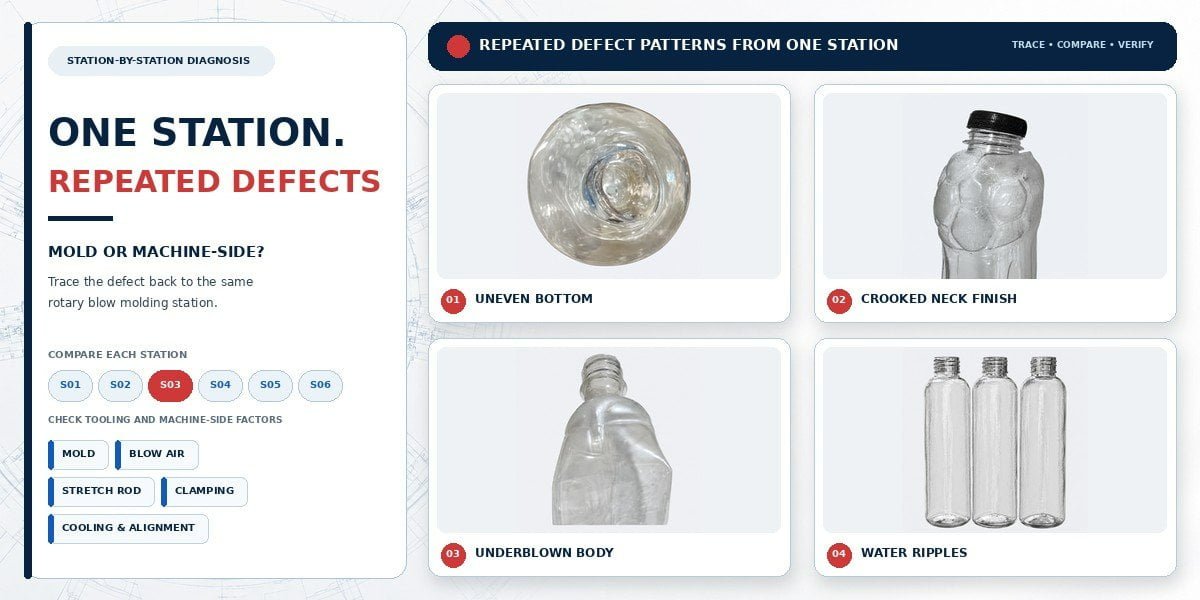
In more than ten years of after-sales support for PET blow molds and bottle production projects, if you ask me which customer problem usually needs the fastest response, my answer is simple: a bottle defect that suddenly appears during production and starts increasing the rejection rate.
Last week, I received exactly this type of urgent call from one of our customers in Canada.
The customer told me that his production scrap rate had increased significantly. When I asked what kind of defect he was seeing, he explained that many bottles had an off-center bottom. The injection gate and bottom material were consistently shifted toward one side instead of remaining properly centered.
I did not immediately tell him that the blow mold was defective.
My first question was: “Which cavity or station is producing these bottles?”
After checking the production, he found an important pattern. The defective bottles were consistently associated with No. 3. Other positions were producing substantially normal bottles.
That information changed the entire diagnosis.
I first asked him to inspect the No. 3 mold and confirm that the tooling was installed correctly and that there was no obvious abnormality in the mold or base. Then we checked the preforms. We wanted to know whether the defective bottles were always coming from one injection-mold cavity number or whether preforms from different preform cavities showed the same off-center result when they were blown at the problem position.
This step was important because an eccentric or dimensionally inconsistent preform can itself influence material distribution. We did not want to blame the blow station before excluding the incoming preform as a variable.
After one round of controlled checks, the pattern remained linked to the same blowing position rather than one specific preform cavity.
The final cause was a slight eccentricity at the lower end of the stretch rod. The rod was not guiding the material along the intended bottle centerline, which resulted in the bottle bottom and gate position shifting consistently in the same direction.
This case represents one of the most important principles we use when troubleshooting a rotary PET blow molder:
Do not decide from the appearance of one defective bottle whether the problem comes from the blow mold or the blow molding machine. First determine whether the defect follows a specific blow station.
KHS and Sidel both provide strong technical support for this station-by-station approach. KHS states that individual blow valves on a stretch blow molder can wear differently and that bottles can therefore develop station-dependent differences in material distribution and wall thickness. Its Unit Mold Control system was specifically developed to regulate individual blow stations. Sidel’s Intelliblower similarly monitors blowing curves at each individual blowing station and identifies station-specific deviations caused by factors such as blowing pressure, inaccurate component calibration and mechanical wear.
So when only one position keeps producing bad bottles, the first engineering question is not:
“Which defect is this?”
It is:
“Why does this defect keep coming from the same station?”
What Does a Station-Specific PET Bottle Defect Actually Mean?
A station-specific defect is a repeatable bottle-quality problem that remains associated with one blowing position while the other stations on the same rotary blow molder continue producing comparatively normal bottles. The defect itself may vary, but its repeated station relationship provides an important clue about where diagnosis should begin.
On a rotary stretch blow molding machine, multiple blow stations are producing the same bottle format under what should be very similar process conditions.
They normally use the same preform specification, the same heating recipe, the same overall blowing program and the same bottle design.
For this reason, if every station suddenly begins producing the same defect, we normally think differently from a situation where only station No. 3 produces it.
A general defect across many stations may point us toward a common process variable: preform temperature, overall blowing settings, incoming preform quality or another machine-wide condition.
A defect that repeatedly appears at one station gives us a different diagnostic direction.
That station has something the others do not.
It may be the particular blow mold installed there. It may be the base mold. It may be a cooling difference. Or it may be a station-side condition involving stretching, blowing, sealing, positioning or mechanical wear.
This distinction is important because the visual appearance of a bottle does not tell us enough by itself.
An off-center bottom can be associated with preform eccentricity, stretching alignment, positioning or tooling-related conditions.
An underformed region may involve venting, pressure delivery, local mold condition or material distribution.
A bottle that begins deforming after the machine has been running for some time may lead us to investigate thermal behaviour.
Different symptoms may eventually have very different root causes.
But the first diagnostic principle remains the same:
Defect appearance tells you what happened to the bottle; defect repetition tells you where to start looking.
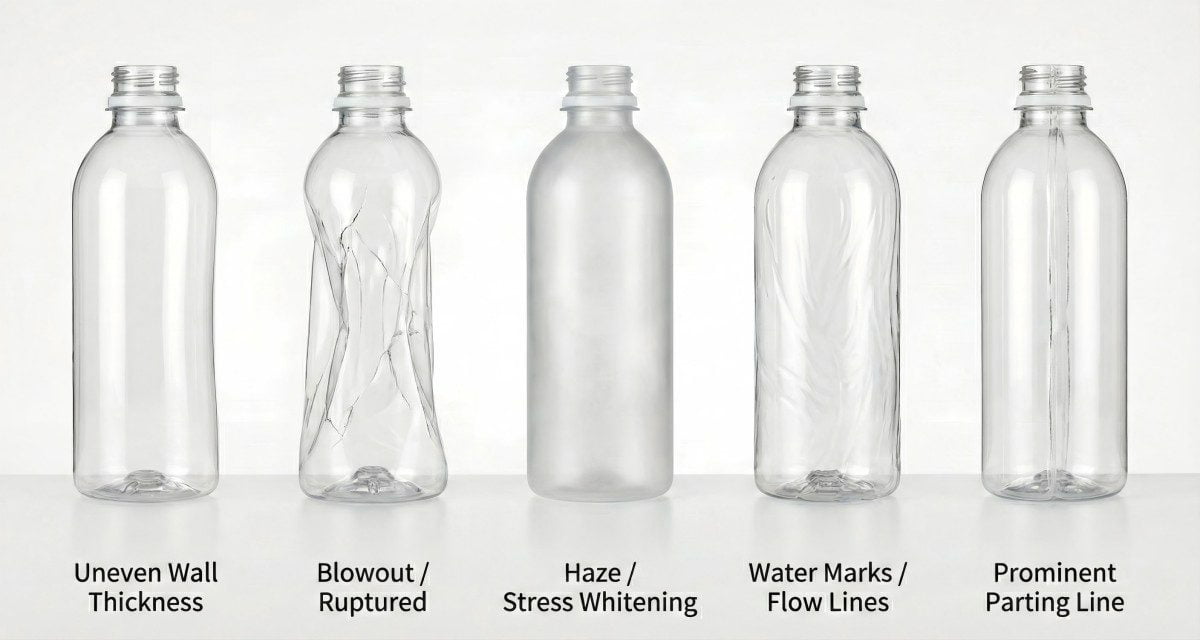
The image above should therefore not be interpreted as a chart where one bottle appearance automatically equals one machine fault.
Uneven bottoms, deformation, incomplete forming or other symptoms are only the starting evidence.
The next question is whether those symptoms occur randomly throughout production or repeatedly at one identified blow station.
This station-level variability is not theoretical. KHS states that even on advanced stretch blow molding equipment, individual stations can develop differences in PET material distribution. Its Unit Mold Control continuously measures individual bottles because the amount of wear on components such as blow valves can vary between stations.
Sidel describes the same engineering reality from another direction: blowing pressure differences at individual stations, inaccurate calibration and mechanical wear can create inconsistent material distribution between blowing positions.
That is why we should establish the station pattern before changing the entire machine recipe.
How Can You Confirm That the Defect Really Follows One Blow Station?
Before adjusting the mold or machine, establish a repeatable production pattern. Track consecutive bottles against their blow-station identity and confirm whether the same defect repeatedly returns at the same position. One or two defective bottles are not enough evidence for a station-specific diagnosis.
This is where I normally ask customers to slow down their diagnosis before they start changing settings.
When scrap is increasing, the natural reaction is to act immediately.
Increase pre-blow.
Change heating.
Adjust high-pressure blowing.
Remove the mold.
Change the stretch rod.
The problem is that if several changes are made at the same time, the factory can lose the original evidence.
We prefer to first understand the production pattern.
If a rotary machine has multiple stations and the same characteristic defect appears once during each repeatable station cycle, that information is much more valuable than simply knowing that “there are many bad bottles.”
This is exactly what changed our Canadian customer’s case.
At first, I knew only that there were many bottles with an off-center bottom.
Once the customer identified that the bottles were consistently associated with No. 3, we stopped treating the problem as a general bottle-bottom defect.
Now we had a station-related hypothesis to test.
The next step is to determine whether the pattern remains stable.
Does No. 3 continue to produce the same deviation during consecutive production?
Does the defect appear immediately after startup, or only after the machine reaches stable high-speed operation?
If overall process settings are adjusted slightly within a safe and approved operating range, does No. 3 remain different from the other stations?
Those questions help separate a real station signature from random process noise.
Where the production and inspection system allows it, station identification and bottle traceability make this much easier. Krones PET-View, for example, publicly lists inspection capability for container gate position and sidewall material distribution, as well as preform characteristics including gate position and optional mold-number reading. This illustrates the broader value of linking inspection data to where the preform or bottle came from rather than evaluating isolated rejected containers.
The principle is:
Before changing the mold or machine settings, prove that the defect is station-related.
Once that is established, the investigation becomes much more efficient.
Why Should You Check the Preform Before Blaming the Blow Station?
A station pattern is strong evidence, but the incoming preform should still be considered before the machine is blamed. Preform concentricity, gate position and dimensional variation can affect stretching and material distribution, so a useful diagnosis asks whether different preform cavity numbers produce the same defect at the suspected blow station.
This was one of the checks in our Canadian case.
After the customer identified No. 3 as the problem position, I did not immediately say:
“The machine’s No. 3 stretch rod is wrong.”
We still had to exclude other variables.
One was the preform.
A PET preform is not just a source of material. Its wall distribution, concentricity, gate position and geometry influence how material stretches into the bottle.
If the preform itself has a consistent eccentricity, the finished bottle may also show an off-center material distribution.
That is why I asked the customer to check whether the bottles with the shifted bottom all came from the same preform mold cavity.
If one specific preform cavity always produced the problem regardless of blowing position, the diagnosis would move back toward preform quality.
But if preforms from multiple injection cavities all became similarly off-center only when processed through the same blow station, the evidence against the preform becomes stronger.
This is a good example of why mold numbers and station numbers should not be mixed together.
A preform injection cavity number identifies where the preform was molded.
A rotary blow station identifies where that preform became a bottle.
For accurate troubleshooting, the factory should know which of those two identities the defect follows.
PETMOLDER discusses the importance of preform geometry in PET Preform Concentricity: Why Mold Precision Matters. For station-specific bottle diagnosis, the important lesson is that an incoming preform defect should be excluded before machine-side conclusions are made.
Does the Defect Follow the Blow Mold—or Stay With the Machine Station?
A controlled tooling comparison is one of the most useful ways to separate mold-related problems from station-related problems. If the defect moves with the tooling, the mold deserves closer investigation; if it remains at the original station after suitable tooling comparison, station-side conditions become a stronger suspect.
This is probably the most valuable diagnostic logic in this entire article.
Suppose station No. 3 repeatedly produces an abnormal bottle.
There are two main physical groups of components involved.
The first group moves with the tooling: mold halves, base mold and tooling-specific cooling or interfaces.
The second group belongs to the machine station: the station’s stretching system, blowing-air delivery, mechanical positioning and other station hardware.
Under the blow molder manufacturer’s safety requirements and only where the equipment design and operating procedures allow it, a controlled tooling comparison can help separate these two groups.
Imagine that the tooling from problem station No. 3 is moved to a verified normal station.
If the characteristic defect also moves and now appears where that tooling is installed, the mold becomes a much stronger suspect.
Now reverse the logic.
If known-good tooling is installed at the original No. 3 position and a similar defect still appears there, while the original No. 3 tooling operates normally at another suitable station, the investigation should move toward the machine position.
The important word is evidence.
This is not a 100% automatic root-cause formula.
PET stretch blow molding is a system. A mold may interact differently with a marginal station condition, and moving components can sometimes change thermal or installation variables.
The purpose of the comparison is not to declare a final cause instantly.
Its purpose is to dramatically reduce the investigation area.
This is also why an article such as Preventing PET Bottle Scratches: Is Your Mold or Blow Molding Machine to Blame? is relevant to the broader philosophy: the same visible defect can involve tooling, machine or interaction between the two. We should diagnose from evidence rather than from the component we happen to manufacture.
What Should Be Checked If the Defect Follows the Blow Mold?
If the defect consistently moves with the tooling, investigate how that specific mold forms, cools and locates the bottle rather than continuing to adjust the entire blow molder. The exact checks should follow the observed defect because different bottle regions depend on different tooling functions.
At this point, the mold deserves a closer inspection.
But I still would not turn the diagnosis into a generic checklist of every possible mold component.
The bottle itself tells us which function of the mold is worth examining.
If one local feature consistently fails to reproduce the cavity while the rest of the bottle is well formed, then we need to understand what is happening in that region.
Is trapped air preventing complete cavity contact?
Does the surface or venting condition differ from the other cavities?
If the problem is concentrated at the bottom and follows the same mold, then the base mold becomes more relevant.
We would compare its geometry, location and relationship with the mold halves against a known-good tooling set.
If the defect appears only after continuous production, thermal behaviour becomes more important.
A mold can produce acceptable bottles when cold and begin to drift after the tool reaches another thermal state if its cooling circuit does not behave like the other stations.
For replacement rotary tooling, another issue is repeatability.
The cavity may be dimensionally correct when measured on the bench but still require correct installation and positioning every time the blow station closes.
This is why mold manufacturing is not only about machining a bottle cavity.
The mold must repeatedly establish the same bottle centerline and mechanical relationship during rotary production.
If inspection confirms genuine wear or tooling damage, the next decision is whether the mold should be repaired, refurbished or replaced. PETMOLDER’s PET Blow Mold Maintenance: When to Refurbish vs. When to Replace for Maximum ROI addresses that commercial decision separately.
The key is not to replace the tooling simply because the bad bottles were first noticed at one cavity.
First prove that the problem actually moves with that tooling.
What Should Be Checked If the Defect Stays With the Same Blow Station?
If known-good tooling does not remove the defect and the same blowing position continues to produce the abnormal bottle, the diagnosis should move toward station-specific process and mechanical conditions. Repeatedly modifying a good mold at this point can hide the actual machine-side problem instead of solving it.
This is where a mold supplier has to be careful.
A customer may send us a bad bottle and ask:
“Can you modify the mold?”
Sometimes the correct answer is that we should not modify it yet.
KHS provides very direct evidence for this situation. Its Unit Mold Control documentation states that individual blow valves can wear by different amounts over the operating life of a stretch blow molder. This can cause station-dependent changes in PET material distribution and bottle-wall thickness. KHS also states that data from individual stations can provide maintenance information on valves, stretching systems and mold shells.
Sidel describes a similar mechanism. According to its Intelliblower documentation, material-distribution inconsistencies can arise from incorrect blowing pressures at individual blowing stations, inaccurate calibration of components or mechanical wear. Its system therefore analyses each station’s blowing curve rather than assuming every station is behaving identically.
This is exactly why we should not use one machine-wide setting to explain every local problem.
If 19 stations are producing good bottles and station No. 3 is not, increasing or decreasing a global setting may improve No. 3 while moving the other 19 away from their optimum condition.
The more useful question is:
What is physically or pneumatically different at station No. 3?
For one defect, that may be blowing-air delivery.
For another, it may be stretching.
For another, mechanical positioning or calibration may deserve attention.
This is what happened with our Canadian customer.
Once the mold installation and preform variables had been checked, the investigation moved toward the stretching system.
The lower end of the stretch rod was slightly eccentric.
That small station-specific mechanical deviation was enough to disturb the intended stretching path and consistently shift the bottle bottom.
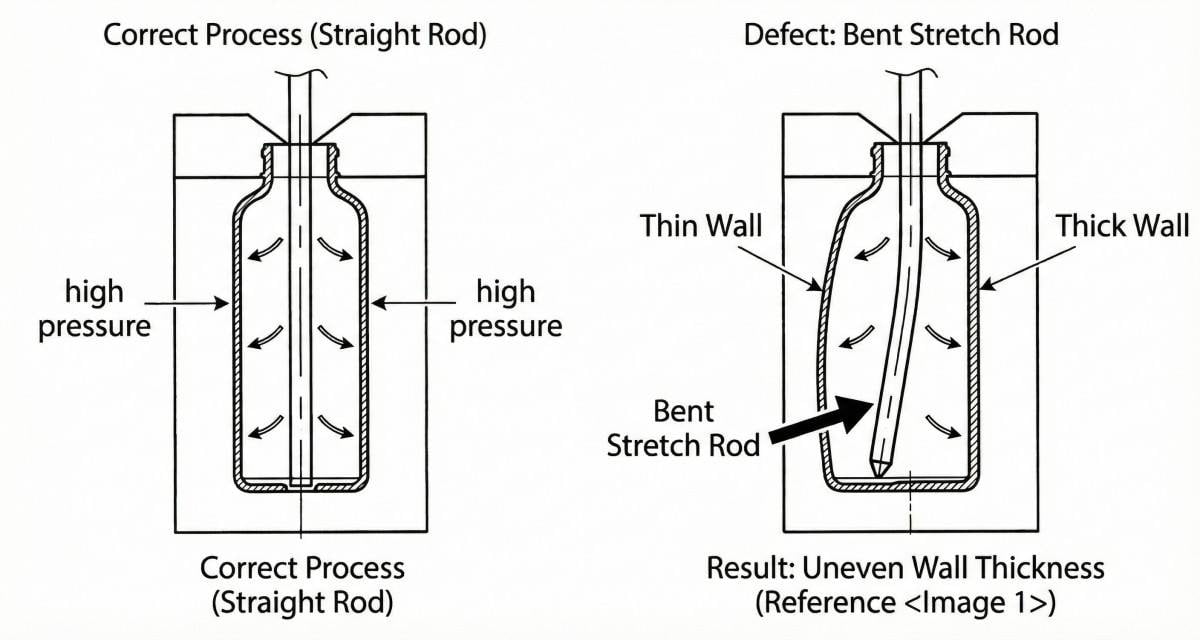
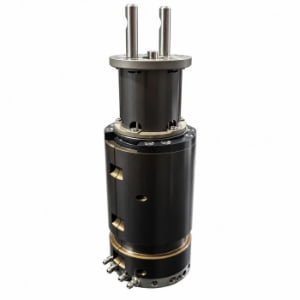
The image above represents the type of machine-side stretching problem that should be considered when an off-center result remains tied to one position.
Sidel’s current StarLITE-R technical description also provides useful evidence for why stretch-rod geometry matters specifically at the bottle base: Sidel states that its advanced stretch-rod end design improves preform end-cap stretching and helps ensure accurate injection-gate centering in the bottle.
That does not mean every off-center gate is caused by the stretch rod.
It means the stretching system has a direct physical role in where the preform end-cap material develops.
For a full defect-specific procedure, PETMOLDER already has Bottom Gate Off-Center? A 6-Step Protocol to Fix PET Bottle Eccentricity. The purpose of this article is different: to explain why a defect isolated to one station should first be diagnosed as a station-versus-tooling problem.
Canadian Case: How We Traced an Off-Center Bottle Bottom to Station No. 3
Our Canadian case shows why station tracking should come before component replacement. The bottles pointed us toward the bottom, but the repeatable No. 3 pattern, preform comparison and mold inspection eventually showed that the actual cause was a slightly eccentric stretch rod at that blowing position.
Let me put the sequence together because this is much closer to how we actually handle an urgent production call.
The customer first told me only one thing:
“The rejection rate is very high.”
That does not give an engineer enough information.
I asked him to describe the bottle.
He told me the bottom was shifted toward one side.
Now we knew the symptom, but we still did not know the source.
So I asked him for the cavity or station number.
After checking, he found that the defective bottles were consistently associated with No. 3.
That was the first major piece of evidence.
Next, I asked him to inspect the No. 3 mold itself.
Was the tooling properly installed?
Was there an obvious difference in the base or cavity?
Did anything appear loose or incorrectly seated?
We did not find evidence that immediately explained the repeated defect.
Then I asked about the preforms.
Were all of these defective bottles coming from the same preform cavity number?
Or would preforms carrying several different injection cavity numbers all develop the same off-center result at No. 3?
This check helped us reduce the probability that one eccentric preform cavity was creating the problem.
Once the defect continued to point toward the same blow position, we looked further into the machine-side stretching condition.
The final finding was that the lower end of the stretch rod was slightly eccentric.
That matched the observed bottle behaviour.
The stretching path at No. 3 was no longer centered in the same way as the other positions, so the bottle-base material and gate location consistently moved off the intended center.
After correcting this station-side issue, there was no reason to modify a blow mold that was not the root cause.
This is why I consider this case useful for production managers.
The final repair may sound simple.
The diagnosis was the valuable part.
If we had assumed at the beginning that an off-center bottom must be a base-mold problem, the customer could have spent time removing and modifying tooling without correcting the source of the defect.
Can Cooling Differences Make Only One Station Produce Bad Bottles?
Yes. A shared cooling-water system does not automatically prove that every installed mold experiences the same local thermal condition. A connector restriction, flow difference, base-cooling issue or mold-specific circuit condition can create station-to-station thermal variation, especially after continuous high-speed operation.
Cooling is a good example of why time matters during diagnosis.
Suppose the machine starts in the morning and all stations produce acceptable bottles.
Thirty minutes or an hour later, one station begins showing base deformation or dimensional drift.
That pattern is different from a defect that appears on the very first cycle.
It suggests we should ask what is changing as the machine reaches thermal equilibrium.
Bottle bases can be particularly sensitive because the material distribution and wall thickness in this area may leave more heat to remove after blowing.
KHS has publicly discussed targeted bottle-base cooling when increasing Blomax output. It states that the base, which can remain relatively hot, is specifically cooled so that critical thicker regions do not deform.
Sidel likewise describes dual base cooling in its StarLITE-R technology: an external mold-base cooling circuit focuses on warmer base zones while internal cooling is provided through a hollow stretch rod.
These examples do not mean every rotary machine uses the same cooling design.
They demonstrate why bottle-base thermal control can materially affect bottle quality.
For station diagnosis, the practical comparison is not simply:
“Does cooling water enter the machine?”
It is:
Does the problem station achieve the same effective mold thermal condition as the normal stations?
This is where connector condition, water passage, mold circuit cleanliness and actual local cooling behaviour may matter.
If the defect follows the tooling during a controlled comparison, its mold cooling deserves more attention.
If the thermal abnormality remains tied to one machine position regardless of suitable tooling, then the station-side cooling interface should also be considered.
The important diagnostic clue is the production trend over time.
Cold-start samples and steady-state high-speed samples can tell different stories.
Why Do Wall Thickness and Material Distribution Help Identify a Problem Station?
Visual inspection can miss early station variation. Comparing wall-thickness or material-distribution profiles by station can reveal a repeatable process deviation before the bottle becomes obviously defective, especially when one position consistently shifts PET toward the same shoulder, sidewall or base region.
Not every station problem immediately creates a bottle that looks unacceptable.
Sometimes all bottles appear visually normal.
But when measured, station No. 3 may consistently have a thinner shoulder.
Station No. 7 may leave more PET in the base.
Another position may repeatedly shift material toward one side.
These differences matter because PET bottle performance depends on where the material is distributed, not just whether total bottle weight is correct.
This is precisely why KHS developed Unit Mold Control. KHS states that the system continuously measures material distribution in each bottle and adjusts individual stations, reducing wall-thickness variation from mold to mold by more than 30% in the application described.
Sidel’s Intelliblower takes a related approach by recording and comparing real blowing curves for individual stations. Sidel reports that the system can identify blowing stations producing outside accepted tolerances and that station-to-station standard deviation in material distribution can be reduced through individual regulation.
For factories without these automatic control systems, the same diagnostic philosophy can still be applied manually.
Do not only collect “good bottle” and “bad bottle.”
Connect the measurement to the production position.
The useful information becomes:
bottle appearance + wall-thickness pattern + blow-station identity + production time
Consider our Canadian case again.
The visible symptom was the off-center base.
But if the stretch rod had been only slightly farther from the intended center and the bottles were still passing visual inspection, repeated thickness measurements might have revealed a directional material shift before the rejection rate became high.
This is why station-by-station quality data are valuable for maintenance, not just final inspection.
A repeated material-distribution signature can be an early indication that the process or mechanical condition of one station is drifting away from the others.
What If the Defect Appears Only on One Bottle Design?
If one station behaves normally with other bottle formats but becomes problematic with a particular lightweight or difficult bottle design, the diagnosis may involve interaction between station condition and process window rather than a simple “machine fault” or “mold fault.”
Real production is not always divided neatly into two categories.
Machine bad.
Mold good.
Or mold bad.
Machine good.
Sometimes a station has a small mechanical or pneumatic deviation that does not matter when producing a robust bottle with a wide process window.
Then the factory installs a lighter bottle or a more difficult base geometry.
Suddenly that same station becomes the first one to create defects.
Why?
Because the new bottle may be more sensitive to material distribution, stretching timing or pressure differences.
Sidel’s Intelliblower documentation itself was developed in the context of improving material-distribution consistency and lightweighting. Its station-level regulation exists because small process deviations matter more when the available PET material and process tolerance become tighter.
KHS makes a similar point in its Unit Mold Control documentation, particularly for lower-weight containers and bottles with recycled PET, where material variation can reduce process stability.
Therefore, if only one bottle format exposes the problem, do not immediately conclude:
“The new mold is defective because the old bottle runs normally.”
Nor should we conclude:
“The machine is fine because another bottle works.”
The better conclusion is:
This bottle design is revealing a station-to-station difference that the previous format tolerated.
Now the job is to determine whether that difference should be corrected mechanically, pneumatically, thermally or through tooling/process optimisation.
This system-level thinking is important when producing increasingly lightweight PET bottles.
When Should You Repair the Blow Mold, Service the Station, or Replace the Tooling?
The repair decision should follow the evidence. If the defect consistently follows one tooling set and inspection confirms wear, cooling or geometry problems, repair or replacement may be justified. If it remains at one machine station, service that station first. If the problem depends on both station and bottle format, evaluate the interaction before replacing either component.
For a production manager or purchasing manager, this is ultimately the question that matters.
Where should the maintenance budget go?
If the defect clearly follows the mold after controlled comparison and physical inspection confirms an actual tooling issue, then we can discuss whether to repair the cavity, refurbish the mold, replace a base component or manufacture replacement tooling.
If the mold moves to another suitable station and operates normally, while different tooling continues to produce the same abnormality at the original position, repeatedly modifying the mold makes little sense.
The machine station should be serviced.
And there is a third situation.
The defect may appear only when one sensitive bottle format is installed on one marginal station.
In this case, the correct solution may require both machine-side correction and evaluation of whether the current mold/process combination has enough production margin.
This is why a blow mold supplier should not make a replacement recommendation from one photograph.
When a customer asks PETMOLDER to assist with a station-specific defect, the most useful information is not simply:
“Our bottles are bad.”
We want to know the exact blow molder model, the affected station number, what tooling is installed there, when the defect appears, whether the defect follows that tooling, and what comparison tests have already been completed.
Bottle samples or clear photographs from both the abnormal station and a known-good station are much more useful when their production identity is preserved.
If preform cavity numbers are available, that information can also help eliminate an upstream variable.
For general bottle-deformation issues that occur across the production process rather than one identified station, see Comprehensive Troubleshooting: Why Do PET Bottles Deform After Blowing and How to Fix Them.
The most important purchasing and maintenance principle is:
Do not replace the mold because one station makes bad bottles. First determine whether the defect follows the mold or stays with the station.
A Practical Station-by-Station Diagnosis Sequence
The most efficient diagnosis moves from pattern identification to variable isolation. Confirm the station first, separate preform and tooling influences next, then investigate station-specific blowing, stretching and cooling conditions. This order reduces unnecessary adjustments and protects useful production evidence.
If I reduce the complete method to the way we actually communicate with customers during an urgent call, it looks like this.
First, identify the repeated position.
Do not begin by changing global process parameters. Establish whether the same bottle symptom repeatedly comes from one blow station.
Second, check whether an incoming preform pattern can explain it.
If possible, compare preform cavity identities. A defect that follows one injection cavity tells a different story from a defect produced by multiple preform cavities at one blow station.
Third, inspect the tooling and installation at the problem position.
We want to know whether anything is visibly different from the normal stations before dismantling more of the machine.
Fourth, where the equipment design, OEM instructions and safety procedure permit it, use a controlled tooling comparison to determine whether the defect moves with the mold or remains at the station.
Only after this separation do we investigate the machine-side process in greater depth.
Now blowing curves, pressure delivery, station calibration, stretching alignment, mechanical wear and cooling behaviour have much more diagnostic meaning because we know which position deserves attention.
Finally, verify the repair by returning to the same evidence that identified the problem.
Do not accept only one good bottle after adjustment.
Confirm that the station-specific pattern has disappeared during representative production and that wall distribution or relevant bottle dimensions have returned to an acceptable relationship with the other stations.
This is much safer than troubleshooting by changing one setting after another until the bottle temporarily looks better.
FAQ
Why does only one blow molding station produce defective PET bottles?
One station can develop a different pneumatic, mechanical, thermal or tooling condition from the others. KHS specifically notes that individual blow valves can wear differently and create station-dependent material-distribution changes, while Sidel identifies incorrect station pressure, inaccurate calibration and mechanical wear as causes of station variation. The first step is therefore to confirm that the defect consistently follows one identified station.
How can I tell whether the problem is the blow mold or the blow molding machine?
First prove that the defect is station-specific. Then, where machine design and approved safety procedures allow it, a controlled tooling comparison can help. If the characteristic problem moves with the tooling, investigate the mold more closely. If good tooling develops the same problem at the original station, machine-side conditions deserve priority. The comparison narrows the diagnosis; it does not replace final root-cause verification.
Can one blow station produce different bottle wall thickness from the other stations?
Yes. KHS states that station-to-station differences can cause varying bottle-wall thickness and that its Unit Mold Control individually regulates stations to reduce those variations. Sidel also monitors the blowing curve of each individual station to control material distribution.
Can mold cooling cause defects on only one station?
It can. If one tooling set or one cooling connection has a different effective flow or thermal condition, its bottle temperature and dimensional behaviour can diverge from other stations during continuous production. Bottle bases are particularly relevant because both KHS and Sidel describe targeted base-cooling technologies to control hotter or thicker bottom regions.
What information should I send when asking a blow mold manufacturer to diagnose a station-specific defect?
Send the exact blow molding machine model, affected station number, corresponding mold information, normal and defective bottle photographs or samples, the repetition pattern and any tooling comparison already performed. If possible, preserve preform cavity identification and wall-thickness measurements. This gives the engineer evidence to decide whether investigation should continue on the tooling side, machine side or interaction between the two.
Conclusion
During more than ten years of PET bottle after-sales support, production defects remain some of the most urgent calls we receive because every minute of incorrect diagnosis can mean more rejected bottles.
Our Canadian customer’s case last week is a good example.
The first information we received was simply that the scrap rate was high and many bottles had an off-center bottom.
If we had diagnosed only from the bottle appearance, we could have started by modifying the base mold.
Instead, I asked for the cavity or station identity.
The customer found that the defective bottles consistently pointed to No. 3.
We then checked the No. 3 tooling and installation, compared the preform cavity information to reduce the likelihood of preform eccentricity, and continued narrowing the investigation toward the station itself.
The final cause was a slight eccentricity at the lower end of the stretch rod.
The problem was corrected on the machine side rather than by unnecessarily modifying the mold.
This is why, when our technical team discusses a defect from one cavity or one rotary blow station, we do not start with the assumption that the blow mold is wrong.
Nor do we automatically say that the blowing machine is responsible.
We start with the production pattern.
Defect appearance tells you what happened to the bottle. Defect repetition tells you where to start looking.
And for a station-specific problem, the most useful diagnostic question is:
Does the defect follow the mold, or does it stay with the blow station?
If your rotary PET blow molder has one station that repeatedly produces abnormal bottles, you can send PETMOLDER the machine model, station number, corresponding blow mold information, preform drawing or cavity identification where available, normal and defective bottle samples or photographs, and the comparison tests already completed.
We can help determine whether the next investigation should focus on the blow mold, base mold, cooling system, preform, stretching system or machine station before replacement tooling is ordered.
Do not replace the mold because one station makes bad bottles. First determine whether the defect follows the mold or stays with the station.
Related PETMOLDER Articles
- Bottom Gate Off-Center? A 6-Step Protocol to Fix PET Bottle Eccentricity
- Preventing PET Bottle Scratches: Is Your Mold or Blow Molding Machine to Blame?
- Comprehensive Troubleshooting: Why Do PET Bottles Deform After Blowing and How to Fix Them
- PET Blow Mold Maintenance: When to Refurbish vs. When to Replace for Maximum ROI
- PET Preform Concentricity: Why Mold Precision Matters