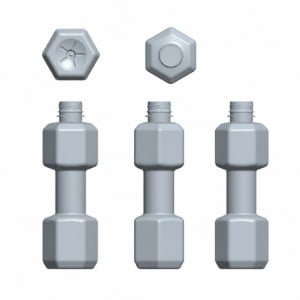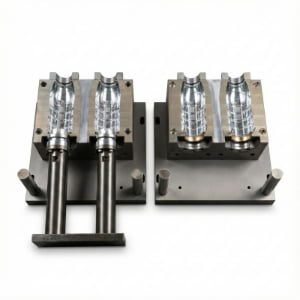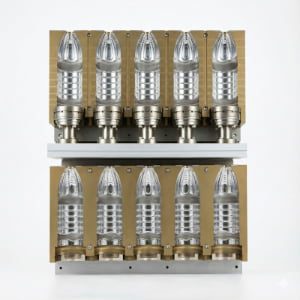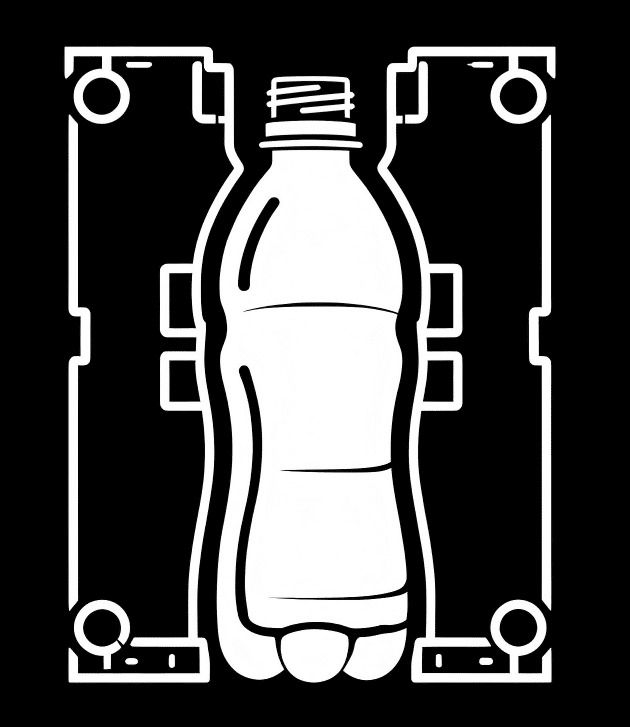
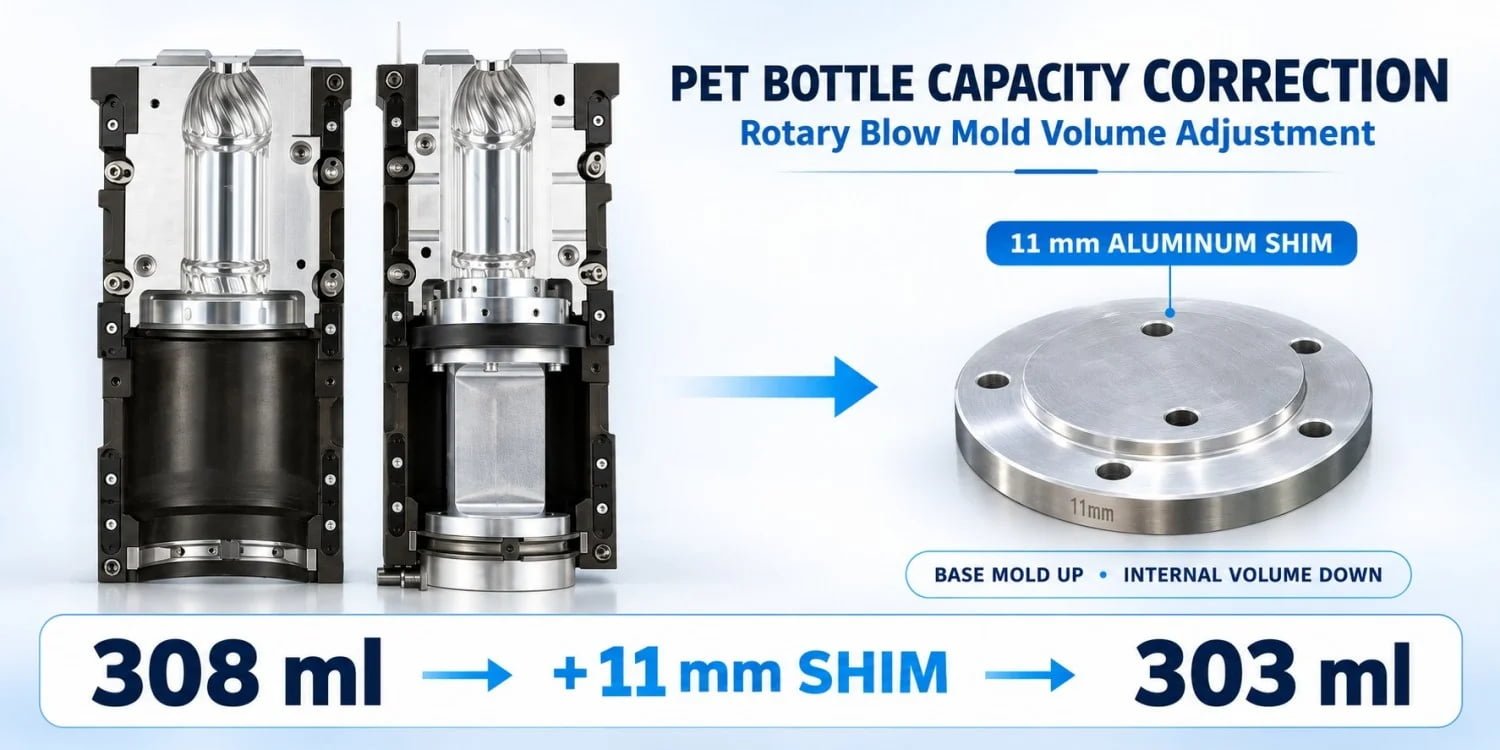
A rotary PET blow mold designed for a 300 mL bottle does not always produce a bottle that measures exactly 300 mL during the first production trial. Actual measured capacity can also be affected by the capacity definition, blowing conditions, PET shrinkage, preform condition, and measurement timing. For a small and predictable deviation, rotary blow mold volume adjustment shims may correct the bottle capacity without remachining the complete mold set.
This article focuses specifically on high-speed rotary PET blow molds. The adjustment principle described here should not be treated as a universal solution for every semi-automatic, linear, or rotary blow mold structure.
Why Can PET Bottle Capacity Differ After a New Rotary Blow Mold Is Installed?
A capacity difference after installation does not automatically prove that the rotary blow mold was machined incorrectly. The first engineering task is to determine whether the difference comes from capacity definition, production conditions, PET dimensional stabilization, measurement method, or the actual mold geometry.
When we evaluate a new bottle drawing, cavity volume is an important design reference. However, the bottle measured on the customer's production floor is a blown PET container, not a CAD cavity.
In two-stage PET stretch blow molding, the preform is reheated, stretched axially, expanded by pre-blow, formed under high-pressure blowing, cooled against the cavity wall, and then released from the mold. The final bottle therefore reflects the interaction between tooling, PET material behavior, and the actual blowing process.
The most common factors should be separated before any mold adjustment is made.
| Factor to Check | Why It Matters to Capacity Measurement | What Should Be Confirmed |
|---|---|---|
| Capacity definition | Nominal fill volume and overflow capacity are not the same value | Whether the requirement refers to filling volume, nominal product volume, or brimful capacity |
| Bottle measurement timing | PET can continue to stabilize after demolding | Whether all samples are measured after the same stabilization period |
| Blowing process | Poor replication of the cavity can affect the final geometry | Heating, stretch rod motion, pre-blow, high-pressure blowing, and cooling stability |
| Preform condition | Preform dimensions and thermal distribution affect stretching behavior | Preform weight, neck finish, material, and consistency |
| Mold temperature | Different thermal conditions can influence dimensional stability | Whether cooling has reached stable production conditions |
| Mold geometry | A true cavity or base dimension deviation directly affects volume | Cavity dimensions, base mold position, and manufacturing consistency |
This distinction is important because different capacity problems require different solutions.
If one cavity produces a substantially different bottle volume from the other cavities in the same mold set, the investigation should focus on machining consistency, cavity dimensions, assembly, and measurement repeatability. We discussed that type of issue separately in 30ml Capacity Variance in Same-Batch PET Blow Molds: A CNC Manufacturing Analysis.
The situation discussed in this article is different. Here, the mold set is producing consistent bottles, but the measured capacity needs a relatively small correction after the tooling is installed on the actual rotary blowing line.
Small capacity deviation does not always mean the complete rotary blow mold must be remachined.
How Does a Volume Adjustment Shim Change PET Bottle Capacity?
A volume adjustment shim changes the installed axial position of the base mold within a predefined mechanical range. When the effective position of the base-forming surface changes, the available forming volume at the lower part of the bottle also changes. The exact relationship between shim thickness and bottle volume depends on the individual rotary mold design.
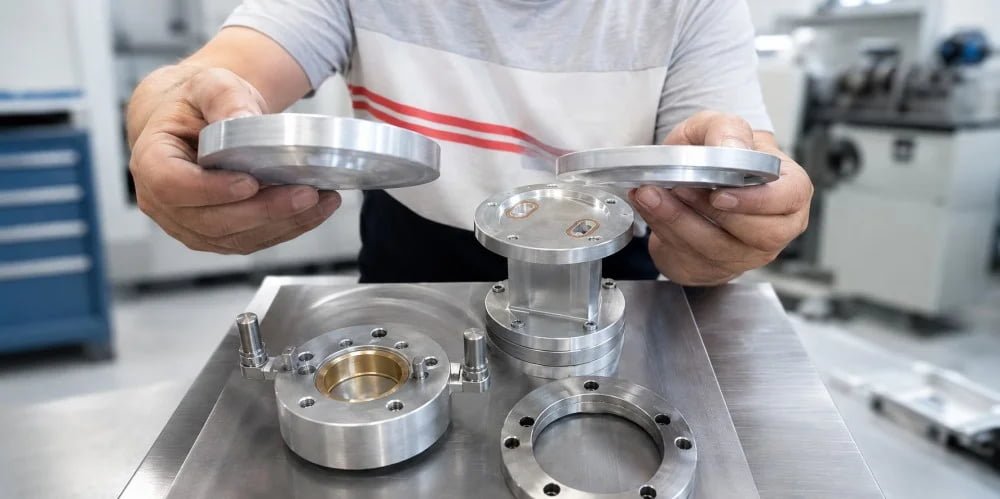
The key point is that the shim does not directly “change the volume” by itself. It changes the mechanical position of the base mold, and that position change modifies the effective forming space inside the bottle cavity.
When we design a rotary blow mold with this adjustment structure, the base mold, side mold cavity, mounting interface, and shim position have to be considered as one mechanical system.
If the base-forming surface moves slightly toward the bottle cavity, the effective internal forming space changes. Moving it in the opposite direction changes the space in the other direction.
However, the direction and amount of capacity correction must always be confirmed from the actual mold construction.
It is therefore not technically correct to create a universal rule such as:
“a thicker shim always reduces capacity,”
or:
“every 1 mm of shim thickness equals a fixed number of millilitres.”
Different bottle bases have different projected areas and geometries. A relatively flat base, a champagne-style base, and a CSD petaloid base do not respond identically to the same axial movement.
The mechanical installation of the shim can also differ between mold designs.
A useful way to understand the engineering relationship is shown below.
| Design Variable | Influence on Capacity Correction |
|---|---|
| Effective bottle base area | A larger effective area can create a larger volume change for the same axial movement |
| Base geometry | Petaloid, champagne, and other base profiles change the effective displaced volume |
| Shim installation position | Determines how shim thickness translates into actual base mold movement |
| Base mold mounting structure | Different machine and mold designs can use different mechanical relationships |
| Allowed axial adjustment | Limits how far capacity can be corrected without affecting other bottle features |
| Side mold-to-base mold transition | Must remain geometrically acceptable after adjustment |
This is why the relationship between shim thickness and millilitres should be established for the specific mold set.
In the actual mold used for the case discussed later in this article, we prepared 9 mm and 11 mm adjustment shims as part of the designed capacity-correction arrangement.
Those dimensions were not intended to become a general industry conversion table. They were prepared for the geometry and mechanical configuration of that particular rotary mold.
Case Study: A 300 mL Bottle Measured 308 mL on a 20-Cavity Rotary Blow Mold
In one of our recent Saudi projects, we supplied a 20-cavity rotary PET blow mold for a bottle specified at 300 mL. After the tooling was installed on the customer's production line, the customer measured approximately 308 mL. Because the mold had been designed with spare capacity adjustment shims, we could evaluate a controlled field correction instead of immediately remachining the mold.
The customer called me and asked:
“Vivian, I ordered a 300 mL bottle. Why is the bottle I am blowing now 308 mL?”
At that point, the mold was no longer in our factory in Guangdong. It was already operating on the customer's rotary blow molding line in Saudi Arabia.
This makes the service strategy very different from a mold that is still in our workshop.
Because we had prepared the capacity adjustment structure in advance, we asked the customer to use the 11 mm shim configuration specified for this mold.
For this particular tooling configuration, the expected correction was approximately 5 mL lower capacity.
The practical result can be summarized clearly.
| Item | Project Condition |
|---|---|
| Customer market | Saudi Arabia |
| Mold type | Rotary PET blow mold |
| Number of cavities | 20 |
| Specified bottle volume | 300 mL |
| Capacity measured by customer | Approximately 308 mL |
| Adjustment used | 11 mm shim configuration |
| Expected capacity correction | Approximately -5 mL |
| Resulting capacity | Approximately 303 mL |
| Customer acceptance | Approximately 303 mL was within the required range for this project |
The most important point is not the number “11 mm.”
The engineering lesson is that 11 mm produced this approximate correction on this specific mold design.
It should not be interpreted as:
“11 mm always reduces PET bottle capacity by 5 mL.”
If another buyer has a 300 mL bottle with a different diameter, base shape, mold platform, or shim arrangement, the same shim thickness may produce a different result.
Shim selection should therefore follow the calibration logic of the actual mold rather than an assumed millilitre-per-millimetre formula.
Why Are Capacity Adjustment Shims Especially Useful on Rotary Blow Molds?
Volume adjustment shims are particularly valuable on rotary blow molds because these molds normally operate on multi-station, high-speed production equipment. Once a complete mold set has been shipped internationally and installed, a small correction can become expensive if the only solution is to return major mold components for machining.

Rotary tooling is different from a small mold that can be removed and sent to a nearby machine shop with limited impact on production.
A high-speed rotary system may contain many blow stations. In the Saudi project above, there were 20 cavities.
If the bottle capacity is only several millilitres away from the accepted target, but the customer must remove and return the base molds or the complete mold set to China, the real cost is not simply the CNC machining operation.
The project may involve production interruption, packing, international freight, customs procedures, workshop modification, return shipping, reinstallation, and another production trial.
For buyers sourcing replacement tooling for Krones, Sidel, or similar rotary platforms, mechanical compatibility is already an important part of the mold project. Our article High-Speed Rotary Blow Molds for Krones & Sidel: A Guide to Premium Compatible Tooling explains this platform-specific tooling requirement in more detail.
Capacity adjustment should be considered in the same way.
The shim is a small physical component, but its engineering value is larger than its material cost.
The shim is not only an adjustment part; it is a serviceability feature designed into the rotary blow mold.
This is especially relevant for overseas tooling.
When the mold is still in our factory, a confirmed modification can be transferred quickly from measurement to engineering and machining. Once the tooling is installed in another country, even a relatively minor mechanical correction can involve several companies and much more production time.
Good rotary tooling therefore needs to be evaluated not only for initial accuracy but also for reasonable field serviceability.
How Do You Decide Which Shim Thickness to Use?
The correct shim thickness should be selected from the measured capacity deviation and the calibration data for the specific mold. Production must first be stable enough to prove that the capacity difference is repeatable. Only then should the base mold position be changed.
The most common mistake would be to measure one bottle, see that it is several millilitres too large, and immediately increase or decrease shim thickness.
That skips several important engineering checks.
A better approach is to use a controlled sequence.
| Step | Engineering Check | Reason |
|---|---|---|
| 1 | Stabilize the blowing process | Prevent a process variation from being mistaken for a mold-volume problem |
| 2 | Standardize the capacity measurement | Make sure the comparison uses the same capacity definition and test condition |
| 3 | Sample several bottles | Confirm that the capacity deviation is repeatable |
| 4 | Compare cavities | Check whether the problem is common to the mold set or isolated to individual stations |
| 5 | Confirm current shim configuration | Establish the mechanical starting point |
| 6 | Refer to mold-specific calibration | Select the approved shim rather than guessing |
| 7 | Run another controlled trial | Confirm capacity and other bottle dimensions after adjustment |
Production stability matters because the final bottle geometry depends on the blowing process.
Heating imbalance, incorrect stretch rod motion, unstable pre-blow, insufficient cavity replication, or poor cooling conditions should be corrected before the mold position is altered.
The capacity measurement also needs to be consistent.
A bottle measured immediately after blowing should not be compared casually with another bottle measured under a different stabilization condition.
PET bottles can change slightly as they stabilize after blowing. The relationship between bottle volume and post-blow dimensional change is discussed in PET Bottle Volume Shrinkage Analysis: Why Did Your 500ml Bottle Drop to 498ml Overnight?.
Only after those variables are controlled should the mold-specific shim calibration be used.
Why Must Fill Volume and Overflow Capacity Be Distinguished Before Adjustment?
Before any capacity correction is made, the mold maker and customer must agree on what “300 mL” actually means. Nominal product volume, production filling volume, and overflow capacity are different packaging parameters. This distinction is particularly important for CSD bottles, where the bottle normally requires volume above the actual liquid fill level.
A customer may send an inquiry saying:
“I need a 300 mL CSD bottle.”
Commercially, that description is understandable.
From an engineering perspective, it is still incomplete.
A 300 mL product does not necessarily require a bottle with exactly 300 mL brimful capacity.
The packaging system must provide the volume required by the filling process and the final bottle application.
| Capacity Term | Practical Meaning | Why It Matters to Mold Design |
|---|---|---|
| Nominal product volume | The volume declared for the packaged product | Usually describes what the consumer is buying |
| Filling volume | The actual product volume placed into the bottle | Determines the liquid level during production |
| Headspace | Internal space remaining above the product | Can be required by the filling and product system |
| Overflow or brimful capacity | Internal bottle capacity measured to the defined upper filling reference | Usually larger than the nominal product volume in many beverage applications |
For CSD packaging, the internal volume above the product level must be considered as part of the complete package and filling process.
This means a bottle sold commercially as a 300 mL beverage bottle should not automatically be interpreted as having exactly 300 mL overflow capacity.
If the mold supplier interprets “300 mL” as a nominal product volume while the buyer later evaluates the mold using brimful capacity, both sides may believe they are discussing the same specification when they are not.
That misunderstanding should be resolved before machining.
For CSD tooling projects, bottle capacity should also be evaluated together with the neck finish, pressure-related bottle design, base geometry, and actual filling application. These broader design checks are covered in Customizing CSD Bottle Molds: 5 Costly Design Oversights Buyers Must Avoid.
Does PET Shrinkage Affect the Capacity You Measure?
Yes. The final measured capacity of a PET bottle is affected not only by the metal cavity dimensions but also by how the stretched PET cools and stabilizes after blowing. This is one reason capacity measurements should be made under controlled and repeatable conditions before a tooling adjustment is approved.
In a two-stage PET process, the preform is heated and biaxially stretched before it reaches the final bottle shape.
The material is first elongated by the stretch rod and then expanded radially by air pressure. The PET is pressed against the cold mold surface and begins to set while it is still under the influence of heat, orientation, and internal stress.
After the bottle is released from the mold, its dimensions continue to reflect those thermal and mechanical conditions.
This does not mean that an 8 mL deviation should simply be dismissed as shrinkage.
It means that shrinkage and measurement timing should be ruled out before metal is changed.
From our manufacturing perspective, the correct question is not:
“Does the CAD cavity say 300 mL?”
The more useful question is:
“Under the agreed measurement method and stable production conditions, what capacity does the finished bottle repeatedly produce?”
That is the value that should be compared with the target.
When Can a Shim Solve the Problem, and When Is Mold Rework Necessary?
A volume adjustment shim is intended for a small, controlled correction within the range designed into the mold. It should not be used to compensate for a major bottle redesign, an incorrect cavity geometry, or a capacity difference that requires the base mold to move beyond its intended mechanical position.
The boundary between adjustment and rework should be clear before the customer starts changing shim thickness.
| Production Situation | Recommended Engineering Direction |
|---|---|
| Small and repeatable overall capacity deviation | Evaluate calibrated shim adjustment |
| Capacity deviation remains within the designed base-position range | Use the approved shim configuration |
| Individual cavities show different capacities | Inspect machining, dimensions, assembly, and station consistency |
| Base profile itself needs to change | Evaluate base mold modification or replacement |
| Bottle height or body diameter changes | Recalculate the complete bottle geometry |
| Target capacity changes significantly | Evaluate cavity and base geometry together |
| Bottle design changes substantially | Evaluate new or reworked complete blow mold tooling |
| Process is unstable | Correct the blowing process before changing the mold |
The adjustment range should not be extended indefinitely.
The base mold is part of the bottle geometry, not an independent volume-control piston.
If the base mold is moved farther than the intended design range, the change may begin to affect the transition between the base and the side cavity, bottle height, standing surface, bottom definition, and PET material distribution.
For a CSD bottle, base geometry is also structurally important.
A capacity correction should not compromise bottle-bottom performance simply to achieve a target millilitre reading.
The relationship between PET bottle base geometry and bottle performance is discussed further in PET Blow Mold Design Guide: Preventing Bottle Stress Cracking via Base Geometry?.
Why Is This Design Valuable for Overseas Rotary Blow Mold Customers?
For an overseas buyer, a calibrated shim can reduce the service burden of a small capacity correction. The important saving is not the price of machining a small mold component; it is the possibility of avoiding unnecessary mold return, international logistics, production interruption, reinstallation, and another complete commissioning cycle.
This is one reason we prefer to discuss serviceability while the rotary blow mold is still being designed.
When tooling is in our Guangdong factory, dimensional inspection, engineering evaluation, mold assembly, and CNC machining are available within the same manufacturing process.
When the same tooling has already been installed in Saudi Arabia, Turkey, Mexico, Africa, or another overseas production site, the service path becomes much longer.
A small correction can involve several stages.
| Without a Suitable Field Adjustment | With a Pre-Designed Shim System |
|---|---|
| Stop production and remove tooling | Confirm stable production data |
| Identify parts for modification | Confirm the current shim configuration |
| Pack parts for international shipment | Select the calibrated replacement shim |
| Handle freight and customs | Replace the shim under engineering guidance |
| Return parts to the mold factory | Run a verification trial |
| Remachine the tooling | Confirm capacity and bottle dimensions |
| Ship the tooling back overseas | Resume production if results are acceptable |
| Reinstall and recommission | Escalate to mold rework only if adjustment is insufficient |
The table does not mean that every capacity problem can be solved locally.
Some problems genuinely require mold modification.
The value of the shim is that a small and anticipated correction does not automatically have to follow the longest possible service route.
Good overseas tooling should not only be accurate when it leaves the factory; it should also be designed for efficient correction when actual production conditions differ.
Is a Capacity Adjustment Shim a Way to Compensate for Poor Mold Manufacturing?
No. A capacity adjustment shim should be a planned engineering feature, not a way to hide machining errors or poor cavity consistency. If different cavities in the same rotary mold set produce significantly different volumes, the cause should be investigated before any common shim adjustment is applied.
This distinction is essential in a multi-cavity rotary system.
Suppose all 20 stations consistently produce bottles around the same capacity, but the common value is slightly above the approved target. That can be a reasonable situation in which a common calibrated base-position correction is evaluated.
Now consider a different result where several cavities are close to the target but others are significantly higher or lower.
A single common shim change would move all of them together. It would not correct the underlying cavity-to-cavity inconsistency.
The investigation should then include cavity dimensions, base mold dimensions, assembly, mold positioning, machine station condition, and measurement repeatability.
A properly designed shim improves the serviceability of a precise mold.
It should not be treated as compensation for an imprecise mold.
What Should Be Confirmed Before Ordering a Rotary Blow Mold With Capacity Adjustment Shims?
If bottle capacity is a critical acceptance parameter, the adjustment strategy should be discussed before the rotary mold is manufactured. The mold maker needs to understand the bottle drawing, capacity definition, preform, machine interface, filling application, and expected production conditions before deciding whether a shim-based correction system is appropriate.
The required project information is better treated as an engineering package rather than a simple list of isolated dimensions.
| Project Information | Why We Need It |
|---|---|
| Bottle drawing or approved physical sample | Defines the bottle geometry that the cavity must reproduce |
| Nominal volume and target measurement method | Prevents confusion between product volume and overflow capacity |
| Neck finish | Confirms compatibility with the preform, closure, and machine handling |
| Preform drawing and weight | Supports stretch-ratio and material-distribution evaluation |
| Filling application | Distinguishes still water, CSD, juice, edible oil, and other requirements |
| Rotary machine brand and model | Defines tooling interfaces and mechanical compatibility |
| Number of blow stations | Determines the complete mold-set configuration |
| Existing mold or interface drawing | Helps verify replacement-tooling dimensions |
| Cavity pitch or relevant machine interface data | Supports correct rotary tooling installation |
| Required output | Helps confirm the production platform and application |
| Capacity acceptance requirement | Determines how tightly volume must be controlled and verified |
If a buyer is developing a completely new bottle rather than replacing an existing mold, the bottle should be technically defined before the adjustment range is discussed. The development sequence is covered in How to Develop a 500ml PET Bottle: The Step-by-Step Timeline Guide.
The same principle applies regardless of whether the bottle is 300 mL or 500 mL:
the mold should be designed around an agreed bottle specification, not around a capacity number alone.
A volume adjustment shim is not intended to rescue an incorrect cavity design after shipment.
Its purpose is to provide a controlled method for correcting a small difference that may appear when the mold moves from the supplier's test conditions to the customer's real production environment.
Design the adjustment method before the mold ships overseas, not after the capacity problem appears.
What Should Be Checked After the Shim Is Replaced?
Capacity is only one part of the verification. After the base mold position is adjusted, the customer should confirm that the bottle still meets the required dimensions and that the base, material distribution, and production stability remain acceptable.
The trial after adjustment should use the same production and measurement conditions used to establish the original deviation.
This makes the before-and-after data comparable.
The verification should cover more than one bottle.
Samples from multiple blow stations should be checked to make sure that the result is representative of the complete rotary mold set.
| Verification Item | Purpose |
|---|---|
| Bottle capacity | Confirms whether the intended volume correction was achieved |
| Bottle height | Detects an unintended dimensional change |
| Base geometry | Confirms proper base definition after the position change |
| Standing stability | Checks whether the bottle still sits correctly |
| Side-to-base transition | Confirms that the mold surfaces remain properly coordinated |
| Wall thickness distribution | Helps identify an undesirable change in stretch behavior |
| Multi-station consistency | Confirms that all relevant blow stations remain within the expected range |
| Continuous production stability | Confirms that the result is sustainable rather than a short trial result |
If the bottle reaches the desired capacity but another critical bottle characteristic moves outside the approved requirement, the adjustment should be reconsidered.
Capacity correction should remain part of the complete bottle-performance evaluation.
Frequently Asked Questions
What Is a Volume Adjustment Shim in a Rotary PET Blow Mold?
A volume adjustment shim is a replaceable mechanical component used to change the installed position of the base mold within a predefined range.
By using a calibrated shim configuration, the effective lower cavity volume can be adjusted slightly without immediately remachining the main rotary mold components.
The actual correction depends on the individual mold structure.
Can a Shim Correct a PET Bottle That Is Several Millilitres Over Capacity?
It may be possible if the deviation is small, repeatable, and within the adjustment range designed into the mold.
In our Saudi 20-cavity project, a bottle specified at 300 mL measured approximately 308 mL. The 11 mm shim configuration selected for that mold was expected to reduce the volume by approximately 5 mL, bringing the bottle to about 303 mL.
That relationship applies to this mold only.
Does Every 1 mm Change in Shim Thickness Produce the Same Capacity Change?
No.
The capacity change depends on the bottle base area, base geometry, shim installation method, and the specific base mold construction.
For this reason, there is no reliable universal formula in which 1 mm of shim thickness always equals a fixed number of millilitres.
Can Volume Adjustment Shims Fix a Badly Designed PET Bottle Mold?
No.
A shim is intended for limited capacity correction.
If the bottle height, body profile, base geometry, or overall cavity design is wrong, the relevant mold components should be redesigned or remachined.
A shim should not be used to extend the base mold beyond its designed adjustment range.
Why Should Overseas Buyers Discuss Capacity Adjustment Before the Mold Ships?
Because field service becomes more complicated after a complete rotary mold set has been installed overseas.
If the mold has a suitable calibrated adjustment system, some small and predictable capacity differences may be corrected on the customer's production line under engineering guidance.
If no such system exists, even a relatively small correction may require the relevant tooling to be returned for machining.
Conclusion
Bottle capacity should be treated as a packaging-engineering parameter, not simply as a number engraved on a drawing.
When a new rotary PET blow mold produces a bottle that is slightly above or below the intended capacity, the correct response is to first confirm the capacity definition, stabilize the blowing process, standardize the measurement method, and determine whether the deviation is consistent.
If the difference is small and falls within the adjustment range designed into the mold, a calibrated base mold shim may provide a practical correction.
Our Saudi 20-cavity project is a useful example. The customer required a 300 mL bottle but measured approximately 308 mL after installation. Because the tooling had been prepared with a capacity adjustment system, we could recommend the mold-specific 11 mm shim configuration, which was expected to reduce the capacity by approximately 5 mL and bring the bottle to about 303 mL, within the accepted range for that project.
The important lesson is not that a certain shim thickness always equals a certain number of millilitres.
The important lesson is that rotary blow mold volume adjustment should be engineered and calibrated before the mold is shipped.
For overseas buyers, that preparation can make the difference between a controlled field correction and an unnecessary international mold-return process.
If you are preparing a new rotary PET blow mold project, we can evaluate the capacity-control method together with your bottle drawing or sample, neck finish, preform weight and drawing, rotary blow molding machine model, number of blow stations, cavity pitch or machine interface information, required output, and filling application.
Related PETMOLDER Articles
- 30ml Capacity Variance in Same-Batch PET Blow Molds: A CNC Manufacturing Analysis
- High-Speed Rotary Blow Molds for Krones & Sidel: A Guide to Premium Compatible Tooling
- PET Bottle Volume Shrinkage Analysis: Why Did Your 500ml Bottle Drop to 498ml Overnight?
- Customizing CSD Bottle Molds: 5 Costly Design Oversights Buyers Must Avoid
- PET Blow Mold Design Guide: Preventing Bottle Stress Cracking via Base Geometry?